
12 Volt DC Wire Connectors: Types and Fit Compared

For a named 12 volt DC connector, start with MILAPEAK 18 AWG Barrel Pigtails when your device uses a 5.5 mm outer, 2.1 mm inner barrel jack and needs a male/female pigtail pair. Choose a different option if you need a battery quick-disconnect, a sealed crimp splice or a low-voltage lighting splice instead.
We earn a commission if you buy through links on this page. As an Amazon Associate I earn from qualifying purchases. Products are compared on manufacturer specifications, not hands-on testing.
- Best overall: MILAPEAK 18 AWG Barrel Pigtails – The 18 AWG pigtail pair has 2.1 mm × 5.5 mm barrel plugs and a maker-rated 5 A capacity.
- Best for heavier battery leads: 12 AWG SAE Harness with Caps – The harness uses 12 AWG wire and includes polarized SAE quick-disconnect plugs with dust caps.
- Best for sealed crimp splices: TICONN Heat-Shrink Crimp Kit – The assortment has adhesive-lined heat-shrink insulation with a 3:1 shrink ratio.
| Product | Best for | Connector style | Wire gauge | Pack quantity | Shop |
|---|---|---|---|---|---|
| MILAPEAK 18 AWG Barrel Pigtails | DC barrel devices | 2.1 × 5.5 mm barrel | 18 AWG | 10 pairs | Check Price on Amazon |
| 12 AWG SAE Harness with Caps | Battery quick-disconnects | SAE 2-pin | 12 AWG | 5 harnesses | Check Price on Amazon |
| 14 AWG 13-Inch SAE Harness | General SAE leads | SAE 2-pin | 14 AWG | 5 harnesses | Check Price on Amazon |
| 2-Pin Low-Voltage Splice Connectors | Lighting wire splices | 2-pin quick splice | — | 50 connectors | Check Price on Amazon |
| TICONN Heat-Shrink Crimp Kit | Sealed wire crimps | Crimp terminals | 22–10 AWG | 120 pieces | Check Price on Amazon |
12 volt DC wire connectors compared
Match the connector interface to the device or harness first, then choose wire gauge and environmental protection for the job.
MILAPEAK 18 AWG Barrel Pigtails
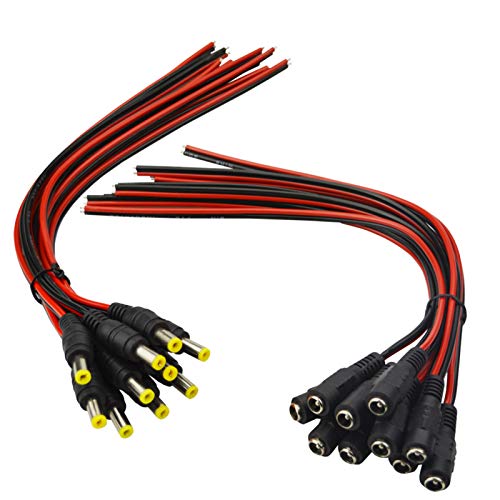
The 2.1 mm × 5.5 mm barrel interface makes this pigtail set the direct choice for devices with matching DC jacks. Each male/female cable pair uses 18 AWG copper-strand conductors, and the maker says the cable is suitable for 5 A. That gauge offers more current-carrying potential than thinner 22 AWG pigtails, but the 5 A claim is not a substitute for checking the device and power-supply limits. Choose another connector style if your equipment uses SAE plugs, screw terminals or bare-wire crimp joints.
Bottom line: Pick this when your DC device has the matching 2.1 × 5.5 mm barrel jack.
12 AWG SAE Harness with Caps

For battery leads rather than barrel-jack devices, this harness uses a polarized 2-pin SAE quick disconnect and 12-inch, 12 AWG wire. Its heavier conductor and rubber dust cap suit users connecting compatible motorcycle, car or tractor accessories that need a detachable lead. The cap protects the unplugged connector from dust and rain, but the facts do not give a connected-use waterproof rating; do not assume the plug is safe for immersion or sustained wet exposure. Check SAE polarity before connecting electronics.
Bottom line: Choose this for a compatible battery accessory that needs a heavier SAE lead.
14 AWG 13-Inch SAE Harness

This 13-inch SAE lead is the shorter-gauge alternative to the 12 AWG battery harness, with five 14 AWG, two-pin quick disconnects in the set. Its PVC shell and pure copper wire make it appropriate for users building compatible car, motorcycle or boat accessory leads. The maker says the PVC withstands temperatures up to 105°C.
Bottom line: Pick this for a compatible SAE accessory where 14 AWG and a 13-inch lead fit.
2-Pin Low-Voltage Splice Connectors

Unlike cable pigtails, these 2-pin connectors are intended to join low-voltage wires directly for lighting and similar projects. The solderless plug-in design has a locking buckle, and the PA66 nylon housing is described as heat-resistant and suitable for indoor or outdoor applications. They are aimed at 12 V or 24 V circuits, but no wire-gauge or current capacity appears in the facts. Confirm that the connector accepts your wire size and circuit load before using it; a matching voltage alone does not establish a safe connection.
Bottom line: Choose these for a low-voltage lighting splice after confirming wire size and load.
TICONN Heat-Shrink Crimp Kit

For permanent wire-to-terminal joints rather than detachable plugs, this 120-piece assortment covers 22–10 AWG and uses tinned copper crimp barrels. The dual-wall insulation has adhesive and a 3:1 shrink ratio, forming a sealed joint when crimped and heated correctly; red, blue and yellow colors help distinguish terminal sizes. A suitable crimp tool and controlled heat are essential, since a poor crimp or overheated insulation can compromise the connection. This kit is not the right fit when the device needs a barrel jack or SAE disconnect.
Bottom line: Pick this for properly crimped, insulated terminal joints rather than a plug connection.
How to choose 12 volt DC wire connectors
Choose the connector interface before choosing the wire: a barrel plug, SAE disconnect, splice block and crimp terminal do different jobs. Barrel connectors are common on small DC electronics; the 5.5 mm × 2.1 mm size must match both the socket and plug, since similar 5.5 mm × 2.5 mm plugs can fail to fit securely. SAE connectors are polarized two-wire quick disconnects often used on battery accessories. Crimp terminals need a terminal that matches both wire gauge and stud or tab size. With a detachable device jack, choose a matching plug; with a wire-to-wire joint exposed to moisture, choose a correctly crimped sealed connector.
Wire gauge and current capacity
Lower AWG numbers mean thicker wire: 12 AWG is thicker than 14 AWG, which is thicker than 18 AWG. Current capacity depends on more than gauge, including wire length, insulation temperature rating, bundling, ambient heat and acceptable voltage drop. For a long 12 V run, voltage drop can matter even when the wire does not overheat; calculate the full round-trip length and load current before sizing. Use the circuit fuse to protect the smallest wire in the circuit, and never treat a connector’s physical fit as proof that its wire or contacts can carry the load.
Protection for outdoor 12 volt wiring
Outdoor connectors need protection at the joint, not just an insulated shell. Heat-shrink crimp terminals with adhesive can seal around a wire when the barrel is crimped correctly and the tubing is heated evenly; a dust cap mainly protects an unplugged connector and is not an immersion rating. For landscape wiring, keep joints above standing water and use connectors intended for the environment. Disconnect power before cutting or joining low-voltage conductors, and prevent bare ends from touching; a 12 V supply can still overheat thin wire during a short circuit.
Connector types and best-fit jobs
Barrel pigtails are suited to devices with a matching coaxial DC jack, SAE leads to compatible battery accessories, and crimp terminals to permanent wire joints. A splice connector can speed up lighting connections, but only if its wire range and load rating match the circuit. Use this distinction to rule out a tempting but incompatible plug before wiring.
| Job | Connector type | Verify first |
|---|---|---|
| Power a DC jack device | Barrel pigtail | Inner and outer diameters, polarity |
| Detach a battery accessory | SAE lead | Polarity and wire/load suitability |
| Join insulated wire ends | Heat-shrink crimp terminal | Wire gauge and terminal size |
| Splice low-voltage lighting | 2-pin splice connector | Wire range and circuit rating |
Frequently Asked Questions
How do I identify a 5.5 mm barrel connector size?
A 5.5 mm barrel size gives the outer diameter, while the inner diameter may be 2.1 mm or 2.5 mm. Check both measurements and polarity against the device socket before connecting power.
Can an SAE connector plug into a barrel jack?
No, an SAE two-pin connector and a coaxial barrel jack are different interfaces. Use a properly wired adapter only when its polarity and current capacity match the device and supply.
Does thicker wire always allow more current?
Thicker wire generally has lower resistance, but safe current also depends on run length, insulation, temperature and installation conditions. Protect the circuit with a fuse sized for the smallest wire and its intended load.
Are heat-shrink crimp connectors waterproof?
Adhesive-lined heat-shrink can seal a correctly crimped joint against moisture, but the finished connection’s protection depends on the connector and installation. Do not assume it is suitable for submersion unless its rating explicitly says so.