
Solar Lights With Timer: 4 Options Compared by Use

For solar lights with a timer, choose a coop or shed fixture for task lighting and a string-light set for patio decor; the fixture style is the deciding difference. Solar Coop Light, 2-Pack suits a simple dusk-triggered schedule, while Brightown 52-Foot Solar String Lights and Brightown 108-Foot Solar String Lights are alternatives for decorative strings with dimming or remote controls.
Choose a different style if you need adjustable color and brightness: Three-Color Solar Coop Light adds those controls, while the string sets focus on outdoor ambience rather than a hanging ceiling lamp.
We earn a commission if you buy through links on this page. As an Amazon Associate I earn from qualifying purchases. Products are compared on manufacturer specifications, not hands-on testing.
- Best overall: Solar Coop Light, 2-Pack – Its dusk sensor and 3-, 5-, or 8-hour timer schedule suit utility lighting.
- Best for adjustable light: Three-Color Solar Coop Light – It offers three-color modes and four brightness levels.
- Best for compact patios: Brightown 52-Foot Solar String Lights – The 52-foot set combines solar and USB charging with a dimmable timer.
- Best for long runs: Brightown 108-Foot Solar String Lights – The 108-foot string provides 52 LED bulbs and a remote.
| Product | Best for | Fixture style | Timer/control | Shop |
|---|---|---|---|---|
| Solar Coop Light, 2-Pack | Coop and shed | Ceiling light | 3, 5, or 8 hours | Check Price on Amazon |
| Three-Color Solar Coop Light | Adjustable ambiance | Pendant light | Timer; 4 brightness levels | Check Price on Amazon |
| Brightown 52-Foot Solar String Lights | Small patio strings | String lights, 52 ft | Remote; dimmable timer | Check Price on Amazon |
| Brightown 108-Foot Solar String Lights | Long patio runs | String lights, 108 ft | Remote; dimmable, timed | Check Price on Amazon |
Solar Lights With Timer Compared
Compare fixture style, timer controls and weather ratings to match the light to its location.
Solar Coop Light, 2-Pack

For utility lighting with a scheduled shutoff, this two-pack pairs a dusk-to-dawn sensor with selectable 3-, 5-, or 8-hour run times. Each light measures 13.8 inches, and a 16.4-foot cord separates the fixture from its solar panel, which can help when the installation spot is shaded. The maker says the timer setting is remembered for following nights. The fixed timer choices are the main limitation: choose another option if you want dimming or multiple light colors rather than a preset duration.
Bottom line: Choose this for a coop or shed when a simple timed ceiling fixture is the priority.
Three-Color Solar Coop Light
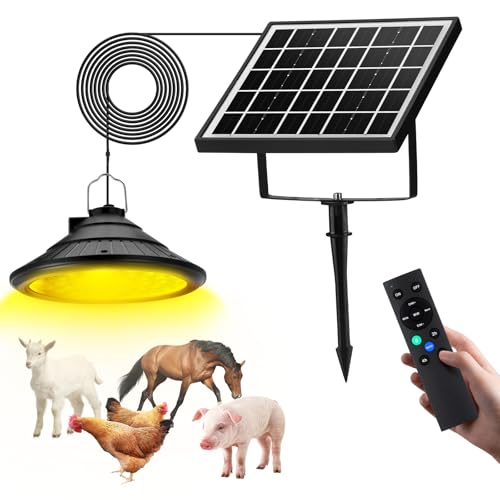
Color and brightness control set this hanging coop light apart: it has three light modes and four brightness levels, unlike the simpler fixed-duration option. Its 5-watt solar panel and 4,500mAh battery are paired with USB charging. The maker says it can provide 48 hours of illumination after six hours of sunlight at 10% brightness, so that runtime claim applies to a low setting. The product is a single pendant-style fixture, not a long decorative string; pick it for adjustable light in a coop or garage rather than patio coverage.
Bottom line: Choose this when color choice, dimming and USB charging matter more than a string format.
Brightown 52-Foot Solar String Lights

The 52-foot run is the shorter decorative-string option, with 15 sockets plus one extra LED bulb. Solar and USB charging provide two ways to replenish its battery. The maker claims more than 30 hours of runtime on a full charge and a four-hour full-charge time; actual solar charging depends on exposure and weather. Its IP65 rating suits outdoor exposure to rain but does not mean the set can be submerged. Choose this string for a patio or garden where the shorter span is enough; it is not a ceiling pendant for focused work lighting.
Bottom line: Choose this for a shorter outdoor string with both solar and USB charging.
Brightown 108-Foot Solar String Lights

The 108-foot string covers a longer route than the 52-foot alternative and uses 52 LED bulbs, including two spares. The package also includes cable ties and a mounting clip for the solar panel, useful when positioning the panel separately from the lights. It cannot be connected to another string, so measure the route first and treat 108 feet as the total run. The available features identify dimming, timing and a remote, but the maker does not give a weather rating; confirm its suitability for the intended exposure before installation.
Bottom line: Choose this for a single long decorative run when 108 feet covers the layout.
How to Choose Solar Lights With a Timer
Start with the job: a pendant or ceiling fixture directs light to a shed or coop, while a string set spreads decorative points of light across a patio. Timer controls also differ: some switch off after a set number of hours, while others pair dusk sensing with a remote or dimming. Solar panels need clear exposure; in the Northern Hemisphere, a generally south-facing panel receives useful sun, but shade and seasonal sun angle change charging. As a practical rule, choose a fixed-hour timer if you want lights off before bedtime, and dusk-to-dawn control if you want a sensor-triggered schedule. A small panel in shade may not recharge a battery enough for long nightly runs.
Weather ratings help distinguish rain resistance from immersion protection. An IP65 enclosure resists water jets, while IP66 is rated for stronger water jets; neither rating makes a fixture suitable for submersion. Mount panels where they receive direct sun and keep connections protected from standing water.
Timer Types and Solar Charging
A timer that runs for a selected duration saves battery charge compared with leaving a light on all night, but the usable runtime still depends on the battery, brightness setting and solar input. A photocell detects falling ambient light and turns a dusk-to-dawn fixture on automatically; a timer can then end operation after a chosen interval. These are separate controls, so check whether a fixture offers one or both. Solar charging is strongest with several hours of direct sunlight, and cloudy weather or winter’s shorter days reduce the energy collected. For multi-night use, reduce brightness or choose a shorter timer when the panel cannot receive full sun. USB charging can provide a backup charging route on the model that supports it.
Use this guide to match the control to the intended schedule.
| Control need | Choose |
|---|---|
| Automatic dusk start with fixed shutoff | Dusk sensor plus hour timer |
| Changeable color or brightness | Multi-mode pendant |
| Decorative patio coverage | Timed string lights |
Placement, Coverage and Weather Fit
Measure the illuminated route before choosing string lights: a 52-foot span works for a smaller layout, while a 108-foot single run covers more distance but cannot be connected to another string. Place the solar panel outside the shadow of rooflines, trees and walls, even if the fixture itself hangs indoors under a roof. A separated panel and light allow different mounting positions, but cord length limits how far apart they can be. For exposed installations, match the fixture’s IP rating to the weather: IP65 and IP66 protect against water jets, not immersion. Keep panels and connectors out of puddles, and secure hanging fixtures so wind cannot pull on the cord or mounting point.
For task lighting in a coop or shed, position the fixture to reduce shadows over the work area; strings are better suited to broad decorative coverage than concentrated illumination.
Solar Timer Mistakes to Avoid
Expecting the same runtime every night is a common mistake: cloudy charging days, winter daylight and high brightness all reduce available operating time. A long timer can drain a battery before morning, so use a shorter duration when overnight lighting is unnecessary. Another mistake is mounting a panel for convenience rather than sunlight; even partial shade can reduce charging. Test the placement during daylight before fixing the panel permanently, and make sure the cable reaches without tension. Outdoor-rated does not mean waterproof under every condition: water resistance ratings do not cover submersion, and seams or connectors can remain vulnerable if installed poorly. For a light near animals, secure cords and keep them out of reach to prevent chewing or entanglement.
Frequently Asked Questions
How many hours of sun do solar lights need to charge?
Many small solar lights need roughly 6 to 8 hours of direct sunlight for a full charge, though panel size, battery capacity, shade and weather change the result. Place the panel where it receives unobstructed sun rather than behind glass or beneath eaves.
Do solar lights with timers turn on at dusk?
A dusk-to-dawn sensor uses falling ambient light to trigger the light, while a timer controls how long it stays on. A fixture needs both features for automatic dusk start followed by a timed shutoff.
Can solar string lights stay outside in rain?
An IP65 or IP66 rating indicates resistance to water jets, not submersion. Keep connectors out of standing water and use the fixture only in the exposure conditions its rating supports.
Why do solar lights turn off early at night?
Insufficient charging is a common cause: shade, cloudy weather, short winter days and higher brightness reduce stored energy. Try moving the panel into direct sun or shortening the timer to reduce overnight battery use.
Can a solar panel charge indoors near a window?
A panel generally charges better outdoors in direct sunlight than through a window, because glass and indoor placement reduce available light. Put the panel outside in an unshaded spot and route its cord to the fixture.