
One-Way See-Through Curtains: Privacy and Fit Compared

One-Way Mirrored Roller Shade, Blue is the closest match for one-way see-through privacy because its mirrored shade is designed to block outdoor views while allowing visibility from indoors. Choose HOMEIDEAS White Privacy Sheers, 63 in. or JOLLADE White Privacy Sheers, 84 in. instead if you want soft daylight through sheer fabric; those panels are not described as providing one-way visibility.
We earn a commission if you buy through links on this page. As an Amazon Associate I earn from qualifying purchases. Products are compared on manufacturer specifications, not hands-on testing.
- Best overall: One-Way Mirrored Roller Shade, Blue – Its mirrored exterior blocks outdoor views while preserving a view from indoors.
- Best for soft daylight: JOLLADE White Privacy Sheers, 84 in. – Two 52-inch-wide, 84-inch-long panels filter light through a privacy sheer fabric.
- Best for shorter windows: HOMEIDEAS White Privacy Sheers, 63 in. – Two 52-inch-wide panels are 63 inches long, with light-filtering privacy fabric.
| Product | Best for | Product type | Panel or shade size | Light control | Shop |
|---|---|---|---|---|---|
| One-Way Mirrored Roller Shade, Blue | Daytime one-way view | Mirrored roller shade | 31.5 × 59.1 in. | Blackout when lowered | Check Price on Amazon |
| JOLLADE White Privacy Sheers, 84 in. | Long sheer panels | Privacy sheer panels | 52 × 84 in. each | Light filtering | Check Price on Amazon |
| HOMEIDEAS White Privacy Sheers, 63 in. | Shorter sheer panels | Privacy sheer panels | 52 × 63 in. each | Light filtering | Check Price on Amazon |
| NICETOWN Blackout Curtains, 42 × 84 in. | Room darkening | Blackout curtain panels | 42 × 84 in. each | 85%–99% light blocked | Check Price on Amazon |
| Simplebrand Black Sheer Curtains, 84 in. | Black sheer styling | Sheer curtain panels | 42 × 84 in. each | Light filtering | Check Price on Amazon |
One-Way See-Through Curtains and Window Coverings
Choose by whether you need a daytime one-way view, filtered daylight or substantial room darkening.
One-Way Mirrored Roller Shade, Blue

Unlike fabric curtain panels, this is a roller shade with a reflective exterior intended to block outdoor views while keeping indoor visibility. The blue PET shade measures 31.5 inches wide by 59.1 inches high, and its reflective layer is described as rejecting 90% of UV rays. It can be pulled down for blackout or raised partway to keep some of the view. Choose it for a window that fits its narrow width and where daytime privacy matters. The one-way effect relies on brighter light outdoors than indoors; at night, interior lights can reverse the privacy advantage.
Bottom line: Choose this when you want a reflective shade for daytime one-way viewing and the window fits its dimensions.
JOLLADE White Privacy Sheers, 84 in.
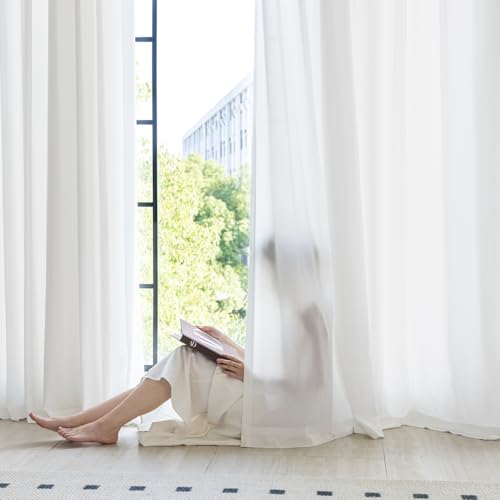
These longer privacy sheers suit buyers who want filtered daylight rather than the directional view of a mirrored shade. The set has two white panels, each 52 inches wide by 84 inches long, with a 3-inch rod pocket. Its dense, heavier weave is intended to blur outside views while admitting soft natural light. That is a different privacy setup from One-Way Mirrored Roller Shade, Blue: sheer fabric does not provide a clear view out with a blocked view in. Choose these for a long window and a soft, diffused look; skip them if one-way visibility is essential.
Bottom line: Pick these for a long window where soft daylight and blurred views matter more than one-way visibility.
HOMEIDEAS White Privacy Sheers, 63 in.

For shorter windows, these white privacy sheers offer a 63-inch panel length, unlike the 84-inch option from JOLLADE White Privacy Sheers, 84 in.. The two panels are each 52 inches wide and filter light through a more textured fabric. The maker describes the weave as helping keep neighbors from seeing inside, but this is still a sheer curtain rather than a reflective one-way covering. The hanging length differs slightly by method: 63 inches from rod-pocket top to hem or 64 inches with ring clips. Measure from the actual hanging point before choosing the length.
Bottom line: Choose these for a shorter window and filtered light, not for a clear one-way view.
NICETOWN Blackout Curtains, 42 × 84 in.
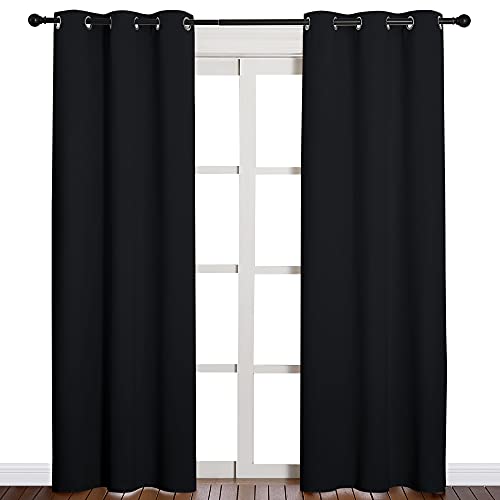
These black blackout panels prioritize darkness rather than seeing through the window, making them a different option from sheer panels or a one-way shade. The set includes two 42-inch-wide by 84-inch-long panels with six grommets per panel. Triple-weave fabric is said to impede 85% to 99% of light and UV rays, with dark colors working better; it is also intended to reduce noise and insulate against heat and cold. Choose them for room darkening, not daytime one-way viewing. Each panel is narrower than the 52-inch sheers, so check the combined coverage against the window.
Bottom line: Pick these when room darkening is the priority and a one-way view is not needed.
Simplebrand Black Sheer Curtains, 84 in.
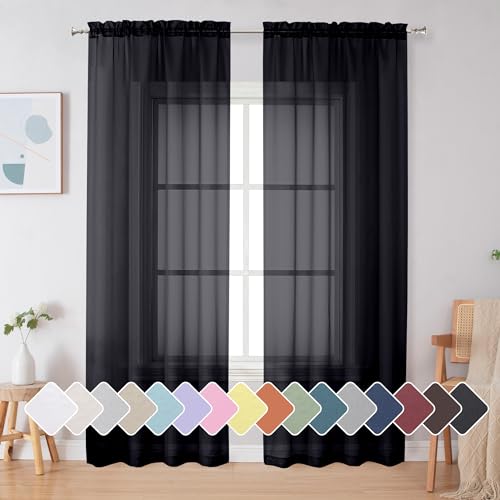
These black sheers provide a darker decorative layer, not a mirrored one-way view. Each of the two panels measures 42 inches wide by 84 inches long and has dual rod pockets; the fabric is polyester. They can be used alone or layered, with light passing through the sheer material. Layering can make a window treatment look fuller, but the panels are narrower than the 52-inch privacy sheers, and the maker does not promise the same view-blurring effect. Choose these for color and layering rather than dependable privacy or a clear view out.
Bottom line: Choose these for black sheer styling or layering, not for one-way privacy.
How one-way see-through curtains work
One-way visibility depends on a brightness difference, not on a permanent privacy effect. Reflective film or a mirrored shade is most effective when the outdoor side is brighter than the room; if the room becomes brighter after dark, people outside may see indoors. A sheer curtain works differently: its weave softens light and obscures views to some degree, but it does not guarantee a clear outward view with a blocked inward view. For evening privacy, pair a reflective treatment with a conventional curtain or closeable shade. If privacy must remain reliable regardless of lighting, choose an opaque treatment rather than relying on a one-way effect.
How to size a window covering
Measure the glass or frame width and height, then decide whether the covering will sit inside or outside the frame. For an inside mount, allow clearance for the frame and hardware; for an outside mount, overlap the opening to reduce side gaps. A pair of panels measuring 52 inches each gives 104 inches of fabric width before gathering, while a 31.5-inch roller shade covers a much narrower opening. As a practical rule, if the opening is wider than the shade by more than a small edge margin, choose panels or another wider shade rather than assuming the reflective model will cover it. Measure from the rod or mounting point, not just from the top of the window.
Sheers, reflective shades and blackout curtains compared
Match the covering to the view and light you want. Reflective shades offer the directional daytime privacy effect, sheers admit diffuse daylight, and blackout curtains aim to reduce incoming light. No single type delivers all three jobs at once.
| Need | Covering type | Tradeoff |
|---|---|---|
| Daytime view out with privacy | Reflective shade | Effect can reverse at night |
| Soft daylight | Privacy sheer | Not a true one-way view |
| Reduced room light | Blackout curtain | Blocks the view when closed |
Fabric fullness also affects the result: a common curtain rule is to use roughly 1.5 to 2 times the window width in panel fabric for a gathered appearance. That fullness changes how much the window is covered when the panels are drawn, so compare total panel width with the opening rather than relying on panel count alone.
Common privacy and installation mistakes
The most common mistake is treating a reflective covering as private at every hour. Before relying on it, compare indoor and outdoor brightness at the times the room is occupied; add an opaque layer for nighttime use. Another mistake is measuring only the glass and overlooking the mounting area. A rod pocket, grommet, adhesive strip or frame mount each uses space differently, and the covering needs to sit securely without leaving exposed gaps. For adhesive-mounted shades, clean and dry the surface before attaching the strips and allow the bond to set as directed. Keep cords and operating parts out of children’s reach, and do not let a shade interfere with a window’s emergency opening.
Frequently Asked Questions
Do one-way curtains work at night?
Not reliably: the one-way effect depends on the outdoor side being brighter than the room. When indoor lights make the room brighter after dark, use an opaque curtain or shade for privacy.
Can people see through sheer curtains during the day?
Sheers soften and blur views, but visibility depends on fabric density and the lighting on each side. Choose a reflective treatment for a directional daytime view, and use an opaque layer when privacy must be dependable.
How much wider should curtain panels be than a window?
A common target is total fabric width about 1.5 to 2 times the window width for a gathered look. Wider coverage also helps reduce gaps when panels are closed.
Does a one-way window shade block all sunlight?
A reflective shade may reduce glare and UV exposure, but that does not mean it blocks all visible light. A blackout curtain is a better fit when substantial room darkening is the priority.