
Best Fly Killer Indoors: 5 Options Compared by Type

STEM Indoor Fan Trap suits most people because its fan and blue light target mosquitoes, fruit flies and house flies without spray. Choose Zevo Flying Insect Spray instead for contact treatment, or a fruit-fly-specific bait or light trap if those insects are the main problem.
Indoor fly killers either attract and capture insects or kill them on contact; placement and removing breeding sources matter as much as the device.
We earn a commission if you buy through links on this page. As an Amazon Associate I earn from qualifying purchases. Products are compared on manufacturer specifications, not hands-on testing.
- Best overall: STEM Indoor Fan Trap – Combines a fan and blue light with glue traps for mosquitoes, fruit flies and house flies.
- Best for contact control: Zevo Flying Insect Spray – Targets several flying insects with a spray designed to kill on contact.
- Best for fruit flies: TERRO Fruit Fly Trap 4-Pack – Uses food-based liquid lure in four countertop traps.
| Product | Best for | Control method | Target insects | Included supply | Shop |
|---|---|---|---|---|---|
| STEM Indoor Fan Trap | Mixed flying insects | Fan, UV light, glue boards | Mosquitoes, fruit flies, house flies | 1 device, 5 glue traps | Check Price on Amazon |
| Zevo Flying Insect Spray | Targeted contact use | Contact-kill spray | Fruit flies, gnats, house flies, mosquitoes | 30 fl oz | Check Price on Amazon |
| TERRO Fruit Fly Trap 4-Pack | Kitchen fruit flies | Food-based liquid bait | Fruit flies | 4 traps, 180-day lure supply | Check Price on Amazon |
| LFSYS Plug-In Fly Trap | Small flying insects | UV light, adhesive boards | Fungus gnats, fruit flies, moths | 1 device, 11 refills | Check Price on Amazon |
| ASPECTEK 20W Electric Bug Zapper | Broad flying insects | UV bulbs, high-voltage grid | Flies, mosquitoes, gnats, moths | 2 replacement bulbs | Check Price on Amazon |
Indoor fly killers compared
Choose by the insects you need to control and whether you prefer trapping or contact treatment.
STEM Indoor Fan Trap

Unlike bait or contact spray, this plug-in trap draws insects toward a blue light and fan, then catches them on a glue board. It targets mosquitoes, fruit flies and house flies, and its touch display offers fan-speed selection plus 3-, 8- or 12-hour timers and continuous operation. The 6-foot cord can help position it in an indoor room or enclosed patio. The tradeoff is that it needs an outlet and replacement glue boards; choose another approach if you need immediate contact treatment rather than ongoing capture.
Bottom line: Pick this for ongoing capture of several flying-insect types without spraying.
Zevo Flying Insect Spray

For insects already flying in a particular spot, this aerosol is a targeted alternative to traps that work over time. The maker says its rosemary- and cornmint-oil formula kills fruit flies, gnats, house flies, drain flies and mosquitoes on contact; the can is 30 fluid ounces. It is intended for spot use in places such as kitchens and bathrooms. Sprays require deliberate application, so this is less suitable than a passive trap for people who want to leave a device running. Follow the product label for application and precautions.
Bottom line: Choose this for targeted contact treatment when insects appear.
TERRO Fruit Fly Trap 4-Pack

For fruit flies around food and waste, these four apple-shaped traps use liquid food-based lure rather than UV light or a spray. The maker says the bait attracts and eliminates fruit flies within days, and the built-in windows let you monitor catches and lure levels. The set provides a 180-day lure supply. This narrow target makes it less appropriate when mosquitoes or house flies are the main concern. Put traps near likely fruit-fly activity, while also removing overripe produce and cleaning sticky spills that can keep attracting insects.
Bottom line: Pick this for countertop fruit-fly monitoring and baiting.
LFSYS Plug-In Fly Trap

Compared with the bait trap, this plug-in unit uses light and transparent, double-sided adhesive boards to catch flying insects. The maker says its dual 365 nm and 397 nm lamps attract fungus gnats, fruit flies and moths. The compact body measures 3.72 inches high, 2.71 inches long and 2.53 inches wide, and the package includes 11 refills. The maker recommends a dark room for best results, so it may be less useful in bright spaces or when house flies and mosquitoes are the priority.
Bottom line: Choose this for gnats and fruit flies in a darker room.
ASPECTEK 20W Electric Bug Zapper
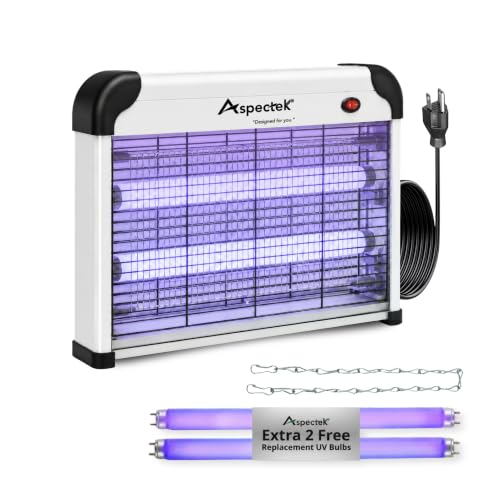
Unlike glue-board traps, this zapper uses two UV bulbs to draw insects to a high-voltage metal grid. The maker specifies a 2,800-volt grid and names flies, mosquitoes, gnats, moths and other flying insects among its targets. A protective mesh screen covers the grid, and the unit can be hung with the included chain and hooks or placed on a solid surface. Its 15.16-inch length and 11.02-inch width call for more room than a small plug-in trap. Keep electric zappers away from food-preparation surfaces.
Bottom line: Pick this for a larger indoor area where a grid zapper suits the setup.
How to choose an indoor fly killer
Match the control method to the insect and where it appears. Contact spray is for insects in sight; bait and adhesive traps capture over time, while UV devices attract flying insects toward glue or a grid. Fruit-fly traps are a focused choice for activity around produce or trash, whereas devices naming mosquitoes and house flies cover a broader mix. Source control is essential: discard overripe produce, rinse recycling, and clean sticky spills so traps are not competing with food residue. A simple decision rule is to choose fruit-fly bait when fruit flies dominate near counters, and a broader trap or contact spray when multiple kinds of flying insects appear. Do not assume a trap intended for gnats will be equally useful for house flies.
Where to place indoor fly traps
Placement changes how well a trap can attract insects. UV traps work best away from bright competing light; the maker of the plug-in light trap recommends using it in a dark room. Put fruit-fly bait near the activity, such as fruit bowls or trash cans, but keep it out of food and drink. Avoid placing a light trap directly beside an open door or window, where it may attract insects from outside. For zappers, keep the unit away from food-preparation surfaces because insect fragments can fall from the grid. Select a stable spot with an outlet within cord reach, and keep cords and devices clear of wet sinks or standing water.
Fly-control methods compared
Each method suits a different job, so use the target insect and placement to narrow the choice. Traps generally capture insects as they approach, while spray is applied directly for contact treatment. A zapper uses an electrified grid, so its placement deserves more care around food and household activity. This table summarizes the basic tradeoffs.
| Method | Useful when | Practical constraint |
|---|---|---|
| Food-based bait | Fruit flies near produce or trash | Focused on fruit flies |
| UV light with glue board | Ongoing capture of named flying insects | Needs good placement and board replacement |
| Contact spray | Visible insects in a targeted area | Requires direct application |
| UV grid zapper | Broad flying-insect control | Keep away from food-preparation surfaces |
How to reduce flies at the source
Traps work better when breeding and food sources are removed. Fruit flies develop in fermenting organic matter, so clear overripe fruit, empty food waste regularly and clean residue from recycling containers. Drain flies can breed in the organic film inside drains; scrub the drain walls rather than relying only on a surface spray. House flies are attracted to exposed food and garbage, so use covered bins and clean spills promptly. If insects persist after cleanup, identify where they gather before adding more traps: a device placed near the source is more useful than one across the room. Keep bait and spray away from food, dishes and food-contact surfaces.
Frequently Asked Questions
Do UV fly traps work in a bright room?
UV traps are generally more useful where competing light is limited; the maker of the LFSYS trap recommends a dark room. Place the unit away from bright windows and lamps to give its light a clearer role.
How do I get rid of fruit flies near a drain?
Scrub the drain walls to remove organic film, since fruit flies and drain flies can be drawn to residue and moist organic matter. Also remove overripe produce and clean spills; a trap alone does not remove breeding sources.
Should a fly zapper go near a kitchen counter?
Keep an electric grid zapper away from food-preparation surfaces because insect remains can fall from the grid. Choose a stable location away from food and dishes, and follow the device’s placement precautions.
Can one indoor trap catch every kind of fly?
No single trap method targets every insect equally well; fruit-fly bait is focused on fruit flies, while broader devices may name house flies, mosquitoes or gnats. Identify the insects first, then choose a control method that names them as targets.