
Best Infrared Knee Massager: 3 Models Compared

For most people, LTW Knee Massager with Heat and Red Light is the strongest fit because it combines 660nm red and 850nm infrared LEDs with three heat settings and selectable timers. Choose 660nm/850nm Knee Massager with 72 LEDs or Puroth Red Light Therapy Knee Brace instead if its vibration controls or adjustable light intensity better match your preferences.
These wearable devices combine light-emitting diodes with options such as heat or vibration; they are for comfort routines, not a substitute for medical care.
We earn a commission if you buy through links on this page. As an Amazon Associate I earn from qualifying purchases. Products are compared on manufacturer specifications, not hands-on testing.
- Best overall: LTW Knee Massager with Heat and Red Light – Its 72 LEDs pair with three heat settings and 20-, 30- and 40-minute timers.
- Best for vibration choices: 660nm/850nm Knee Massager with 72 LEDs – It offers four vibration levels, including off, and two pulse frequencies.
- Best for light adjustment: Puroth Red Light Therapy Knee Brace – It has five red light intensity settings and three vibration modes.
| Product | Best for | Vibration options | Shop |
|---|---|---|---|
| LTW Knee Massager with Heat and Red Light | Timed heat sessions | 3 modes | Check Price on Amazon |
| 660nm/850nm Knee Massager with 72 LEDs | Flexible vibration | 4 levels; 2 pulse modes | Check Price on Amazon |
| Puroth Red Light Therapy Knee Brace | Light intensity choices | 3 modes | Check Price on Amazon |
Infrared Knee Massagers
Compare the light wavelengths and controls first, then choose the combination that suits your comfort routine.
LTW Knee Massager with Heat and Red Light

Timer choices distinguish LTW Knee Massager with Heat and Red Light: it offers 20-, 30- and 40-minute operating cycles alongside 72 LEDs with 660nm red and 850nm infrared light. Three heat settings run from 113°F to 140°F, and the 5,000mAh rechargeable battery supports cordless use. Choose it if you want to set a session length and adjust warmth.
Bottom line: Choose this if selectable session lengths and three heat levels are your priorities.
660nm/850nm Knee Massager with 72 LEDs

660nm/850nm Knee Massager with 72 LEDs stands out for its vibration controls: four levels include an off setting, with pulse frequencies of 10Hz or 40Hz. Its 72 LEDs combine 660nm red and 850nm near-infrared light, and the 5,000mAh rechargeable battery makes it cordless. The dimensions are 14.57 × 12.2 × 2.76 inches. This suits buyers who want to switch vibration off or choose a pulse frequency. Heat settings and session timers are not part of the feature set, so choose another option if those controls are essential.
Bottom line: Pick this if adjustable vibration and two pulse frequencies matter most.
Puroth Red Light Therapy Knee Brace
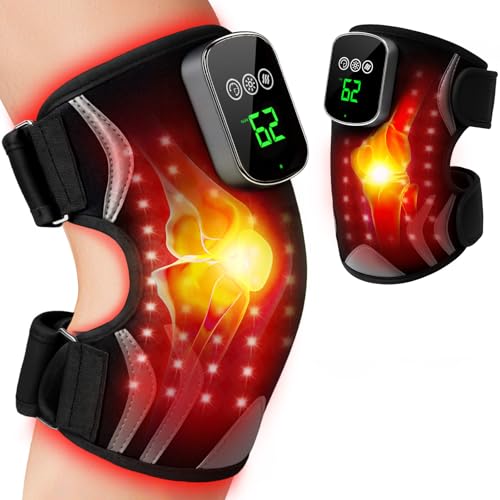
Five red light intensity settings make Puroth Red Light Therapy Knee Brace the choice for buyers who want more than one light level to try. It combines 660nm red and 850nm near-infrared wavelengths with three vibration modes, and its 5,000mAh battery is rechargeable and cordless. The product name also identifies it as a wrap, which may appeal to someone seeking a wearable format.
Bottom line: Choose this if five light-intensity settings are the deciding feature.
How to choose an infrared knee massager
Start with the controls you will actually use: light wavelength, heat adjustment, vibration and session length are separate features. Wavelengths are measured in nanometers; 660nm red light and 850nm near-infrared are the combination on all three matching options here. LED count alone does not establish light dose: irradiance, distance from skin and treatment time also matter, and those values are not provided in this comparison. If a timer is important, select a device that names its cycle lengths; if warmth is important, compare the actual temperature settings. These devices are comfort accessories, not a replacement for evaluation of persistent or worsening knee symptoms.
What 660nm and 850nm mean
660nm and 850nm refer to different wavelengths of light, not temperature or intensity. Red light is visible; near-infrared is beyond visible red, so a person cannot judge its output by brightness alone. A 72-LED count describes the number of emitters, but it does not tell a buyer the delivered energy per area or prove a particular result. For a measurable selection rule, if named wavelengths are essential, choose a device that explicitly identifies both values; otherwise the output is difficult to compare. Avoid treating claims about reaching deeper tissue or easing pain as guaranteed outcomes, since the maker does not establish clinical effectiveness.
Heat and vibration safety
Heat settings in these devices range from 98°F to 140°F where temperatures are given, and the highest setting can feel substantially warmer than body temperature. Start with the lowest heat and a short session, then stop if the skin becomes uncomfortable, numb or unusually red; do not fall asleep wearing a heated device. People with reduced skin sensation or circulation should seek clinician guidance before using heat, because they may not notice excessive warmth promptly. Vibration ranges from adjustable levels to preset modes, and one device allows vibration to be turned off. Keep the wrap positioned comfortably rather than cinched tightly, and discontinue use if pressure or vibration causes pain.
How to compare session controls
Session length and intensity are not interchangeable controls: a longer timer does not mean stronger light, and a higher heat setting does not change the LED wavelength. One matching model provides 20-, 30- and 40-minute timers, while another specifies vibration pulse rates of 10Hz and 40Hz. A useful decision rule is to prioritize named controls over broad labels: choose a timer-equipped model if you want a defined cutoff, or one with a vibration-off option if you may prefer light and warmth without massage. Do not infer light dose from LED count or battery capacity; neither measurement states how much light reaches the knee.
Frequently Asked Questions
Can near-infrared light be seen during use?
Near-infrared light at 850nm is beyond the visible range, so it may not appear bright to the eye. Visible brightness is not a reliable way to assess infrared output.
How hot do infrared knee massagers get?
The products here with numeric heat settings span 98°F to 140°F. Begin with the lowest comfortable setting, and avoid use if reduced sensation makes it hard to judge warmth.
Can I wear a knee massager while sleeping?
Do not sleep while wearing a heated massager. Sleep can prevent noticing excess heat or pressure, increasing the risk of skin irritation or burns.
Should I choose a wrap that includes vibration?
Choose vibration if you want that additional adjustable sensation, and prioritize an off setting if you may want light or heat without it. Stop use if vibration creates pain or numbness.