
US Army Sleep System: 4 Modular Options Compared

For an authentic modular U.S. military sleep system, Genuine U.S. Military IMSS, ACU is the clearest fit: its four pieces are identified as genuine U.S. Government Issue and can be used separately or together. Choose Genuine U.S. Military Gore-Tex 5-Piece System for its named five-piece format and wider dimensions, or USGI Gear 4-Part Modular Sleeping Bag System and MT Army Modular Sleep System, OCP for military-style alternatives with distinct materials and configurations.
We earn a commission if you buy through links on this page. As an Amazon Associate I earn from qualifying purchases. Products are compared on manufacturer specifications, not hands-on testing.
- Best overall: Genuine U.S. Military IMSS, ACU – Identified as genuine U.S. issue and includes four modular components.
- Best for five-piece format: Genuine U.S. Military Gore-Tex 5-Piece System – Its name identifies a five-piece system, with an 82-inch length.
- Best for OCP color: MT Army Modular Sleep System, OCP – The OCP system includes a bivy cover and layered bags.
| Product | Best for | Pieces | Length | Weight | Shop |
|---|---|---|---|---|---|
| Genuine U.S. Military IMSS, ACU | Authentic modular system | 4-piece | 80 in | 1.9 lb | Check Price on Amazon |
| Genuine U.S. Military Gore-Tex 5-Piece System | Five-piece configuration | 5-piece | 82 in | 2.7 lb | Check Price on Amazon |
| USGI Gear 4-Part Modular Sleeping Bag System | Cold-weather claims | 4-piece | 86 in | 3 lb | Check Price on Amazon |
| MT Army Modular Sleep System, OCP | OCP modular setup | Multi-layered | 86.6 in | 6 lb | Check Price on Amazon |
US Army Sleep Systems Compared
Compare the systems by their components, dimensions and fit before choosing a modular setup.
Genuine U.S. Military IMSS, ACU

For buyers prioritizing identified U.S. Government Issue gear, this four-piece Improved Modular Sleep System is the strongest match. The set includes a patrol bag, intermediate cold-weather bag, waterproof bivy cover and compression sack; the bags and cover can be used independently or combined. The ACU digital system measures 80 inches long by 32 inches wide and weighs 1.9 pounds according to the specifications. Its components make it easier to assess than a system sold under a generic military label. The limitation is its narrower 32-inch width, which may not suit sleepers who need more room.
Bottom line: Choose this if confirmed U.S. issue status and a defined four-piece configuration matter most.
Genuine U.S. Military Gore-Tex 5-Piece System

The five-piece format is the distinguishing feature of this item, whose name identifies it as a genuine U.S. military Gore-Tex modular system. Its ACU color, standard size and dimensions of 82 inches long by 36 inches wide provide a longer, wider profile than the 80-by-32-inch system. The weight is 2.7 pounds. Confirm the included components before ordering if the exact layer mix matters.
Bottom line: Choose this for the 82-by-36-inch profile and named five-piece format, after confirming the components.
USGI Gear 4-Part Modular Sleeping Bag System
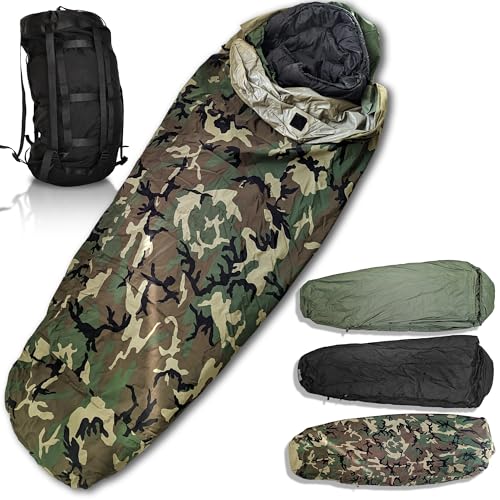
This military-style system differs from the genuine-issue options by specifying 210T ripstop nylon with a DWR coating and a claimed temperature span. It includes a patrol bag, intermediate cold-weather bag, waterproof bivy cover and compression sack, with a woodland camouflage color and 86-inch length. The manufacturer claims protection from 50°F down to -50°F; treat that as a product claim, not a standardized comfort rating. At 36 inches wide and 3 pounds, it has a broader stated profile than the 32-inch IMSS. Its limitation is that the specifications do not establish U.S. Government issue status.
Bottom line: Choose this if the ripstop construction and claimed temperature span fit your plans.
MT Army Modular Sleep System, OCP

The OCP camouflage and described multi-layer construction set this system apart from the other options. It includes a bivy cover and patrol/recon sleeping bag; the maker describes the cover as waterproof, breathable and wind-resistant, and the bag as nylon ripstop with a heavy-duty two-sided zipper. The dimensions are 86.6 inches long by 35.4 inches wide, with a 6-pound weight. The maker recommends a comfortable temperature range of 5–15°C and gives -1°C as an extreme low. This is a military-style system, not one identified as genuine U.S. Government Issue.
Bottom line: Choose this if OCP color and the maker-described layered configuration are priorities.
How to Choose a US Army Sleep System
Start with component identity and the conditions you expect, not the word “military” alone. A modular system typically pairs a lighter patrol layer with a warmer inner bag and a bivy shell; combining layers adds insulation, while the shell helps block wind and moisture. Temperature labels are not interchangeable: standardized sleeping bag ratings under ISO 23537 distinguish comfort, limit and extreme values, and an extreme figure is not a sensible target for routine sleep. Compare the maker’s rating type and test basis before using a number to plan cold-weather nights. For a practical choice, select a system with separated layers if expected temperatures vary substantially; choose a single configuration only when its rating and conditions clearly align.
Fit and Dimensions for Modular Bags
Length and width affect comfort as well as insulation: excess empty space takes more body heat to warm, while a tight bag can compress insulation. A common sizing starting point is a bag roughly 6–12 inches longer than the sleeper, then checking shoulder and foot space in the manufacturer’s sizing guidance. Compare dimensions on the same basis, since a bivy shell can be wider or longer than the inner bag. The options range from 80 to 86.6 inches long and 32 to 36 inches wide. If you are near a bag’s length, verify the internal fit before buying; outer dimensions alone do not guarantee usable sleeping space.
What the Bivy Cover and Layers Do
A bivy cover is an outer barrier, not a substitute for insulation: it can reduce wind exposure and shed moisture, while the sleeping bags supply most of the warmth. Waterproof fabrics can also trap water vapor from perspiration, so ventilation and drying matter after use. A shell described as breathable still needs airflow and a dry-down plan, especially after a damp night. Use separate layers when temperatures change, but avoid compressing insulation under tight straps or clothing.
| System type | Typical role | Decision point |
|---|---|---|
| Patrol bag | Lighter layer for milder conditions | Check its individual temperature rating |
| Intermediate bag | Added insulation for colder conditions | Check how it layers with the patrol bag |
| Bivy cover | Wind and moisture barrier | Plan ventilation and drying |
| Combined system | Layered setup for variable conditions | Use the rating for the exact configuration |
Care and Cold-Weather Mistakes
Dry the sleeping bags and bivy cover fully before long-term storage; damp insulation loses loft and can develop odor or damage over time. Store lofted insulation loosely when possible rather than compressed for months, and follow the care label for washing because coatings and laminates can be harmed by unsuitable detergents or heat. A common cold-weather mistake is treating the lowest temperature claim as a comfort rating. Another is relying on a waterproof shell without managing condensation. Keep a dry sleep layer, ventilate when conditions allow, and test the complete combination in a controlled setting before depending on it in severe weather.
Frequently Asked Questions
What does a modular sleep system include?
A modular system commonly combines a patrol sleeping bag, an insulating inner bag and an outer bivy cover, sometimes with a stuff sack. The pieces can be used separately or together, so compare the rating for the exact arrangement you intend to sleep in.
How should I read sleeping bag temperature ratings?
Look for whether a temperature is a comfort, limit or extreme rating under a standard such as ISO 23537. The extreme value is a survival-oriented boundary, not a recommendation for comfortable sleep; allow margin for cold sensitivity, clothing and sleeping-pad insulation.
How much longer should a sleeping bag be than you?
A common starting point is about 6–12 inches longer than your height, with enough room at the shoulders and feet to avoid compressing insulation. Check internal dimensions when available, since outside measurements can include the shell.
Can I sleep in a bivy cover without a sleeping bag?
A bivy cover primarily blocks wind and moisture and usually does not provide the insulation of a sleeping bag. In cold conditions, use an appropriately rated insulated bag and sleep pad; moisture can also accumulate inside a closed shell.
How should I store a military sleeping bag system?
Dry every layer completely before storage and keep insulated bags loosely stored rather than compressed for long periods. Follow the care label for washing, because waterproof coatings and laminated fabrics may be damaged by excess heat or harsh cleaners.