
GardePro E6 Trail Camera: Models Compared by Fit

For a GardePro E6 trail camera, choose GardePro E6 if you want the E6’s smartphone-only WiFi connection, which reaches up to 45 feet. Buyers who need a longer open-area connection should consider GardePro E6+ or GardePro E6 2.0, while GardePro E5S suits those who prefer retrieving an SD card instead of connecting by WiFi.
Trail cameras use motion sensing to capture activity in a chosen area; these GardePro models differ most in phone access, video claims and whether they use WiFi at all.
We earn a commission if you buy through links on this page. As an Amazon Associate I earn from qualifying purchases. Products are compared on manufacturer specifications, not hands-on testing.
- Best overall: GardePro E6 – The named E6 model pairs 64MP photos and 1296P video with smartphone access up to 45 feet.
- Best for longer phone range: GardePro E6+ – Its dual antennas support a connection range up to 165 feet in open conditions.
- Best for SD-card retrieval: GardePro E5S – This non-WiFi model uses SD-card retrieval and has a 0.1-second trigger claim.
| Product | Best for | Phone connection range | Video | Access method | Shop |
|---|---|---|---|---|---|
| GardePro E6 | E6 phone viewing | Up to 45 ft | 1296P HD | Direct smartphone WiFi | Check Price on Amazon |
| GardePro E6+ | Longer phone range | Up to 165 ft open | — | Direct smartphone WiFi | Check Price on Amazon |
| GardePro E6 2.0 | 4K video claim | Up to 165 ft open | 4K | Direct smartphone WiFi | Check Price on Amazon |
| GardePro E5S | No-WiFi retrieval | — | 1296P HD | SD-card retrieval | Check Price on Amazon |
GardePro E6 Trail Camera Models
Compare the named E6 with related GardePro models by connection method, range and video capability.
GardePro E6

The GardePro E6 is the exact model named in this search, with 64MP photos, 1296P HD video and a 110° view. Its built-in WiFi and Bluetooth connect directly to a smartphone through the GardePro Mobile App, with no monthly fee. The connection range is up to 45 feet, and the camera does not connect to a home router or cellular network. That makes it a fit for checking captures nearby rather than viewing them remotely. The tradeoff is its shorter phone range than the dual-antenna options, so it matters if the camera will be placed farther from the phone.
Bottom line: Pick this model if you want the E6 name and expect to check it within 45 feet.
GardePro E6+

The E6+ differs from the E6 with dual antennas and a claimed connection range up to 165 feet in open conditions. Like the E6, it uses Bluetooth and built-in WiFi to connect directly to a smartphone through the GardePro Mobile App; it does not connect to a home router or cellular network. Its 110° wide-angle view is useful when framing a broad trail section. The maker’s range figure is expressly for open conditions, so trees, terrain and other obstructions can affect the connection. Choose it over the named E6 when the extra phone-to-camera distance matters more than matching the exact model.
Bottom line: Choose it when longer phone access in open terrain is more important than the exact E6 model.
GardePro E6 2.0
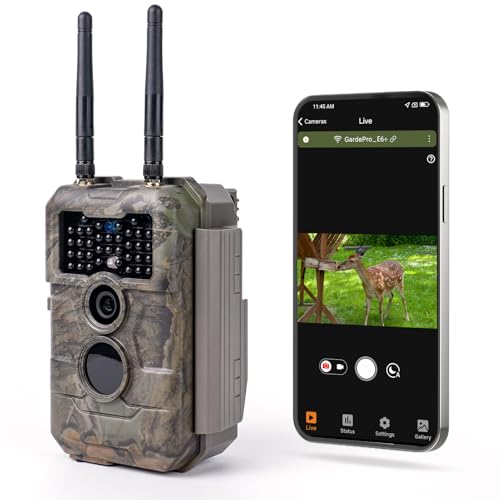
The E6 2.0 stands apart by combining a 4K video claim with dual antennas and a phone connection range up to 165 feet in open conditions. It connects to a smartphone through Bluetooth and the camera’s built-in WiFi, not a router or cellular network. This is the related option for buyers prioritizing the higher video format and longer open-area phone range. Its model information does not give a numerical field of view, unlike the 110° figure attached to the E6 and E6+. Anyone comparing framing width should verify that measurement before choosing. The camera remains an on-site phone-viewing model, not a remotely networked camera.
Bottom line: Pick it if 4K video and longer open-area phone range are your priorities.
GardePro E5S
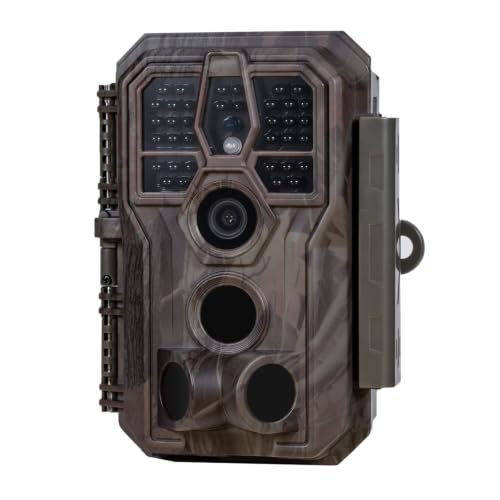
The E5S is the alternative for someone who wants no WiFi connection: it is non-cellular and non-WiFi, and footage is retrieved from its SD card. It captures 64MP photos and 1296P HD video, with a 0.1-second trigger claim and 100-foot no-glow night vision. Its IP66 waterproof rating and 1/4-inch-20 mounting thread distinguish it from the phone-viewing E6 models. This choice avoids maintaining a phone connection, but requires visiting the camera and removing the card to review captures. Pick it for a simple retrieval routine rather than app access.
Bottom line: Choose it if you prefer SD-card retrieval and do not need on-site phone viewing.
How to Choose a GardePro E6 Trail Camera
Choose first by how you plan to retrieve footage: the E6 models connect directly to a nearby smartphone, while the E5S uses SD-card retrieval. A trail camera’s WiFi is generally a local connection, not a way to send footage over the internet; these E6 models specifically do not connect to home routers or cellular networks. For an open-area phone range up to 45 feet, the E6 fits; the E6+ and E6 2.0 claim up to 165 feet under open conditions. Dense brush, terrain and walls can reduce practical range. If you need footage from a distant property without visiting the camera, none of these non-cellular options provides that remote access.
| Need | Model direction | Decision point |
|---|---|---|
| Exact E6 | E6 | Phone range up to 45 ft |
| Longer open-area phone reach | E6+ or E6 2.0 | Up to 165 ft claim |
| No WiFi setup | E5S | Retrieve the SD card |
Trail Camera Placement and Field of View
Place a trail camera about 3 to 4 feet above ground for many deer-trail setups, then adjust for the animal and slope; a camera aimed straight at a path can miss the side-to-side movement that triggers capture. A common starting point is 10 to 20 feet from the expected activity, but tighter framing may be needed for a narrow trail. The E6 and E6+ have a 110° view, so they can include a broad scene but may make distant animals smaller in the frame. Clear branches from the detection area and test the framing before leaving the camera unattended. Avoid aiming into sunrise or sunset, which can create glare and reduce useful contrast.
WiFi Trail Camera Access and Range
Local WiFi trail cameras require the phone to be near the camera, and the E6 family here uses a direct phone connection rather than a router-based network. Treat 45 feet for the E6 and up to 165 feet in open conditions for the E6+ and E6 2.0 as maximum-use guidance, not guaranteed distance through vegetation. Bluetooth supports the connection process, while the camera’s built-in WiFi handles direct access. Keep the phone and camera close during setup; then move outward gradually if you need to determine a workable position. For a site with trees or uneven ground, choose based on the shortest likely clear route rather than the maximum open-area figure.
Night Vision, Triggering and Outdoor Setup
No-glow night vision avoids a visible flash, but it does not mean a trail camera is invisible to animals or people in every condition. The E5S specifies 100 feet of no-glow night vision and a 0.1-second trigger claim; those figures are maker claims, and a fast trigger cannot compensate for poor placement. Aim across the route so an animal crosses the detection zone, rather than approaching directly toward the lens. Secure the camera to a stable tree or post and keep leaves out of its field of view, since wind-driven movement can trigger captures. The E5S has an IP66 rating, but outdoor ratings do not eliminate the need to close the housing correctly and inspect the mount after severe weather.
Frequently Asked Questions
Can the GardePro E6 connect to home WiFi?
No, the E6 connects directly to a smartphone through Bluetooth and its built-in WiFi. Its phone connection range is up to 45 feet, and it does not connect to home routers or cellular networks.
How far can a trail camera be from a phone?
The E6 has a range up to 45 feet, while the E6+ and E6 2.0 claim up to 165 feet in open conditions. Trees, walls and terrain can shorten the usable distance.
What height should I mount a deer trail camera?
About 3 to 4 feet above ground is a common starting point for deer-trail placement. Raise or lower the camera to account for slope, animal size and the direction of travel.
How far from a trail should a camera go?
A starting distance of 10 to 20 feet works for many trail-camera setups, with a closer position useful for a narrow route. Adjust distance to keep the expected movement inside the camera’s detection area.
Does no-glow night vision mean the camera is invisible?
No-glow describes the night illumination, not complete invisibility of the camera. The E5S specifies 100-foot no-glow night vision, but placement and nearby movement can still reveal the device.