
Underground PVC Pipe Locator Options Compared by Range

For a long buried PVC line, ZHOUCE ZC-D830 Pro is the strongest match because its maker claims up to 6.7 feet of detection depth in plastic pipe and a 100-foot signal line. Choose VEVOR 100 ft Pipe Locator if you prefer adjustable sensitivity, or ZHOUCE ZC-D830 100 ft if its lower stated PVC depth better fits your task; these tools use a signal line and probe rather than locating every pipe passively.
A PVC locator sends or detects a signal that helps trace a nonmetallic pipe, but the method and probe must match the line. Confirm the pipe type before choosing a claimed depth.
We earn a commission if you buy through links on this page. As an Amazon Associate I earn from qualifying purchases. Products are compared on manufacturer specifications, not hands-on testing.
- Best overall: ZHOUCE ZC-D830 Pro – The maker claims 6.7 feet of detection depth in plastic pipe and a 100-foot signal line.
- Best for sensitivity control: VEVOR 100 ft Pipe Locator – It has adjustable sensitivity and a 100-foot signal line.
- Best for precise clog locating: ZHOUCE ZC-D830 100 ft – Its maker claims 1.2-inch clog locating precision and 20-inch PVC detection depth.
| Product | Best for | Claimed PVC detection depth (in) | Shop |
|---|---|---|---|
| ZHOUCE ZC-D830 Pro | Deeper PVC lines | 80.4 in | Check Price on Amazon |
| VEVOR 100 ft Pipe Locator | Sensitivity adjustment | 15.7 in | Check Price on Amazon |
| ZHOUCE ZC-D830 100 ft | Clog locating | 20 in | Check Price on Amazon |
Underground PVC pipe locators
Match the locating method and claimed reach to the pipe material, depth and access you have.
ZHOUCE ZC-D830 Pro

ZHOUCE ZC-D830 Pro stands apart with the deepest PVC detection claim among these signal-line tools: the maker says it can detect plastic water pipes up to 6.7 feet deep. It also has a 100-foot transmitter range, switchable narrow and wide scanning modes, an IP67 rating and 10 extra probes. That combination may suit a long buried irrigation or sewer run where greater claimed depth is the deciding factor. The maker gives a much lower 4-inch depth for brass, cast iron and copper, so the 6.7-foot figure should not be applied to metal pipe.
Bottom line: Choose this when the pipe is plastic and its claimed 6.7-foot depth is relevant.
VEVOR 100 ft Pipe Locator

VEVOR 100 ft Pipe Locator is the option here that specifically offers adjustable sensitivity, useful when a scan needs tuning rather than relying on one fixed response. Its 100-foot signal line is paired with an IP67 rating and eight spare waterproof probes. The maker gives a 0–40 cm detection distance for nonmetal pipe and 0–15 cm for metal pipe, making this a more modest depth claim than ZHOUCE ZC-D830 Pro for PVC. It suits buyers prioritizing sensitivity adjustment and replaceable probes, but its nonmetal range may not suit deeper lines.
Bottom line: Pick this when adjustable sensitivity and spare probes matter more than greater claimed PVC depth.
ZHOUCE ZC-D830 100 ft
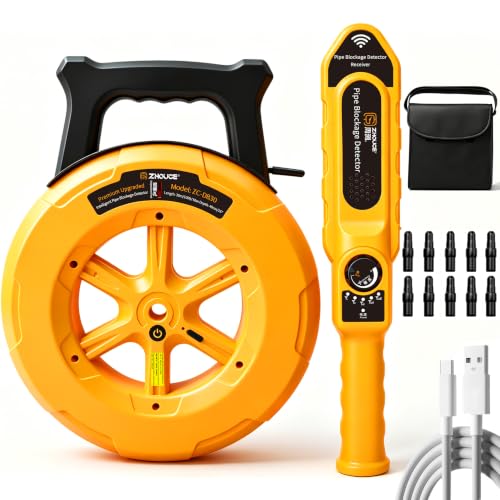
ZHOUCE ZC-D830 100 ft focuses on pinpointing a blockage, with the maker claiming 1.2-inch clog-location precision alongside a 100-foot signal cable. Its claimed maximum depth is 20 inches for PVC, with 6 inches for brass, cast iron and copper, and it includes 10 spare probes with an IP67 waterproof rating. The lower PVC depth claim makes this a better fit for shallower pipe work than ZHOUCE ZC-D830 Pro, while the clog precision claim may appeal for repair work. Pipe material changes the claimed reach, so distinguish plastic from metal before relying on the depth figure.
Bottom line: Choose this for shallower PVC runs when the clog-location precision is useful.
How underground PVC pipe locators work
Signal-line locators trace a signal sent through a cable and probe, while sonde locators detect a small transmitter placed at the point being traced. PVC is nonconductive, so a basic metal detector cannot follow a bare PVC pipe by its material alone. A tracer wire installed alongside the pipe can provide a conductive path for compatible transmitters; a sonde can mark a camera or probe location inside an accessible pipe. Before selecting a tool, identify whether the pipe has tracer wire or can be accessed for a probe. Signal-line reach is not the same as detection depth: the former is cable length, while the latter is a maker’s claimed maximum under particular conditions.
How to compare claimed PVC detection depth
Compare depth claims only for the same pipe material and locating setup. The maker claims 6.7 feet for plastic pipe with ZHOUCE ZC-D830 Pro, 0–40 cm for nonmetal pipe with VEVOR 100 ft Pipe Locator, and 20 inches for PVC with ZHOUCE ZC-D830 100 ft. Those figures are not directly equivalent guarantees: the products may use different probes and signal arrangements, and soil, pipe position and nearby utilities can affect signal clarity. A practical decision rule is to reject any tool whose PVC depth is below the known burial depth; if burial depth is uncertain, first establish it from plans or a safe exploratory method rather than assuming the maximum claim will apply.
Choosing between a signal-line locator and a sonde
A signal-line tool is suited to tracing a cable or probe path that can be connected to its transmitter, while a sonde locator is useful when a transmitter can travel inside the pipe or with an inspection camera. Sonde depth depends on the transmitter being accessible and compatible; line tracing depends on a usable conductive signal path. Choose based on access first, then compare reach and mode count. No locator removes the need to identify other buried utilities before digging.
Safe steps before digging near a located pipe
In the United States, call 811 before digging so participating utilities can mark their lines; the service does not mark every privately owned pipe, such as some yard irrigation or water lines. Treat locator readings as an aid, not a clearance to excavate: signals can be distorted by nearby conductors, bends, depth changes or parallel utilities. Keep the transmitter and probe arrangement matched to the tool, and verify the route at multiple points before opening a trench. For a private PVC line, use plans, visible endpoints or a compatible probe to establish the route. Never dig directly over an uncertain reading; expose the line cautiously using the applicable local safe-digging practices.
Frequently Asked Questions
Can a locator find PVC pipe without tracer wire?
Yes, a compatible signal-line probe or sonde can help trace PVC without relying on the pipe itself to conduct electricity. A bare PVC line is nonconductive, so a standard metal detector cannot follow it by material alone.
How deep can an underground PVC pipe locator detect?
The products here give different maker claims, from 0–40 cm for nonmetal pipe to 6.7 feet for plastic pipe. Treat those as model- and setup-specific maximum claims, not a guaranteed depth in every soil condition.
Does a 100-foot signal cable mean 100-foot depth?
No, 100 feet describes the cable’s reach along the route, not vertical detection depth. Compare cable length and claimed depth as separate measurements when selecting a locator.
Should I call 811 before digging for a PVC pipe?
Yes, call 811 before digging in the United States so participating utilities can mark their lines. Private yard pipes may not be included, so use plans or a compatible locator to trace those separately.
Can one locator find PVC and metal pipes equally well?
Not necessarily; detection claims can vary by pipe material, and ZHOUCE ZC-D830 Pro and ZHOUCE ZC-D830 100 ft give lower depth figures for metal than for PVC. Confirm the pipe material and compare the matching material-specific claim before relying on a reading.