
Best Memory Foam Shoe Inserts: 4 Picks Compared

DWTWLE 4D Cloud Insoles, Men’s 11–13 is the best starting point for memory foam shoe inserts because its size range and honeycomb ventilation pair cushioning with a U-shaped heel and gel insert. Choose another option if you need a women’s size range, two pairs, or a slimmer profile for tighter-fitting shoes.
Memory foam insoles compress under body heat and pressure, so they add cushioning but can reduce shoe volume; leave enough room above the toes and across the instep.
We earn a commission if you buy through links on this page. As an Amazon Associate I earn from qualifying purchases. Products are compared on manufacturer specifications, not hands-on testing.
- Best overall: DWTWLE 4D Cloud Insoles, Men’s 11–13 – Men’s US 11–13 sizing combines honeycomb ventilation with a gel insert and U-shaped memory foam heel.
- Best for women’s sizes: SMILESKY 4D Cloud Steppers, Women’s 5–9 – The women’s US 5–9 version is trim-to-fit and includes two pairs.
- Best for slim shoes: Airplus Memory Comfort Insoles – The full-length memory foam insole is described as slim and trim-to-fit.
| Product | Best for | Size range | Pairs | Fit feature | Shop |
|---|---|---|---|---|---|
| DWTWLE 4D Cloud Insoles, Men’s 11–13 | Ventilated cushioning | Men’s US 11–13 | — | Honeycomb design | Check Price on Amazon |
| SMILESKY 4D Cloud Steppers, Women’s 5–9 | Women’s trim fit | Women’s US 5–9 | 2 pairs | Trim-to-fit | Check Price on Amazon |
| Airplus Memory Comfort Insoles | Slim full-length fit | Women’s US 5–11 | — | Trim-to-fit | Check Price on Amazon |
| 2-Pair Memory Foam Inserts, Men’s US 10 | Two-pair replacement | Men’s US 10; women’s US 12 | 2 pairs | Trim edges | Check Price on Amazon |
Memory Foam Shoe Inserts Compared
Compare the size range, pair count and fit features before choosing inserts for your shoes.
DWTWLE 4D Cloud Insoles, Men’s 11–13

DWTWLE 4D Cloud Insoles, Men’s 11–13 stands apart with a honeycomb design and a gel insert beneath its U-shaped memory foam heel. The men’s US 11–13 size is intended for that range, making it a direct option for larger men’s shoes when its dimensions suit the shoe. The maker says the design promotes airflow and moisture management, while the heel and gel insert absorb impact. The trade-off is its narrow stated size range; shoppers outside men’s US 11–13 should choose a different size option rather than assume it will trim down or stretch.
Bottom line: Choose this if you wear men’s US 11–13 and want a ventilated design with added heel cushioning.
SMILESKY 4D Cloud Steppers, Women’s 5–9

SMILESKY 4D Cloud Steppers, Women’s 5–9 is the women’s-size choice among these options and comes as two pairs, unlike the single-pair packages or unspecified pair counts elsewhere. Its dimensions are 10.4 inches long, 3.5 inches wide and 0.39 inch high; the maker says the insoles can be trimmed for fit. A honeycomb pattern, memory foam and PU construction, and U-shaped heel are intended to combine airflow and cushioning. The size is women’s US 5–9, so buyers outside that range should not assume trimming makes it suitable for any shoe size.
Bottom line: Pick this for women’s US 5–9 shoes when a two-pair pack and trim-to-fit design suit your needs.
Airplus Memory Comfort Insoles

Airplus Memory Comfort Insoles differs with a slim, full-length profile that covers heel to toe, plus a trim-to-fit design. Its women’s shoe-size range is 5–11, so it offers a wider women’s range than the option sized 5–9. The maker says the memory foam molds to the foot and uses Silvadur technology to prevent growth of odor-causing bacteria. The dimensions are about 11 inches long, 3.86 inches wide and 0.39 inch high. It suits shoes where a slim insert matters, but verify the shoe’s removable insole and available interior space before trimming.
Bottom line: Choose this for women’s sizes 5–11 when a slim, full-length insert is the priority.
2-Pair Memory Foam Inserts, Men’s US 10
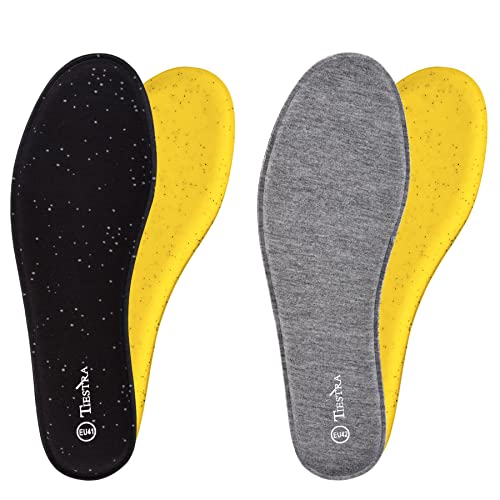
2-Pair Memory Foam Inserts, Men’s US 10 is the only option here with an explicit men’s US 10 size and a two-pair package in black and grey. At 0.31 inch thick, it is the thinnest option with a thickness, a consideration for shoes with limited room. The maker says the memory foam provides rebound cushioning and the material has moisture-wicking treatment. The fit guidance recommends sizing down and says the edges can be trimmed if the insole is too large. Its sizing is limited to men’s US 10 and women’s US 12, so it is not a general fit for other sizes.
Bottom line: Choose this for men’s US 10 shoes when a two-pair package and stated slim thickness are useful.
How to choose memory foam shoe inserts
Start with shoe volume, then choose the cushioning and support features that fit your use. Memory foam compresses under load and often takes more room than a thin fabric sockliner; an insert that crowds the toes can change how the shoe fits. Measure the shoe’s removable footbed from heel to toe and compare it with the insert’s length, then check width and thickness as well. A trim-to-fit edge can shorten an insert, but it cannot make a wide insert narrower through the arch or change its support shape. For snug shoes, favor a slim profile; for roomier footwear, added thickness may be easier to accommodate.
| Need | What to prioritize |
|---|---|
| Limited shoe room | Slim profile and full-length fit |
| Different shoe sizes | Exact size range before trimming |
| More heel cushioning | Heel cup or added heel cushioning features |
| High arch shape | A specifically high-arch design |
Memory foam insert fit and trimming
Trim-to-fit insoles should be shaped against a removable insole from the same shoe, not cut by guessing from the shoe’s exterior. Trace the old insole and trim small amounts from the toe end, checking the fit frequently; cutting too much can leave gaps or shift pressure. A thickness near 0.39 inch can noticeably reduce interior space, while a 0.31-inch insert may suit a shoe with less room, though actual fit depends on the shoe’s lining and sockliner. Check heel-to-toe length, forefoot width and toe clearance before wear. If the shoe’s factory footbed cannot be removed, check available room before adding another layer.
Memory foam cushioning and support types
Memory foam cushioning and arch support solve different fit preferences. Foam conforms under pressure and provides a cushioned feel, while a shaped arch feature changes where the foot contacts the insert. A high-arch design may feel intrusive to someone used to a flatter footbed; break in a new support shape gradually and stop wearing it if it causes persistent discomfort. Heel cups and gel inserts add structure or cushioning under the heel, but they do not establish that an insole is suitable for every foot condition. Ventilation patterns can help air move through the insert, yet socks and shoe construction also affect heat and moisture. Select the feature based on fit rather than assuming more structure is always better.
Care and safe use of shoe inserts
Keep insoles dry between wears because trapped moisture can contribute to odor and material wear. Remove inserts when the shoe permits, air-dry them at room temperature and avoid high heat, which can deform foam or adhesives. Replace an insert when it remains compressed, tears, or no longer lies flat; a collapsed heel or uneven surface can create pressure points. Check that the insert sits fully against the shoe’s footbed and does not curl at the toe or heel before walking. New inserts can change shoe fit, so test them indoors first and do not continue using a pair that causes numbness, blisters or increasing pain.
Frequently Asked Questions
How thick should memory foam shoe inserts be?
A thickness around 0.39 inch is common among the options here, while a 0.31-inch insert can leave more room in a snug shoe. Choose based on remaining toe and instep clearance, not thickness alone.
Can memory foam insoles be trimmed to fit?
Trim only when the insert is designed for it, and use the shoe’s removable footbed as a template. Cut a little at a time from the toe end, since trimming cannot correct an unsuitable width or arch shape.
Do memory foam inserts support high arches?
Some inserts use a specifically high-arch shape, while others emphasize cushioning or heel features. Choose a high-arch design only if that contour matches your foot and feels comfortable in the shoe.
How often should shoe insoles be replaced?
Replace insoles when the foam stays flattened, the surface tears, or the insert shifts instead of lying flat. Check them every few months if worn daily, since heavy use and moisture can speed wear.
Can I wear new insoles all day immediately?
A new insole changes the shoe’s fit and pressure pattern, so start with a short indoor wear period rather than a full day. Stop if it causes numbness, blisters or persistent discomfort.