
R500 LVLP Spray Guns: Compare Nozzles and Kits

The AEROPRO TOOLS R500 LVLP spray gun suits buyers who want a three-nozzle kit and clear trigger controls; its 1.3, 1.5 and 1.7 mm options cover several coating viscosities. Choose a different kit if you need a 2.0 mm nozzle or disposable cups.
LVLP means low-volume, low-pressure spray equipment: match the gun’s air demand to your compressor’s delivered airflow, not just its tank size.
We earn a commission if you buy through links on this page. As an Amazon Associate I earn from qualifying purchases. Products are compared on manufacturer specifications, not hands-on testing.
- Best overall: AEROPRO TOOLS R500 A610 – Three nozzle sizes and a two-stage trigger make this a straightforward option for varied coating viscosities.
- Best for four nozzle sizes: R500 with Four Nozzles and 10 Cups – The kit includes 1.3, 1.5, 1.7 and 2.0 mm nozzles, plus ten disposable cups.
- Best for body durability: R500 with Mixing Cup and Disposable Cups – Its Teflon-coated forged aluminum body and nickel-plated stainless steel internals distinguish its construction.
| Product | Best for | Nozzle sizes | Cup setup | Shop |
|---|---|---|---|---|
| AEROPRO TOOLS R500 A610 | Three-nozzle control | 1.3, 1.5, 1.7 mm | — | Check Price on Amazon |
| R500 with Four Nozzles and 10 Cups | Broad nozzle range | 1.3, 1.5, 1.7, 2.0 mm | 10 disposable, 650 mL cups | Check Price on Amazon |
| R500 with Mixing Cup and Disposable Cups | Metal construction | 1.3, 1.5, 1.7 mm | 650 mL mixing, 10 disposable cups | Check Price on Amazon |
| BENTOHKLE R500 A610 | Lined cup workflow | 1.3, 1.5, 1.7 mm | 650 mL disposable cup system | Check Price on Amazon |
| R500 with 1.3, 1.7 and 2.0 mm Nozzles | Large nozzle option | 1.3, 1.7, 2.0 mm | 650 mL cup, 10 disposable cups | Check Price on Amazon |
R500 LVLP Spray Guns Compared
Compare nozzle range and cup setup first, then confirm your compressor can supply the required airflow.
AEROPRO TOOLS R500 A610

The AEROPRO TOOLS R500 A610 is the only kit here whose feature set calls out a two-stage trigger and an included setup manual. Air consumption is 3.0–3.9 CFM, with a 2.0–3.5 bar operating pressure range. This kit suits buyers who value setup guidance; choose another option if you specifically need a 2.0 mm nozzle or disposable cup system.
Bottom line: Choose this kit if three nozzle sizes and guided setup fit your coating needs.
R500 with Four Nozzles and 10 Cups

The four-nozzle range separates this R500 kit from the three-nozzle options: the added 2.0 mm nozzle is intended for high-build primer. The kit includes ten 650 mL disposable cups, while the other nozzle uses are 1.3 mm for basecoat or clearcoat, 1.5 mm for general-purpose work, and 1.7 mm for primer or thicker coatings. The operating pressure range is 2.0–3.5 bar. The maker says the gun can reach 65%–70% paint utilization and save 20% of paint; those are maker claims, not a guarantee for every setup. Pick another kit if you do not need the 2.0 mm option.
Bottom line: Choose it if high-build primer and four nozzle sizes are priorities.
R500 with Mixing Cup and Disposable Cups
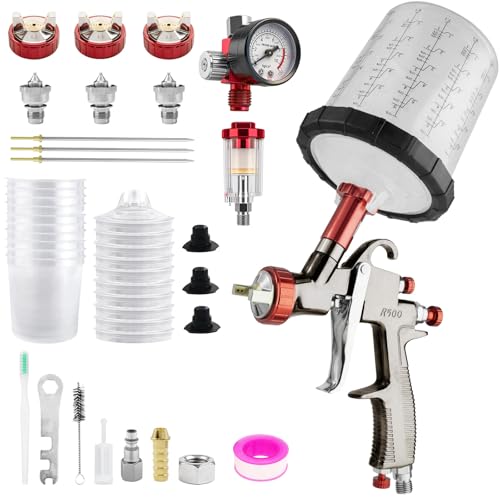
The construction is the distinguishing feature of this R500 kit: it has a Teflon-coated forged aluminum body and nickel-plated stainless steel internals, with a quick-disassembly design for cleaning. The kit pairs 1.3, 1.5 and 1.7 mm nozzle options with a 650 mL mixing cup and ten disposable cups. The maker claims 65% or greater paint utilization and a 280 mm spray width. This choice suits buyers who want the specified metal construction and cup combination. Its nozzle set stops at 1.7 mm, so another kit is a better fit when a 2.0 mm nozzle is needed.
Bottom line: Choose it for the specified body materials and mixing-plus-disposable cup setup.
BENTOHKLE R500 A610

The BENTOHKLE R500 A610 focuses on a lined-cup workflow: its disposable cup system has measurement lines for mixing in the liner, and the liner can be replaced after use. The gun has a Teflon-coated forged aluminum body and includes 1.3, 1.5 and 1.7 mm nozzles for automotive, furniture, home-painting and touch-up tasks. The maker claims paint utilization up to 65%. Buyers who want disposable liners and the body construction may prefer this kit. Its three nozzle sizes do not include the 2.0 mm option offered in one of the other kits.
Bottom line: Choose it if mixing in marked disposable liners is central to your workflow.
R500 with 1.3, 1.7 and 2.0 mm Nozzles

This R500 kit includes a 2.0 mm nozzle but skips the 1.5 mm size included with several other models, making its nozzle lineup a distinct choice. Its package specifies 1.3, 1.7 and 2.0 mm nozzles, a 650 mL mixing cup and ten disposable cups. The maker claims up to 65% paint utilization and a 280 mm spray width. Choose a different kit if you need a 1.5 mm nozzle.
Bottom line: Choose it if you need a 2.0 mm nozzle and do not need 1.5 mm.
How to Choose an R500 LVLP Spray Gun
Choose by coating viscosity and nozzle size, then check the compressor’s delivered airflow. The R500 kits here use 3.0–3.9 CFM; compressor tank capacity alone does not show whether the pump can sustain that airflow while spraying. Coating makers may specify their own reduction and tip requirements, so check those before selecting a nozzle. For vehicle refinishing, spray in a ventilated area and use respiratory protection rated for the coating and its safety instructions; a spray booth or respirator does not make inadequate ventilation safe.
R500 Nozzle Sizes and Coating Fit
Use nozzle size as a starting point, not a substitute for coating instructions. A smaller fluid tip generally suits thinner materials, while thicker coatings often need a larger tip or appropriate reduction; the exact match depends on the product formulation and desired film build. These R500 packages span 1.3 to 2.0 mm, but some omit 1.5 mm or 2.0 mm, so compare the actual included sizes. The 1.3 mm option is associated here with basecoat or clearcoat, 1.5 mm with general-purpose or medium-viscosity work, 1.7 mm with primers and thicker coatings, and 2.0 mm with high-build primer. Do not force an unsuitable coating through a small nozzle; confirm the coating maker’s recommended tip and reduction before spraying.
Compressor and Air Pressure Fit
Match the compressor to 3.0–3.9 CFM of gun demand and verify airflow at the pressure the gun requires. A tank stores compressed air, but sustained pump output determines whether spraying can continue without pressure sag; a compressor with a large tank can still fall short on delivered CFM. Measure pressure at the gun inlet with the trigger pulled, because static pressure can read higher than working pressure. The operating range for several kits is 2.0–3.5 bar, approximately 29–51 psi. Air hose length, inside diameter, fittings and filters add pressure drop, so avoid restrictive connections and check the gun’s own adjustment guidance before spraying.
Disposable Cups, Cleaning, and Spray Safety
Choose a disposable-cup kit if replacing a liner after each session better suits your workflow; the package contents differ, with some options including a 650 mL mixing cup and ten liners. Reusable fluid passages still need cleaning after use: dried paint can block the nozzle, needle and air cap, so disassemble and clean those parts using a solvent compatible with the coating and gun materials. Spray finishing materials only with suitable ventilation and protective equipment; solvent vapors can be flammable and harmful to breathe. Keep ignition sources away, and follow the coating’s safety instructions for respiratory protection, storage and disposal. Never use the spray gun near flames, sparks or an operating heater.
Frequently Asked Questions
How much airflow does an R500 LVLP spray gun need?
These R500 product specifications give an air-consumption range of 3.0–3.9 CFM. Check that the compressor can sustain the required airflow at working pressure, rather than relying on its tank size alone.
What does the 2.0 mm nozzle work best for?
Confirm the coating maker’s recommended tip size and reduction before spraying, since formulations differ.
Should spray pressure be checked with the trigger pulled?
Yes, pressure should be checked at the gun inlet while air is flowing because static pressure may be higher. Several R500 kits give a 2.0–3.5 bar operating range, about 29–51 psi.
How do I avoid clogs when using an LVLP spray gun?
Clean the nozzle, needle and air cap after each use before paint dries. Use cleaning solvent compatible with the coating and gun materials, and avoid forcing overly thick material through a small nozzle.
What safety gear is needed when spraying automotive paint?
Use suitable ventilation and respiratory protection specified for the coating, and keep ignition sources away from flammable solvent vapors. A spray area that lacks safe ventilation is not made safe by wearing a respirator.