
Non-Programmable Scientific Calculators Compared by Features

For most students, TI-30XIIS is the straightforward non-programmable scientific calculator choice, with a two-line display, fraction features and SAT, ACT and AP exam approval. Choose TI-30XS MultiView instead if seeing up to four lines or exploring function tables matters more; choose other models for their distinct power, size or function mix.
We earn a commission if you buy through links on this page. As an Amazon Associate I earn from qualifying purchases. Products are compared on manufacturer specifications, not hands-on testing.
- Best overall: TI-30XIIS – Two-line display, fraction functions and approval for SAT, ACT and AP exams.
- Best for multi-line viewing: TI-30XS MultiView – Its MultiView display supports up to four lines and can show function tables.
- Best for conversions: TI-30Xa – Converts among fraction/decimal, angle and coordinate formats.
- Best for portability: Casio fx-260 SOLAR II – Compact 4.78-inch length and solar power.
| Product | Best for | Display | Power | Length | Shop |
|---|---|---|---|---|---|
| TI-30XIIS | School and exams | Two-line | Solar and battery | 6.1 in | Check Price on Amazon |
| TI-30XS MultiView | Multi-line viewing | Up to four lines | — | 7.25 in | Check Price on Amazon |
| TI-30Xa | Conversion functions | 10-digit | Battery | 5.91 in | Check Price on Amazon |
| Casio fx-260 SOLAR II | Compact solar use | 10-digit | Solar | 4.78 in | Check Price on Amazon |
| SC-216 | Broad function set | 12-digit, two-line | 2 AAA batteries | 6.3 in | Check Price on Amazon |
Non-Programmable Scientific Calculators Compared
Compare the display, power source and function mix to match a calculator to classwork or exam needs.
TI-30XIIS

The TI-30XIIS stands out for its combination of a two-line entry-and-result display and stated approval for SAT, ACT and AP exams. Fraction features, conversions, statistics, and basic scientific and trigonometric functions cover common high-school math and science work. Solar and battery power gives it two power options. Its 6.1-inch length makes it longer than the compact Casio option, so choose another model if a shorter body is the priority.
Bottom line: Pick this if you want a familiar two-line layout and exam approval.
TI-30XS MultiView

The TI-30XS MultiView separates itself with a display supporting up to four lines, allowing multiple calculations to remain visible together. It shows textbook-style expressions and stacked fractions, outputs scientific notation with superscripted exponents, and offers an (x,y) table of values. Those features suit students who compare steps or explore functions. Its length is 7.25 inches, so it is the longest of these options; choose a shorter model if carrying size matters more than screen space.
Bottom line: Choose this for multi-line work and on-screen function tables.
TI-30Xa

The TI-30Xa emphasizes conversion options, including fraction-to-decimal, degrees/radians/grads, DMS/decimal/degrees, and polar/rectangular formats. It also handles trigonometric functions, logarithms, roots, powers, reciprocals, factorials, fractions, and one-variable statistics. A 10-digit display and included slide case make it a compact, focused choice for general math and science. It is battery-powered, unlike the solar-and-battery TI-30XIIS, so students who prefer a solar option should compare those power arrangements.
Bottom line: Choose this if angle and coordinate conversions are central to your coursework.
Casio fx-260 SOLAR II
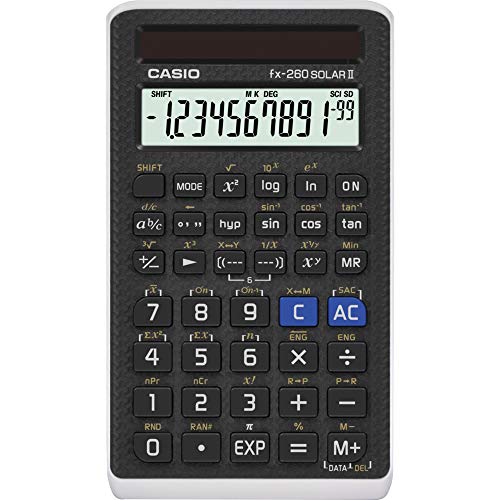
The Casio fx-260 SOLAR II is the shortest model at 4.78 inches and uses solar power. Its 10-digit display and functions include trigonometric and inverse trigonometric operations, permutations, combinations, factorials, and fraction support. It is aimed at middle- through high-school math, including algebra, geometry, trigonometry, and physics. The maker specifies a solar power arrangement rather than a battery option, so students who require battery backup should verify that power requirement before choosing.
Bottom line: Pick this when a short body and solar operation are the priority.
SC-216

The SC-216 distinguishes itself with a 240 functions and 12-digit HD display, plus two-line entry-and-result viewing. Its capabilities include trigonometry, statistics with one- and two-variable calculations, three angle modes, engineering modes, and a fraction key. Two AAA batteries power it, and it includes a hard cover. The maker says it is SAT exam ready, but does not establish approval for other named exams; students facing specific exam rules should confirm eligibility before relying on it.
Bottom line: Choose this for its 240-function range and two-variable statistics.
How to choose a scientific calculator for school
Choose by course functions and exam rules first, then by display and size. Algebra, trigonometry, and general science commonly call for fractions, roots, powers, logarithms, and trig functions; statistics courses may require mean and standard deviation, while function work benefits from a table of values. A two-line screen can show an entry and result together; a four-line screen gives more room to compare calculations. For an exam, check the current testing authority’s calculator policy rather than assuming every non-graphing model is permitted. A model described as exam-ready is not automatically approved for every test.
| Need | Useful feature | Compare |
|---|---|---|
| Review entry and answer | Two-line display | TI-30XIIS or SC-216 |
| See more calculations | Up to four lines | TI-30XS MultiView |
| Carry a shorter model | Shorter body | Casio fx-260 SOLAR II |
Display and calculator size
Display layout matters most when checking multi-step work: two lines keep the current entry and result visible, while the TI-30XS MultiView supports up to four lines. Length ranges from 4.78 inches for the Casio to 7.25 inches for the TI-30XS, a difference of 2.47 inches. If a pencil pouch has less than 5 inches of usable length, choose a model no longer than that space; only the Casio meets that cutoff among these options. Screen line count and digit count are different measures, so compare both if you need to read long values as well as expressions.
Power choices for student calculators
Solar and battery models differ in how they handle power: the TI-30XIIS is solar and battery powered, the TI-30Xa is battery-powered, and the Casio fx-260 SOLAR II is described as solar powered. The SC-216 uses two AAA batteries. If a course involves extended sessions away from bright light, a battery-powered model or a model with both power sources may better match that setting. Keep spare batteries for battery-operated calculators used in exams, and check exam rules about replacement batteries or permitted accessories before test day.
Exam approval and calculator rules
Exam eligibility is set by the testing organization, not by a calculator’s scientific or non-graphing label. The TI-30XIIS is identified as approved for SAT, ACT, and AP exams, while the SC-216 is described as SAT exam ready; those statements should not be treated as identical approval for every exam. Policies can distinguish calculator categories and may change, so confirm the current policy for the specific test before exam day. For classroom use, ask whether the teacher requires particular functions such as statistics or fraction display; a broad function count alone does not ensure that a calculator matches a course or test.
Frequently Asked Questions
What does non-programmable mean on a calculator?
A non-programmable calculator performs built-in operations without letting the user write and store custom programs. Scientific models can still handle functions such as trigonometry, logarithms, powers, and statistics.
Can a scientific calculator show fractions?
Some scientific calculators support fraction entry and operations, while display formats differ by model. The TI-30XIIS, TI-30XS MultiView, TI-30Xa, Casio fx-260 SOLAR II, and SC-216 all include fraction-related capabilities.
How many lines should a calculator display have?
A two-line display can show an entry and its result together, which suits checking a calculation. A model supporting four lines provides more simultaneous screen space for comparing expressions.
Are scientific calculators allowed on every exam?
No; each exam authority sets its own calculator policy. The TI-30XIIS is identified for SAT, ACT, and AP use, but students should confirm current rules for their specific test.
What calculator functions help with statistics?
One-variable statistics can provide measures such as mean and standard deviation; two-variable statistics can handle paired data. The TI-30Xa includes one-variable statistics, and the SC-216 lists both one- and two-variable calculations.