
Blower for Car Detailing: 5 Options Compared

For touch-free exterior drying, Adam’s Air Cannon Car Dryer is the direct fit because it is a dedicated car dryer with filtered air, adjustable power and a 30-foot hose. Choose a cordless blower instead if portability or short interior dusting tasks matter more than a purpose-built drying setup.
A car-detailing blower moves air across wet surfaces and out of crevices to reduce towel contact; the right style depends on whether you are drying the body or clearing dust inside.
We earn a commission if you buy through links on this page. As an Amazon Associate I earn from qualifying purchases. Products are compared on manufacturer specifications, not hands-on testing.
- Best overall: Adam’s Air Cannon Car Dryer – A dedicated car dryer with filtered air, adjustable power and a 30-foot hose.
- Best for cordless drying: SEESE Turbo Cordless Leaf Blower – A 2.7-pound handheld blower is specified for car drying and yard use.
- Best for interior dusting: WOLFBOX MegaFlow 50 – The compact 0.45-pound duster has three speeds and four nozzles.
| Product | Best for | Power source | Weight | Airflow or speed | Shop |
|---|---|---|---|---|---|
| Adam’s Air Cannon Car Dryer | Exterior drying | Corded dryer | 24.2 lb | 392 CFM; 73,000 ft/min | Check Price on Amazon |
| SEESE Turbo Cordless Leaf Blower | Cordless car drying | Cordless; 21V battery | 2.7 lb | 600 CFM | Check Price on Amazon |
| Plymax Cordless Leaf Blower | Dual-use drying | Cordless; two 21V batteries | — | 800,000 RPM; airflow not given | Check Price on Amazon |
| WOLFBOX MegaFlow 50 | Compact dusting | Rechargeable electric | 0.45 lb | 110,000 RPM | Check Price on Amazon |
| WOLFBOX MF60 Air Duster | Electronics dusting | Rechargeable cordless | 0.5 lb | 25,000–110,000 RPM | Check Price on Amazon |
Blowers for car detailing
Choose by the job first: dedicated exterior drying, cordless vehicle drying, or compact dusting in tight areas.
Adam’s Air Cannon Car Dryer
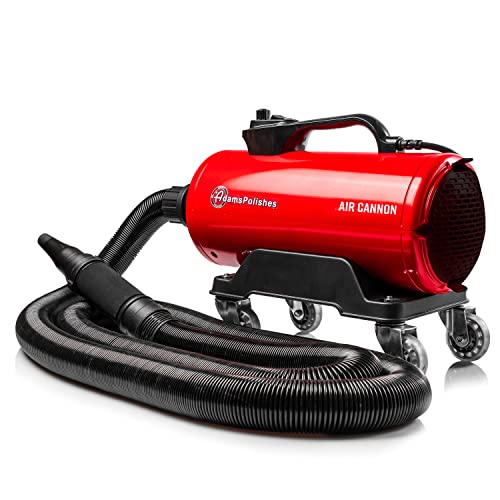
Unlike the handheld blowers, this is a dedicated car dryer with filtered air, adjustable power and a 30-foot self-expanding, retracting hose. The maker says it uses warm air; rubberized attachments help direct airflow around a vehicle. At 24.2 pounds, it is better suited to a fixed garage drying routine than carrying around for quick interior dusting. Its larger form is a tradeoff for buyers who prioritize a purpose-built drying setup over cordless portability.
Bottom line: Choose this for regular touch-free exterior drying when hose reach matters more than a lightweight handheld form.
SEESE Turbo Cordless Leaf Blower

At 2.7 pounds, this handheld option is much lighter than the dedicated car dryer and is specifically described for car drying as well as yard cleanup. Its airflow is 600 CFM, and the maker identifies a 21V, 4.0Ah battery. The leaf blower format may suit someone who wants one cordless tool for vehicle and outdoor tasks. It is not described as a filtered car dryer, so buyers prioritizing filtered air for finish drying should choose a purpose-built dryer instead.
Bottom line: Pick this for a lighter cordless tool that can also be used for car drying.
Plymax Cordless Leaf Blower
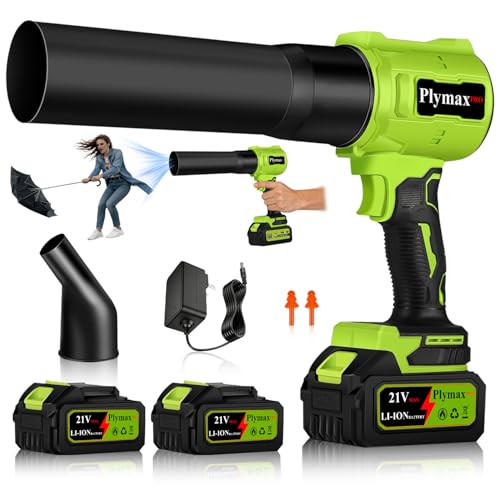
The Plymax differs from the other cordless options by including two nozzles, one wide and one precision jet, plus two 21V batteries. Its features mention car drying alongside patio, lawn, dust and snow cleanup, making it a multi-purpose blower rather than a dedicated car dryer. The precision nozzle may help direct air into narrower areas, while the wide nozzle is for broader coverage. The maker gives a motor speed but no airflow volume, so shoppers comparing drying force by CFM cannot use that figure to make a direct comparison.
Bottom line: Choose this if interchangeable nozzle shapes and two batteries suit your mixed-use needs.
WOLFBOX MegaFlow 50

At roughly 0.45 pound, the MegaFlow 50 is the most compact choice here and is framed as an electric air duster for car, home and outdoor use. It has three adjustable speed settings and four nozzles, which makes it more suited to targeted dust and debris removal than drying an entire wet vehicle. Its lightweight form is handy for short cleaning sessions, but the maker does not position it as a filtered, warm-air car dryer. Choose a dedicated dryer if exterior water removal is the main job.
Bottom line: Pick this for lightweight, targeted dusting rather than full-vehicle drying.
WOLFBOX MF60 Air Duster
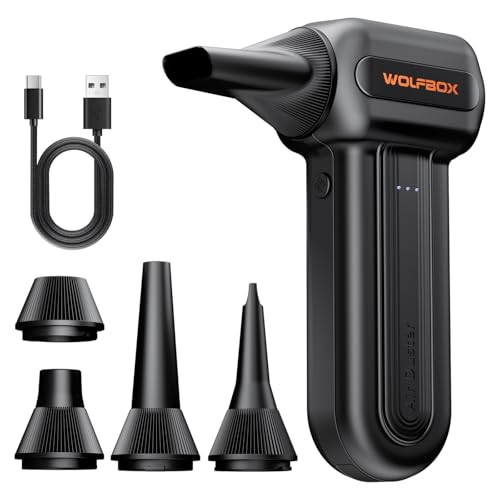
The MF60 gives three stated speed levels—25,000, 60,000 and 110,000 RPM—and is aimed particularly at keyboards, computer cases and radiator fans, with car use also mentioned. At 0.5 pound, it is a compact option for detail work where a small duster is easier to maneuver than a full-size blower. Its maximum runtime is up to 240 minutes on Gear 1. That electronics-focused design is less suited to drying broad exterior panels than a dedicated car dryer or larger blower.
Bottom line: Choose this for small-area dust removal, especially around electronics and interior crevices.
How to choose a blower for car detailing
Start with the surface: a wet exterior needs sustained airflow and reach, while dusty vents and consoles favor a small, controllable nozzle. Dedicated car dryers in this selection provide filtered air and a hose; handheld options trade that setup for portability. Airflow volume in CFM and air speed in feet per minute measure different things, so do not compare their numbers as though they were interchangeable. For broad exterior drying, prioritize an explicitly stated airflow volume or a car dryer design; for confined areas, favor a compact tool with adjustable speeds or multiple nozzles. If you want one tool for both yard cleanup and vehicle drying, a cordless leaf blower can be a compromise, but it is not equivalent to a filtered dryer.
Keep the nozzle moving and avoid directing a concentrated stream at loose trim, seals or delicate components. Remove loose grit before blowing across paint, since debris can scratch when dragged over the finish.
Dedicated car dryers and handheld blowers compared
A dedicated car dryer is the clearest match for drying a washed vehicle without towel contact; compact dusters are better for small cleaning jobs. Use this distinction to narrow the type before comparing individual features.
| Need | Type to choose | Tradeoff |
|---|---|---|
| Drying exterior panels and seams | Dedicated car dryer | Larger and less portable |
| Vehicle drying plus yard cleanup | Cordless leaf blower | Not specified as a filtered car dryer |
| Dusting vents or electronics | Compact air duster | Less suited to broad wet surfaces |
A hose can make it easier to work around a parked vehicle without moving the dryer itself; a handheld tool instead keeps the motor and nozzle together in your hand. Choose based on where the air needs to reach and how often the tool has to move between tasks.
Using a blower safely on paint and trim
Blowing water away can reduce wiping, but it does not make a dirty surface safe to rub or blast. Rinse away grit before drying, then use a clean nozzle and keep it from touching painted panels. Concentrated airflow can disturb loose trim or push water into places where it lingers, so use a controlled setting near badges, seals and electrical openings rather than holding a high-speed stream in one spot. A blower also does not replace washing: dried mineral deposits or road film require appropriate cleaning, not simply more airflow. When drying around the cabin, keep water away from switches, connectors and exposed electronics.
For exterior work, start with roof and glass and move downward, allowing runoff to leave the lower panels last. Check mirrors, handles and grille openings for trapped water after the main panels are dry.
Nozzle choice and reach for detail work
Nozzle shape changes how easily you can direct airflow, not the blower’s airflow rating. A wide nozzle spreads air over larger areas, while a narrow or precision nozzle concentrates it for crevices; concentrated flow calls for more care near seals and fragile trim. A hose gives reach around a vehicle without carrying the dryer, while a cordless handheld format is easier to bring into a garage corner or use for a quick dusting task. For mirror housings, door handles and grille openings, angle airflow so water can escape rather than forcing it deeper. After blowing, inspect those pockets because water can run out later and leave spots.
Frequently Asked Questions
Can a leaf blower dry a car after washing?
A leaf blower can move water off a vehicle, and some handheld models are specifically described for car drying. It is not the same as a dryer described as using filtered air, so buyers who prioritize that feature should choose a dedicated car dryer.
Is a car blower safer than a drying towel?
A blower avoids towel contact during the air-drying step, which can reduce the chance of dragging remaining grit across paint. Rinse off loose dirt first; airflow cannot make abrasive debris harmless.
What does CFM mean on a car blower?
CFM means cubic feet per minute, a measure of airflow volume. Feet per minute measures air speed instead, so compare products using the same kind of rating rather than treating the numbers as equivalent.
Should I use a narrow nozzle on car paint?
A narrow nozzle concentrates airflow, which can help direct air into tight gaps but requires more care around trim and seals. Keep the stream moving and avoid pressing the nozzle against the finish.
How do I keep water from dripping after drying?
Water commonly remains in mirrors, handles, badges and grille openings after broad panels are dry. Direct airflow so water can exit each pocket, then inspect those areas again before finishing.