
Best Orbital Floor Cleaning Machines Compared by Fit

For most users, Oreck Commercial Orbiter is the most versatile pick because its random-orbit head is made for multiple floor types and dry carpet cleaning. Choose a variable-speed buffer instead if you need to tune the speed for heavy soils or floor maintenance.
Orbital floor machines use a rotating head that moves in small overlapping paths; unlike a single-direction rotary buffer, this motion helps limit visible swirl marks.
We earn a commission if you buy through links on this page. As an Amazon Associate I earn from qualifying purchases. Products are compared on manufacturer specifications, not hands-on testing.
- Best overall: Oreck Commercial Orbiter – Random-orbit cleaning handles hard floors and dry carpet cleaning.
- Best for heavy soils: VEVOR 13-Inch Floor Scrubber – Its 0.75 HP motor offers adjustable 1,200–1,900 rpm.
- Best for speed range: 13-Inch Orbital Buffer, 175–2,000 RPM – Its adjustable 175–2,000 rpm range covers varied cleaning tasks.
- Best for wider paths: 17-Inch Random-Orbit Buffer – The 17-inch cleaning path covers more floor per pass.
| Product | Best for | Cleaning width | Speed range | Weight | Shop |
|---|---|---|---|---|---|
| Oreck Commercial Orbiter | Mixed floor types | — | — | 33 lb | Check Price on Amazon |
| VEVOR 13-Inch Floor Scrubber | Heavy soil removal | 13 in | 1,200–1,900 rpm | 34.5 lb | Check Price on Amazon |
| 13-Inch Orbital Buffer, 175–2,000 RPM | Broad speed control | 13 in | 175–2,000 rpm | — | Check Price on Amazon |
| 17-Inch Random-Orbit Buffer | Wider floor coverage | 17 in | 175 rpm | — | Check Price on Amazon |
| HHQ Orbital Floor Scrubber | Hard-floor versatility | — | 175–1,950 rpm | 39 lb | Check Price on Amazon |
Orbital Floor Cleaning Machines
Compare the machines by working width, speed control and the surfaces or tasks each is designed to handle.
Oreck Commercial Orbiter

Random-orbit movement sets this cleaner apart from the variable-speed buffers, and the maker says the pattern helps avoid brush marks, swirls and gouges. The machine is intended for sanding, stripping, scrubbing, waxing and polishing hard flooring, and it dry-cleans carpets without leaving soapy residue. Its 33-pound weight is lighter than the weights of the other models with weights provided. Choose it for varied floor care and tight areas such as bathrooms or under sinks; skip it if you need a cleaning width or adjustable rpm to match a particular job.
Bottom line: Choose this if you want random-orbit care for mixed flooring and carpet.
VEVOR 13-Inch Floor Scrubber
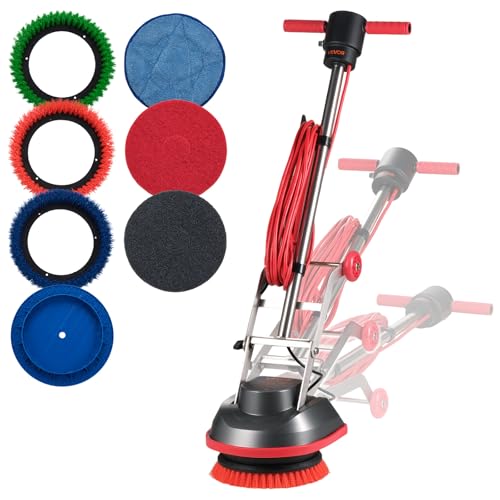
For heavy soils, this model pairs a 0.75 HP commercial motor with adjustable speeds from 1,200 to 1,900 rpm, a distinct combination among these options. Its 13-inch path and included multiple brush heads suit daily cleaning and periodic deep cleaning in indoor spaces such as garages, offices and warehouses. The maker also describes dry carpet care with a microfiber cover. At 34.5 pounds, it is heavier than the Oreck; buyers prioritizing a lighter machine should account for that before choosing it.
Bottom line: Pick this for adjustable speed and a motor aimed at stubborn soils.
13-Inch Orbital Buffer, 175–2,000 RPM

The widest speed range here belongs to this 13-inch buffer: its adjustable settings run from 175 to 2,000 rpm, and the maker specifies a 1/3 HP BLDC motor. The kit includes microfiber, polishing and stripping pads, three brushes, and a hook-and-loop pad driver, giving buyers options for different cleaning tasks without sourcing those tools separately. Its maker says high speeds tackle heavy stains on carpet, concrete and wood. The trade-off is that its weight is not provided, so it is harder to compare carrying effort with the models that have a weight.
Bottom line: Choose this if wide rpm adjustment and a varied pad-and-brush kit matter most.
17-Inch Random-Orbit Buffer

A 17-inch cleaning path makes this the widest machine among these options, useful when covering larger open floors is the priority. Its high-torque random-orbit motor runs at 175 rpm, and the maker says the bidirectional action helps prevent gouges, swirls and sanding marks. The kit includes two brushes and three scouring pads, with an optional solution tank. The version is non-weighted, so buyers seeking a weighted head for additional down-pressure should compare that configuration carefully; its fixed speed also offers less tuning than variable-speed models.
Bottom line: Select this for a broad 17-inch path and fixed-speed random-orbit cleaning.
HHQ Orbital Floor Scrubber

The HHQ combines a 1.5 HP, 1,100-watt ECM motor with adjustable 175–1,950 rpm settings, plus a kit with three scrub brushes, two polishing or stripping pads, a carpet bonnet and pad holder. The maker describes it for hard floors including tile, grout, hardwood, vinyl, concrete and stone, as well as dry carpet cleaning. Its 39-pound weight is the highest among the models with weights provided, which can matter when moving the machine between rooms or storage. Choose it for its broad stated surface coverage and bundled accessories.
Bottom line: Choose this if you want a high-powered scrubber with brushes, pads and a carpet bonnet.
How to choose an orbital floor cleaner
Choose by floor area, soil and control needs: a wider path covers more floor per pass, while adjustable speed lets you tune work between delicate maintenance and stubborn buildup. The machines span 13 to 17 inches in stated width and 175 to 2,000 rpm in stated speed ranges. Fixed-speed units trade adjustment for simpler operation. Brush and pad compatibility matters too: stripping pads remove finish, polishing pads burnish it, and brushes scrub textured surfaces. Match the attachment to the floor coating; aggressive stripping on a finish you want to keep can damage it.
A practical rule is to favor a 17-inch path for open areas where broad coverage matters, and a 13-inch path for narrower routes or compact rooms. Confirm replacement pad size and attachment fit before ordering, since included accessories differ.
Orbital floor machine types compared
Random-orbit machines move the head in overlapping directions, while conventional rotary buffers spin in one direction. The multidirectional motion can reduce the appearance of swirl marks, but pad choice and operator control still affect the finish. Higher rpm is not automatically better: stripping and polishing call for different attachments and techniques, and the coating manufacturer’s care guidance should govern floor work.
This table summarizes the practical distinction between the types in this comparison.
| Type | Motion | Best suited to |
|---|---|---|
| Random orbit | Overlapping multidirectional pattern | Mixed cleaning and finish-sensitive work |
| Rotary buffer | Single-direction rotation | Tasks requiring conventional rotary action |
All five candidates are described as orbital or random-orbit machines, so choose among them by width, controls, weight and attachments rather than assuming all orbital models have identical performance.
Choosing pads, brushes and cleaning speed
Use the least aggressive attachment that can complete the task. Soft microfiber bonnets are intended for carpet surface cleaning, while stiff brushes reach grout and textured tile; stripping pads remove finish and should not be used as routine polishing pads. Start with a small inconspicuous area and low speed when working on coated or unfamiliar flooring, then adjust only if the surface tolerates it.
Floor finish changes the safe operating approach: laminate and sealed wood can be damaged by excess moisture, abrasives or prolonged friction. Keep the head moving, avoid saturating carpet during dry-cleaning work, and unplug a corded machine before changing its pad or brush. A floor machine is heavy rotating equipment, so keep cords clear of the head and secure loose rugs before starting.
What to check before using a floor scrubber
Check the floor material, finish condition and attachment before the first pass. A machine marketed for multiple surfaces does not make every pad suitable for every surface, and unfinished or damaged coatings may respond differently from intact finishes. Remove grit first because trapped particles can scratch flooring under a moving pad. Work in manageable sections and avoid stopping the rotating head in one place.
Dry carpet methods are distinct from wet extraction: a bonnet or dry-cleaning method uses limited moisture, while extraction equipment rinses and removes liquid. These orbital machines should not be treated as carpet extractors unless the model explicitly supports that process. After work, remove and clean attachments according to their material, and inspect brushes for retained grit before reuse.
Frequently Asked Questions
What size orbital floor machine should I choose?
A 13-inch machine is a sensible choice for smaller rooms and narrower routes, while a 17-inch path can cover open floors in fewer passes. Compare the machine’s full dimensions with doorways and storage space, not just its cleaning width.
Can an orbital floor buffer clean carpet?
Some orbital machines support dry carpet cleaning with a microfiber bonnet or cover, as several options here indicate. Dry bonnet cleaning is not the same as hot-water extraction, which rinses and removes liquid from carpet.
Which pad should I use on hardwood floors?
Use a pad specifically intended for the floor’s finish, and begin on a low speed in an inconspicuous area. Stripping pads remove finish, so they are not appropriate for routine cleaning of a finished wood floor.
Does a higher rpm clean floors better?
Not necessarily; the right speed depends on the task, attachment and floor coating. Select a low setting for cautious maintenance and reserve aggressive pads or higher speeds for surfaces and jobs that can tolerate them.
How do I avoid scratches while using a floor scrubber?
Remove loose grit before operating the machine and inspect pads or brushes for embedded debris. Keep the head moving and test the chosen attachment on a hidden area, since trapped particles and prolonged friction can mark a finish.