
PetArmor for Cats: Topical Treatments and Collar Compared

PetArmor Plus is the best fit for most cat owners who want a topical that targets flea eggs and larvae as well as adult fleas, because it contains fipronil and (S)-methoprene. Choose the collar for longer-lasting wearable protection, or the fipronil-only topical if you want a simpler active-ingredient formula.
These products are flea and tick preventives; topical formulas are applied to the cat, while the collar is worn around the neck.
We earn a commission if you buy through links on this page. As an Amazon Associate I earn from qualifying purchases. Products are compared on manufacturer specifications, not hands-on testing.
- Best overall: PetArmor Plus Topical for Cats – Combines fipronil with (S)-methoprene and targets flea eggs and larvae.
- Best for longer coverage: PetArmor Extend Cat Collar – The collar offers up to eight months of protection.
- Best for single-ingredient topical: PetArmor Fipronil Topical for Cats – Uses fipronil as its sole named active ingredient.
| Product | Best for | Format | Active ingredients | Protection period | Shop |
|---|---|---|---|---|---|
| PetArmor Plus Topical for Cats | Flea life cycle | Topical | Fipronil, (S)-methoprene | Up to 30 days | Check Price on Amazon |
| PetArmor Extend Cat Collar | Longer coverage | Collar | Not named | Up to 8 months | Check Price on Amazon |
| PetArmor Fipronil Topical for Cats | Fipronil-only topical | Topical | Fipronil | Up to 30 days | Check Price on Amazon |
PetArmor for Cats Flea and Tick Treatments
Compare application style, active ingredients and claimed protection period to find the right fit for your cat.
PetArmor Plus Topical for Cats
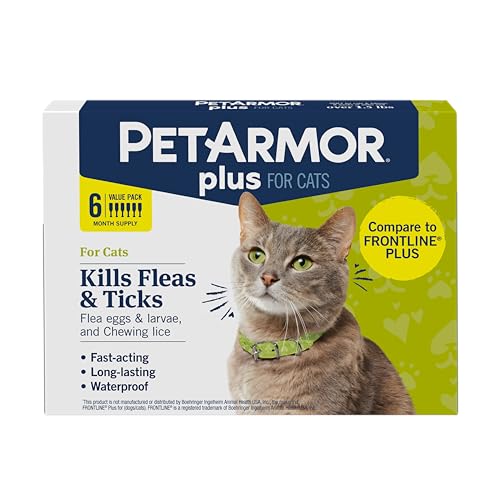
The standout difference is its two-ingredient formula: PetArmor says fipronil and (S)-methoprene kill fleas, eggs, larvae, ticks and chewing lice. The waterproof topical begins killing fleas within 24 hours and provides up to 30 days after application. A six-count package supplies six monthly doses, making it a fit for owners who want to address multiple flea life stages as well as adult pests. Its 1.5-pound minimum is a key fit limit, and the product’s age guidance should be checked before use.
Bottom line: Choose this if targeting flea eggs and larvae is a priority.
PetArmor Extend Cat Collar

The collar stands apart from the monthly topicals with up to eight months of continuous flea and tick protection. PetArmor says it kills and repels fleas and ticks, begins working 24 hours after application, and remains effective when wet; it is formulated for cats and kittens at least 10 weeks old. The two-count package suits households seeking a wearable option rather than repeated topical doses. Collar fit and safe use matter: leave room for adjustment and check the package guidance for proper fitting, especially as a kitten grows.
Bottom line: Pick this for an extended collar format and an eligible cat.
PetArmor Fipronil Topical for Cats

Unlike the Plus formula, this topical names fipronil alone as its active ingredient. PetArmor says it protects against fleas, ticks and chewing lice for up to 30 days, is waterproof, and is intended for cats and kittens at least 8 weeks old and over 1.5 pounds. The six-count package supports monthly application for six months. The product’s feature claims mention deer ticks, but it does not include the flea-egg and larva targeting ingredient named for the Plus formula, so owners focused on breaking the flea life cycle may prefer that option.
Bottom line: Choose this if you want a fipronil-only topical and your cat meets both age and weight limits.
How to choose a PetArmor cat treatment
Choose by application style, target pests and the length of coverage you need. The two topicals are monthly products, while the collar is designed for a longer interval. PetArmor Plus includes fipronil and (S)-methoprene and claims action against flea eggs and larvae; the fipronil-only topical names fleas, ticks and chewing lice. Both topical options list a 1.5-pound threshold, but their age guidance differs, so check the product-specific label before applying. The collar is for cats and kittens from 10 weeks old. For cats that dislike collars or may remove one, a topical may be the better format; for owners who prefer not to repeat a monthly application, compare the collar’s fit and use directions first.
Topical versus collar protection
Topicals deliver treatment through a dose applied to the cat, while collars provide a wearable treatment. A practical decision rule is to choose the collar if your cat is at least 10 weeks old and can wear a properly fitted collar; choose a topical if you prefer a monthly application. The product claims give the collar up to eight months, versus up to 30 days for each topical. A collar should be snug enough to stay on but allow room for adjustment, and kittens need regular fit checks as they grow. These categories are not interchangeable for every cat: age, weight, tolerance of collars and the pests you need to target all affect the choice.
| Need | Option | Claimed interval |
|---|---|---|
| Monthly application | Topical | Up to 30 days |
| Wearable format | Collar | Up to 8 months |
| Flea egg and larva targeting | Plus topical | Up to 30 days |
Age and weight fit for PetArmor
Age and weight are essential checks before using any cat flea treatment. The fipronil-only topical is for cats and kittens at least 8 weeks old and over 1.5 pounds; the collar is for cats and kittens at least 10 weeks old. The Plus topical’s name gives a 1.5-pound threshold, but its age limit should be verified on the package before use. If your cat is younger, smaller, pregnant, nursing, ill or taking medication, ask a veterinarian before choosing a pesticide product. Never substitute a dog flea treatment for a cat product: some dog formulations contain permethrin, which can be highly toxic to cats.
Applying and checking flea treatments
Monthly topical products should be used at the product’s interval, not reapplied early because fleas are still visible. Fleas can continue emerging from eggs, larvae and pupae in carpets and bedding after treatment begins, so vacuuming and washing pet bedding can help address the home environment. Keep topical product away from the eyes and mouth, and prevent grooming or contact with treated skin until the label allows. Waterproof claims do not mean bathing immediately is appropriate; timing around bathing depends on each product label. Check a cat after application for irritation or unusual behavior, and contact a veterinarian if a concerning reaction occurs.
Frequently Asked Questions
Can PetArmor be used on a kitten?
The fipronil-only topical is intended for kittens at least 8 weeks old and over 1.5 pounds, while the collar is for kittens at least 10 weeks old. Check the package age and weight directions for the specific formula before use.
How often do PetArmor cat topicals need reapplication?
Both topical products describe protection for up to 30 days, so their intended schedule is monthly. Do not apply another dose early unless a veterinarian or the product label directs it.
How long does the PetArmor cat collar last?
The Extend collar claims up to eight months of continuous flea and tick protection. Replace or remove it according to its package directions, and check the fit regularly on a growing kitten.
Does PetArmor Plus kill flea eggs and larvae?
PetArmor says the Plus topical targets fleas, flea eggs and larvae, along with ticks and chewing lice. The product combines fipronil with (S)-methoprene and claims up to 30 days of protection after application.
Can I bathe my cat after applying PetArmor?
The topical formulas are described as waterproof, but that does not establish when bathing is appropriate after a dose. Follow the specific package timing, and keep the cat dry for any interval the label requires.
Can I use dog flea medicine on my cat?
No; use only a product labeled for cats, because some dog flea medicines contain permethrin, which is highly toxic to cats. If a cat is accidentally exposed, contact a veterinarian or animal poison-control service immediately.