
Go Kart Differential Axle Kit: 3 Options Compared

The named go kart differential axle kit is not among these options; for a standalone 720 mm axle and differential housing, ICONSPORTSS 720 mm Differential Axle Kit is the closest match. Choose Rear CV Axle Differential and Suspension Assembly if your build needs a broader rear-drive assembly, or CWTD 34 in Motorized Differential Axle Kit if you want a motorized conversion package with tracks.
A differential lets the left and right wheels turn at different speeds in a corner, unlike a solid axle that forces them to rotate together.
We earn a commission if you buy through links on this page. As an Amazon Associate I earn from qualifying purchases. Products are compared on manufacturer specifications, not hands-on testing.
- Best overall: ICONSPORTSS 720 mm Differential Axle Kit – Combines a 720 mm, six-tooth spline axle with a 270 mm differential housing.
- Best for a full rear assembly: Rear CV Axle Differential and Suspension Assembly – Includes CV axle shafts, suspension swingarms, hubs and brake components.
- Best for an electric conversion: CWTD 34 in Motorized Differential Axle Kit – Bundles a 48V 1000W motor, controller, LCD and tracks with the axle kit.
| Product | Best for | Axle length | Spline or drive | Included assembly | Shop |
|---|---|---|---|---|---|
| ICONSPORTSS 720 mm Differential Axle Kit | Standalone axle swap | 28.4 in | 6-tooth spline | Axle and housing | Check Price on Amazon |
| Rear CV Axle Differential and Suspension Assembly | Complete rear assembly | — | CV axle shafts | CV axles, differential, swingarms, hubs | Check Price on Amazon |
| CWTD 34 in Motorized Differential Axle Kit | Tracked electric build | 34 in | — | Motor, controller, LCD, tracks | Check Price on Amazon |
Go Kart Differential Axle Kits
Compare the axle dimensions and included drivetrain parts against your frame and wheel setup before choosing.
ICONSPORTSS 720 mm Differential Axle Kit

The 720 mm six-tooth spline shaft and 270 mm differential housing make this the closest fit for a build seeking an axle-and-case package rather than a complete suspension assembly. The alloy-steel shaft has a black-coated finish, and the kit is presented for go-karts and several other utility or off-road vehicles. Its main limitation is that the package does not include the broader suspension, hub and brake set found in a full rear assembly, so it suits builders sourcing those parts separately. Confirm spline compatibility and the mounting arrangement with your existing components before committing.
Bottom line: Choose this for a standalone axle and differential housing when the six-tooth spline matches your drivetrain.
Rear CV Axle Differential and Suspension Assembly

The broadest mechanical package here combines dual CV axle shafts and a differential housing with suspension swingarms, hubs and a hydraulic brake caliper. The gearbox housing measures 270 × 102 × 143 mm and has M12 × 18 mm threading; the swingarms include two upper and two lower pieces. This setup is suited to a DIY rear-drive build that needs more than a bare axle and case.
Bottom line: Choose this when your rear build needs suspension and brake parts alongside the differential.
CWTD 34 in Motorized Differential Axle Kit
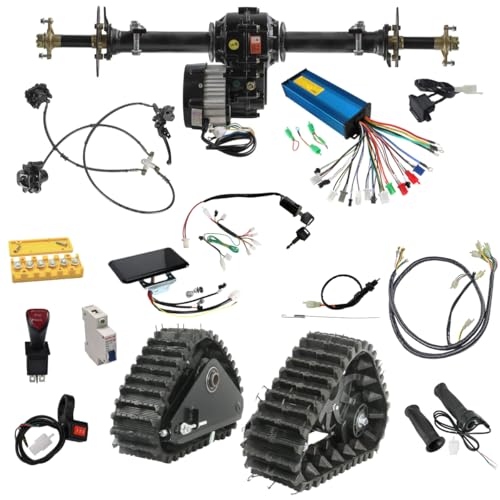
The 34-inch axle kit stands apart by bundling a 48V 1000W brushless motor, controller, LCD, throttle, brake and wiring, plus snow-and-sand tracks. The maker says the chrome axle supports over 500 pounds, and the motor has three speed modes. That makes the package relevant to a go-kart conversion that also needs electric drive and rough-surface traction, rather than a simple axle replacement. Its motor and track package may be unnecessary for a conventional kart drivetrain, and the axle’s spline or connection format should be confirmed against the intended build.
Bottom line: Choose this for a conversion that needs an electric motor and track-equipped drive package.
How to choose a go kart differential axle kit
Start with the connection points, not the package name: axle length, spline or keyway, hub interface, sprocket position and brake mounting all affect whether an axle fits. A differential allows the two drive wheels to rotate at different speeds through a turn, while a solid axle couples their speed and can scrub the inside tire. Measure the frame’s bearing-center span and compare it with the axle’s usable length; overall shaft length alone does not establish the required hub spacing. For a six-tooth spline shaft, match the mating component’s spline count and dimensions rather than assuming a general kart standard. Pick a complete assembly only if its suspension and brake components suit your chassis.
Differential versus solid axle for a kart
A differential is useful when a kart needs left and right drive wheels to turn at different speeds during a corner; a solid axle instead turns both wheels together. That difference matters most in tight turns, where the inside wheel follows a shorter path and can scrub against the ground if both wheels are locked to the same speed. A differential also adds gears, bearings and mounting requirements that a simple live axle does not. For a basic build that prioritizes a simple coupled rear axle, a differential may add parts without solving a need. For a heavier or more utility-oriented build, check the frame mounts and intended load path before selecting the gearbox housing.
Fit checks before installing a differential axle
Measure the kart’s bearing supports, hub spacing and wheel track before selecting an axle; these are separate dimensions, and a shaft’s overall length does not tell you where hubs or sprockets will sit. Check the spline or keyway match at each driven connection, then confirm that sprocket and brake locations align with the chassis. A six-tooth spline cannot be assumed to match every ATV or kart component. A complete CV axle and suspension package also needs mounting points that match the frame geometry. Keep the kart supported securely during drivetrain work, and never run an exposed chain, sprocket or axle where clothing or hands can reach rotating parts.
What comes with each type of axle kit
A bare axle-and-housing kit leaves more component selection to the builder, while a rear assembly can bundle suspension, hubs and braking parts; a conversion package can add motor and control hardware. The package type affects the work ahead, but bundled components still need to match the chassis and drivetrain. Use this comparison to decide which scope fits the build, then check physical interfaces before installation.
| Build need | Package direction | Check first |
|---|---|---|
| Replace axle and differential | Axle and housing | Length and spline match |
| Build rear suspension and drive | CV axle and suspension assembly | Frame mounts and brake layout |
| Add electric drive and tracks | Motorized axle package | Electrical and axle interfaces |
Frequently Asked Questions
What does a differential do on a go kart?
A differential lets the left and right drive wheels rotate at different speeds while turning. The inside wheel travels a shorter path through a corner, so allowing a speed difference can reduce tire scrub compared with a solid axle.
How do I measure a replacement kart axle?
Measure the required span between the bearing supports and separately record hub, sprocket and brake positions. An overall shaft length does not by itself establish bearing spacing or wheel track.
Can I use any six-tooth spline hub?
No; the spline count alone does not guarantee a match. Compare spline dimensions and engagement length, along with the hub’s mounting and retention method.
Why do go karts use solid axles?
A solid axle mechanically couples both rear wheels and uses fewer differential components. Its tradeoff is tire scrub in turns because the inside and outside wheels cannot rotate at different speeds.
What should I guard on a kart drivetrain?
Cover exposed chains, sprockets and rotating shafts so hands, clothing and debris cannot contact them. Keep guards secure during operation and support the kart stably before working near its drivetrain.