
HiVi-Swans OS-10: Specs and Speaker Alternatives

Choose HiVi-Swans OS-10 if you want speakers with built-in amplification; consider HiVi-Swans Oasis 140 only if you already have or plan to add an amplifier, and look at the larger powered models for a different speaker scale and connectivity mix.
We earn a commission if you buy through links on this page. As an Amazon Associate I earn from qualifying purchases. Products are compared on manufacturer specifications, not hands-on testing.
- Best overall: HiVi-Swans OS-10 – The OS-10 is the exact model named and combines active speakers with Bluetooth, optical, coaxial, and line inputs.
- Best for passive systems: HiVi-Swans Oasis 140 – The Oasis 140 is a passive pair intended for use with an amplifier or receiver.
- Best for larger rooms: HiVi-Swans H6 – The H6 pairs a 6.5-inch woofer with 3-way design and multiple wired and wireless connections.
| Product | Best for | Speaker type | Woofer | Connections | Shop |
|---|---|---|---|---|---|
| HiVi-Swans OS-10 | Powered desktop audio | Active | 4 in | Bluetooth, optical, coaxial, line | Check Price on Amazon |
| HiVi-Swans Oasis 140 | Amplifier-based setups | Passive | 4 in | Amplifier or receiver required | Check Price on Amazon |
| HiVi-Swans H6 | Larger-room listening | 3-way bookshelf monitors | 6.5 in | Wi-Fi, Bluetooth, optical, coaxial, line | Check Price on Amazon |
| HiVi-Swans M300MKII | Wireless home audio | 3-way powered | 6.5 in | Wi-Fi, Bluetooth 5.0, optical, coaxial, line | Check Price on Amazon |
HiVi-Swans OS-10 speakers and alternatives
Compare the OS-10 with related speakers by checking whether you need built-in amplification, a larger woofer, or different connections.
HiVi-Swans OS-10

Unlike the passive alternative here, the OS-10 is an active stereo speaker set, so it does not require a separate amplifier to operate. It combines Bluetooth 5.0 with optical, coaxial, and line inputs for a computer, TV, or other compatible source, plus touch controls and a remote. Each cabinet is about 7.95 inches tall, 7.48 inches long, and 5.23 inches wide. HiVi-Swans says the system provides 62 watts RMS. Its 4-inch woofer is the smallest among the powered speaker systems here, so consider a larger model if you want a bigger cabinet and woofer.
Bottom line: Pick this for a compact active stereo system with several source connections.
HiVi-Swans Oasis 140

The Oasis 140 differs from the OS-10 because it is passive and needs an amplifier or receiver to operate. Its two-way design pairs a 4-inch metal woofer with a 20 mm soft-dome tweeter, and its cabinet measures 9.25 inches tall, 5.9 inches long, and 7.8 inches wide. The model name and system design make it a related alternative, not a replacement for someone seeking powered OS-10 speakers. HiVi-Swans says the tweeter reaches frequencies up to 20 kHz. Choose it if your existing audio system has suitable speaker outputs; skip it if you need Bluetooth or amplification built into the speaker set.
Bottom line: Choose this if your system already includes an amplifier or receiver.
HiVi-Swans H6

The H6 differs from the OS-10 with a 6.5-inch woofer and a three-way driver layout, including a 50 mm midrange driver and ribbon tweeter. It offers Wi-Fi, Bluetooth aptX, optical, coaxial, line, and balanced connections, making it the broadest connection set among these options. The cabinet is 12.4 inches tall, 8.98 inches long, and 15.35 inches wide. HiVi-Swans says the system supports 24-bit/192 kHz playback and can fill up to 300 square feet. Its much larger cabinet makes it less suited to a tight desktop than the OS-10; check available shelf or stand space first.
Bottom line: Pick this for a larger setup that benefits from a three-way speaker design.
HiVi-Swans M300MKII
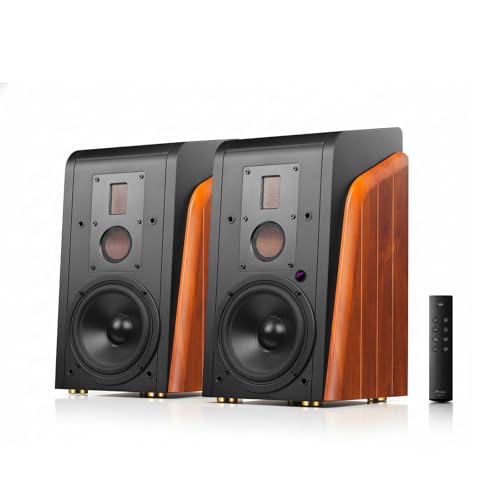
The M300MKII is a larger powered alternative with a three-way layout rather than the OS-10’s compact 4-inch format. Its drivers include a 6.5-inch woofer, 2-inch metal midrange driver, and isodynamic ribbon tweeter; supported connections include Wi-Fi, Bluetooth 5.0, optical, coaxial, line, balanced, and AUX. The cabinets measure 17.32 inches tall, 11.41 inches long, and 9.92 inches wide. HiVi-Swans says the system provides 360 watts RMS and that its ribbon tweeter reaches up to 40 kHz. This size calls for substantially more room than a desktop speaker, so measure the intended placement before choosing it.
Bottom line: Choose this for a larger powered system with Wi-Fi and many connection options.
How to choose HiVi-Swans OS-10 alternatives
Start by deciding whether you need active or passive speakers: active models include amplification, while passive speakers require an external amplifier or receiver. The OS-10 is active, and the Oasis 140 is passive, so they are not direct swaps without accounting for the rest of your setup. Next, match connections to your source: optical and coaxial are digital audio connections, while line inputs accept analog output. Bluetooth can simplify a phone connection, but wireless playback does not replace a wired input when connecting a TV or computer. For desk use, measure speaker width and height against the space beside your display; larger cabinets and woofers generally need more room to place and position well.
Speaker placement for a desk or room
Place a stereo pair at roughly equal distances from your listening position, aiming to form an approximate equilateral triangle; for near-field listening, that often means a few feet between speakers and listener. Keep the tweeters near ear height and angle the speakers slightly toward the listening spot, then adjust by listening rather than assuming one angle suits every room. A wall or corner can reinforce bass, sometimes making it sound boomy, so leave some space behind the cabinets and experiment with placement. Desk reflections from a hard surface can also color the sound; small isolation pads or stands can reduce direct contact and help raise tweeters toward ear level.
Active and passive bookshelf speakers compared
Active speakers need a source connection but do not need a separate power amplifier; passive speakers need both an amplifier and speaker wire. Choose the connection type that matches the source and system you already own, and verify that a passive speaker’s impedance and power handling suit the amplifier before connecting it. For digital TV audio, check whether the speaker accepts the TV’s output format; an optical or coaxial socket alone does not guarantee every format is supported. Use this quick decision guide before choosing a form factor.
| Need | Choose | Reason |
|---|---|---|
| No external amp | Active speakers | Amplification is built in |
| Existing stereo amplifier | Passive speakers | Use the amplifier for power |
| More cabinet and woofer scale | Larger powered monitors | Compare footprint and driver size |
Never connect passive speaker outputs directly to a line-level input, and never connect an amplifier’s speaker output to another amplifier’s input.
What woofer size means for bookshelf speakers
Woofer diameter is only one part of bass performance: cabinet volume, driver design, placement, and room acoustics also matter. A 4-inch woofer can suit close listening or a compact desk, while a 6.5-inch woofer appears in the larger alternatives here; neither size alone predicts the exact low-frequency extension or maximum clean volume. If you want strong deep bass for music or movies, a separate subwoofer may help, but confirm that the speaker and source provide a compatible connection and crossover arrangement. Measure the cabinet footprint, leave room for cables and ventilation where needed, and avoid placing a speaker where a wall or object blocks its drivers.
Frequently Asked Questions
Do the HiVi-Swans OS-10 speakers need an amplifier?
No separate amplifier is needed for the OS-10 because it is an active speaker system. The Oasis 140 is passive and requires an amplifier or receiver.
Can I connect a TV to the OS-10 speakers?
The OS-10 has optical, coaxial, and line inputs, which may match a TV’s audio outputs. Check the TV’s output type and audio format settings, since a connection socket does not guarantee format compatibility.
How far apart should bookshelf speakers sit?
A practical starting point is an approximately equilateral triangle between the left speaker, right speaker, and listening position. In near-field desk setups, that can mean a few feet between each speaker and the listener; adjust for the room and desk reflections.
Are larger bookshelf speakers always louder?
No; woofer diameter alone does not determine loudness or clean output. Amplifier capability, driver design, cabinet volume, and listening distance all affect the result, so choose by room size and placement as well as woofer size.
Can passive speakers connect directly to a computer?
Passive speakers generally need an amplifier between them and a computer’s line or headphone output. Check the amplifier’s impedance compatibility and connect the speakers to its speaker outputs, not directly to a line-level jack.