
Best Oil Based Food Coloring: 5 Sets Compared

Colour Mill Oil Blend Kickstarter Pack suits most bakers because its 12-color palette covers more shades than the other sets, and oil-dispersed color is intended for fat-rich mixtures such as chocolate and buttercream. Choose another set if you need a smaller palette or a specific combination of colors.
Oil based food coloring disperses in fat, making it useful when water-based coloring can cause chocolate to seize. Start with a small amount, mix thoroughly, and add more gradually to control the shade.
We earn a commission if you buy through links on this page. As an Amazon Associate I earn from qualifying purchases. Products are compared on manufacturer specifications, not hands-on testing.
- Best overall: Colour Mill Oil Blend Kickstarter Pack – Its 12 colors provide the broadest palette of the five sets.
- Best for 8 colors: Cakestar Oil Based Food Coloring, 8 Colors – The set includes 8 colors, including Tiffany and Lemon.
- Best for small bottles: Cherrysea Rainbow Oil Food Coloring – Seven 6 mL bottles offer a compact rainbow set.
| Product | Best for | Color count | Bottle amount | Stated uses | Shop |
|---|---|---|---|---|---|
| Colour Mill Oil Blend Kickstarter Pack | Broad color range | 12 colors | 20 mL each | Buttercream, chocolate, ganache | Check Price on Amazon |
| Cakestar Oil Based Food Coloring, 8 Colors | Distinct shades | 8 colors | 20 g each | Chocolate, candy, buttercream | Check Price on Amazon |
| Colour Mill Oil Blend Primary Pack | Primary colors | 6 colors | 20 mL each | Buttercream, chocolate, ganache | Check Price on Amazon |
| Cherrysea Rainbow Oil Food Coloring | Small bottles | 7 colors | 6 mL each | Chocolate, butter, mousse, candy | Check Price on Amazon |
| Oil Based Food Coloring, 6 Colors | Hot pink option | 6 colors | 0.7 fl oz each | Chocolate, candy melts, frosting | Check Price on Amazon |
Best oil based food coloring sets
Compare the color palettes and intended uses to find a set that suits the fats and shades in your recipes.
Colour Mill Oil Blend Kickstarter Pack

The 12-color assortment gives this set a wider palette than the other options, including baby pink, hot pink, forest, lime, sky blue and chocolate. Each bottle contains 20 mL. The oil-dispersed formula is intended for buttercream, Swiss meringue, chocolate, cake batter, ganache and fondant, so it suits bakers who want colors for several fat-rich recipes in one set. The maker identifies it as vegan and allergen-free. Its limitation is the larger palette: if you only need a few basic colors, some shades may go unused.
Bottom line: Choose this set when you want the widest range of colors for varied baking projects.
Cakestar Oil Based Food Coloring, 8 Colors

The Tiffany shade sets this eight-color assortment apart from the basic palettes, alongside black, royal blue, red, lemon, green, orange and purple. Each bottle contains 20 g, and the maker says the formula blends with butter, fat and oil based ingredients. Stated uses include chocolate, candy and buttercream, making this a fit for decorators who want a distinctive blue-green option. The set is described as vegan, gluten-free, kosher, halal and nut-free. Shake well before use; the palette has fewer colors than the 12-color assortment.
Bottom line: Pick this set if Tiffany is a useful addition to your chocolate and frosting colors.
Colour Mill Oil Blend Primary Pack

The six-color primary assortment focuses on black, green, orange, red, royal and yellow rather than the broader selection in the larger Colour Mill pack. Each bottle contains 20 mL. The maker identifies buttercream, Swiss meringue, chocolate, cake batter, ganache and fondant as suitable uses, so the palette covers several common decorating and baking tasks. It is vegan and allergen-free. The tradeoff is the limited shade selection: this set does not include pink, purple or sky blue, so it is less suited to projects that call for those hues.
Bottom line: Choose this palette for the six named colors without adding more shades than you need.
Cherrysea Rainbow Oil Food Coloring
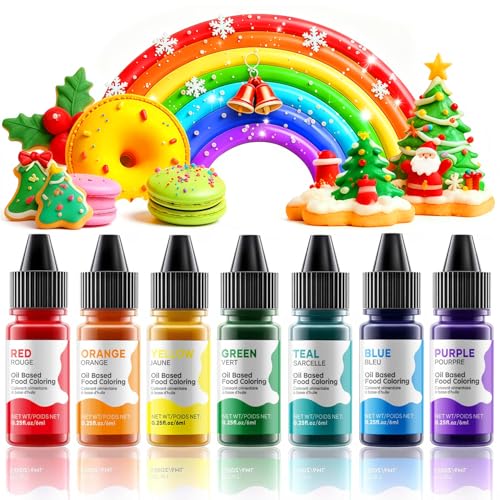
Seven 6 mL bottles make this the smallest bottle format among these options, with red, orange, yellow, green, teal, blue and purple. The maker says the oil based dye is designed for chocolate, butter, mousse and candy, and describes it as vegan and gluten-free. The compact rainbow selection suits occasional decorating or projects that need a range of hues in smaller amounts. Its main limitation is bottle volume: frequent bakers or anyone coloring large batches may prefer a set with 20 mL bottles.
Bottom line: Pick this set for a compact rainbow palette and occasional small-batch use.
Oil Based Food Coloring, 6 Colors

Hot pink distinguishes this six-color set from the other basic palettes; it also includes black, red, yellow, royal blue and green. Each bottle contains 0.7 fl oz. The maker says the concentrated formula blends with chocolate, almond bark and other fat-based ingredients, and lists frosting and baking decoration among its uses. It is described as vegan, gluten-free, nut-free and dairy-free. This set may not suit decorators who need a wider range of colors or more specialized shades such as teal or Tiffany.
Bottom line: Choose this set when hot pink is more useful than a larger assortment of shades.
How to choose oil based food coloring
Choose an oil based color when the recipe has a fat-rich base, such as chocolate, candy melts, ganache or buttercream. Water-based drops can make melted chocolate seize, so use a color formulated to disperse in fats instead. Start with a small amount, mix it fully, then add more in small increments; concentrated colors can deepen quickly, and the shade may look different before it is evenly mixed. For a project requiring several precise shades, compare the palette before choosing: a 12-color set offers more ready-made options than a six-color set. A measurable rule: if your recipe needs more than six distinct colors, select a set with at least seven colors rather than relying on color mixing.
Using oil color in chocolate and candy
Oil based color is intended to blend into fat, but it does not replace chocolate tempering or a candy recipe’s temperature control. Melt chocolate gently and keep utensils and bowls dry; even a small amount of water can cause chocolate to seize. Add coloring in drops, stir until the color is uniform, and stop when the shade is reached. For candy melts, check the maker’s directions for the specific product because formulas vary. A useful decision rule is to test the shade in a small portion before coloring the full batch, especially when matching a target color. Avoid adding water to thin colored chocolate; use a compatible fat-based ingredient if the recipe permits.
Oil based, gel and liquid colors compared
Oil based colors are suited to fat-based mixtures, while standard water-based liquid colors work more naturally in water-based batters and icings. Gel colors are more concentrated than many liquid colors and are commonly used in frosting and batter, but their compatibility with chocolate depends on the product formulation. Use this quick guide to match coloring type to the mixture rather than assuming one dye works everywhere.
| Color type | Typical fit | Decision cue |
|---|---|---|
| Oil based | Chocolate, candy, fat-rich mixtures | Choose when water could seize the mixture |
| Water-based liquid | Drinks, batters, water-based icing | Choose when the recipe can accept added liquid |
| Gel | Frosting and many batters | Check chocolate compatibility on the label |
Do not treat all products called food coloring as interchangeable: the carrier matters as much as the shade.
How to store and handle food coloring
Keep food coloring containers closed between uses and prevent crumbs, batter or wet utensils from entering the bottle. Contamination can shorten the usable life of food products, while clean, dry tools help preserve the colorant. Before each use, check whether the product calls for shaking; one set in this comparison specifically says to shake well. Store coloring as its maker directs, away from heat and direct sunlight, and discard it if the container is damaged or the product changes noticeably in smell or appearance. For food safety, use only edible coloring intended for food, and keep bottles out of reach of young children so they cannot be mistaken for craft supplies.
Frequently Asked Questions
Can oil based food coloring color melted chocolate?
Yes, oil based coloring is intended for fat-rich mixtures such as chocolate. Add a small amount and mix fully before adding more, since the shade can deepen quickly.
Why does water make melted chocolate seize?
Water can make melted chocolate tighten into a thick, grainy mass instead of remaining fluid. Keep bowls and utensils dry, and choose a color formulated for chocolate rather than adding water-based drops.
How much oil based coloring should I add?
Begin with a few drops, mix thoroughly, then increase the amount gradually until the shade is right. For a large batch or a precise color match, test the color in a small portion first.
Can I use oil based color in buttercream?
Yes, the Colour Mill sets in this comparison name buttercream as a use. Add the color gradually and mix until even, because concentrated coloring can make a shade stronger with each addition.
Should I shake oil based food coloring before use?
Shake a bottle when its maker directs; the Cakestar set specifically says to shake well before use. Close containers after dispensing and use a clean, dry utensil to avoid introducing food or moisture.