
Battery Terminal Multiple Connections: 3 Options Compared

For battery terminal multiple connections, LIFSHP 11-Way Battery Terminals offers the most connection points, with 11 positions for cables and accessory leads. Choose SUNMORN Multi-Port Battery Terminals instead for its 150A continuous rating, or Vgate 8-Way Lead-Acid Terminals if you need a mix of cable holders and threaded studs; all three are multi-port terminals for lead-acid battery connections.
We earn a commission if you buy through links on this page. As an Amazon Associate I earn from qualifying purchases. Products are compared on manufacturer specifications, not hands-on testing.
- Best overall: LIFSHP 11-Way Battery Terminals – Its 11 connection points provide four large cable holes, four top studs and three bottom studs.
- Best for 150A-rated circuits: SUNMORN Multi-Port Battery Terminals – It is rated for up to 150A continuous current and accepts 0 to 10 AWG wire.
- Best for mixed cable connections: Vgate 8-Way Lead-Acid Terminals – Its eight-way layout combines four hole-holders with four threaded studs.
| Product | Best for | Connection points | Cable range | Material | Shop |
|---|---|---|---|---|---|
| LIFSHP 11-Way Battery Terminals | More connection points | 11 | 8 AWG–4/0 AWG | 6061 aluminum | Check Price on Amazon |
| SUNMORN Multi-Port Battery Terminals | Rated current capacity | Multiple ports | 0–10 AWG | Nickel-plated zinc alloy | Check Price on Amazon |
| Vgate 8-Way Lead-Acid Terminals | Mixed cable and stud connections | 8 | 8 AWG–4/0 AWG | — | Check Price on Amazon |
Battery Terminals for Multiple Connections
Match the post style and cable sizes first, then choose the connection layout that suits your wiring.
LIFSHP 11-Way Battery Terminals

With 11 connection points, this pair has more separate attachment positions than the other options here. Its layout provides four 2/0 AWG cable holes, four 8 mm top studs and three 6 mm bottom studs. The red and blue anodized 6061 aluminum terminals are intended for SAE tapered-post lead-acid batteries, and the hinge-style tightening head is designed to secure the terminal at the post. Choose this layout when you need several accessory connections and have room for the taller 3.32-inch body. Its 2/0 AWG cable holes may not accommodate a 4/0 AWG cable.
Bottom line: Choose this pair when the number and mix of connection points matter more than accommodating the largest cable.
SUNMORN Multi-Port Battery Terminals
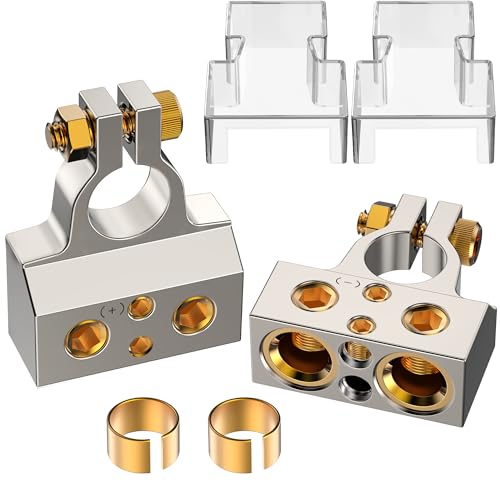
Unlike the larger cable-holder formats, these terminals are built around wire ports for 0 to 10 AWG leads and are rated for up to 150A continuous current. The nickel-plated zinc alloy pair includes clear plastic covers and an Allen wrench, with SAE/JIS Type A post compatibility. That makes it a candidate for accessory wiring where the connected leads fall within its gauge range. The 150A rating does not replace circuit protection: each accessory circuit still needs a fuse matched to its wiring and load. Keep tightening torque at or below 50 in-lb to avoid damaging the connector.
Bottom line: Choose this set for several smaller accessory wires and a continuous-current rating.
Vgate 8-Way Lead-Acid Terminals

The eight-way arrangement splits its connection points between four hole-holders and four threaded studs, rather than using the 11-position layout of LIFSHP 11-Way Battery Terminals. The set is specified for SAE, DIN and EN tapered top posts and lead-acid batteries, including AGM, GEL and wet types. Its cable range reaches 4/0 AWG, and the included holders comprise two 2/0 AWG and two 1/0 AWG positions. Choose this style when a combination of cable holders and studs suits your wiring better. It is not intended for JIS pencil posts; lithium battery use requires a compatible stud-to-post adapter.
Bottom line: Choose this option for a lead-acid tapered-post battery when its mix of four holders and four studs fits your cables.
How to Choose a Multi-Connection Battery Terminal
Choose by post style, cable gauge and connection layout, in that order. SAE tapered posts are not the same as JIS pencil posts, and clamp compatibility should be confirmed before selecting a terminal; a loose or mismatched clamp can make an unreliable connection. Cable gauge is a size designation, with smaller AWG numbers indicating thicker wire: 4/0 AWG is larger than 2/0 AWG, which is larger than 10 AWG. Count each cable and stud connection you actually need, including the main battery lead, before choosing a layout. A terminal’s current rating applies to the terminal, not automatically to every attached wire or device; size fuses to protect each branch circuit and its wire.
Battery Post Fit and Cable Sizes
Battery terminal fit depends on both the post profile and the cable connection, so matching only the battery voltage is not enough. SAE tapered posts are a common automotive style; DIN and EN tapered posts are closely related standards, while JIS pencil posts are narrower and need a specifically compatible clamp. Cable entries also vary: a hole-holder accepts a cable end sized to that opening, while a threaded stud needs a ring terminal with a matching hole. Before installation, compare the battery’s post type with the terminal’s fit and check every cable against the terminal’s supported gauge and opening. Do not force an oversized cable into a smaller holder or use a loose ring terminal on a stud.
Plan Accessory Wiring and Circuit Protection
Every added battery lead creates another circuit to plan, not just another place to attach a wire. Automotive accessory wiring should use an appropriately sized fuse near the battery connection so a short in the lead is protected; match the fuse to the wire’s safe capacity and the accessory’s draw. A terminal’s current rating is not a substitute for branch fuses, and adding several loads can exceed the battery connection or cable capacity even when each accessory works alone. Draw a simple connection plan before assembly, labeling positive and negative leads and reserving a connection for the main cable. Keep exposed positive metal from contacting the vehicle chassis or tools.
Safe Installation and Corrosion Care
Disconnect the negative battery cable first and reconnect it last when working on a typical negative-ground vehicle; that sequence reduces the chance that a tool touching the chassis will short the positive post. Remove jewelry and keep metal tools from bridging the battery terminals, because a lead-acid battery can deliver very high fault current. Clean post and clamp contact surfaces before tightening, and secure each cable so vibration does not pull sideways on the post. Check connections periodically for looseness, corrosion or heat damage, especially in marine and off-road environments. Do not over-tighten a connector: excess force can damage the clamp, threads or battery post.
Frequently Asked Questions
Can I put several accessory wires on one battery terminal?
Yes, if the terminal provides enough separate, correctly sized connection points. Fuse each accessory lead near the battery and size its wire and fuse for the load.
How do I know whether a terminal fits my battery post?
Match the terminal’s post type to the battery: SAE tapered posts, DIN/EN tapered posts and JIS pencil posts are not interchangeable by assumption. A clamp that does not seat securely should not be tightened harder to compensate.
What does a 4/0 AWG cable rating mean?
4/0 AWG is a very large cable size; in the AWG system, a smaller number means a thicker conductor. Check both the supported gauge and the actual cable opening, since a terminal may support some cable sizes but not every connection position.
Should every battery accessory have its own fuse?
Each separate accessory circuit should have overcurrent protection sized for its wire and load. Put the fuse close to the battery source so the lead is protected if it shorts.
Which battery cable should I disconnect first?
On a typical negative-ground vehicle, disconnect the negative cable first and reconnect it last. This helps reduce the chance of a wrench touching the chassis and creating a short while working on the positive terminal.