
Dough Sheeter for Home: 5 Manual Models Compared

For most home kitchens, 40.6-Inch Foldable Manual Sheeter is the strongest fit because it folds to 19.7 by 11.8 inches and adjusts across 56 thickness settings. Choose a narrower board if counter space is tight, or a fixed-frame model if folding storage is not a priority.
These are hand-cranked sheeters: rollers press dough to a controlled thickness without a motor. Before choosing a large-frame model, measure both the counter space available during use and the cabinet space available for storage.
We earn a commission if you buy through links on this page. As an Amazon Associate I earn from qualifying purchases. Products are compared on manufacturer specifications, not hands-on testing.
- Best overall: 40.6-Inch Foldable Manual Sheeter – It folds to 19.7 by 11.8 inches and offers 56 settings across a 0–25 mm range.
- Best for narrow boards: 12-Inch Folding Manual Sheeter – Its 12-inch format is the narrowest size among these options.
- Best for fixed setup: Fixed-Frame Manual Sheeter – Its fixed stainless steel frame has a carrying handle and 0–25 mm adjustment.
| Product | Best for | Stated size | Thickness range | Storage design | Shop |
|---|---|---|---|---|---|
| 40.6-Inch Foldable Manual Sheeter | Compact storage | 40.6 × 22.8 in | 0–25 mm | Folds to 19.7 × 11.8 in | Check Price on Amazon |
| 40.5-Inch Foldable Sheeter | Fine adjustments | 40.5 × 22.8 in | 0–25 mm | Folds to 19.7 × 11.8 in | Check Price on Amazon |
| Fixed-Frame Manual Sheeter | Fixed placement | 40.6 in; other dimensions not given | 0–25 mm | Fixed frame; carrying handle | Check Price on Amazon |
| 15.5-Inch Folding Sheeter | 15.5-inch board | 15.5 in board; 40.5 × 22.8 × 9.8 in overall | 55 options; range not given | Folding | Check Price on Amazon |
| 12-Inch Folding Manual Sheeter | Narrow working width | 12 in | 0–25 mm | Foldable | Check Price on Amazon |
Dough Sheeters for Home
Compare the frame style and stated dimensions with the counter and storage space you can dedicate to rolling dough.
40.6-Inch Foldable Manual Sheeter

The fold-down footprint makes this a practical pick when a home kitchen needs a large working setup that can be put away afterward. It measures 40.6 by 22.8 inches when open and folds to 19.7 by 11.8 inches. The manual crank needs no electricity, and the maker says dual-side controls offer 56 thickness settings across 0–25 mm. It is aimed at doughs including pizza, croissants, pasta and pie crust. The main limitation is its open footprint: a small counter may not have enough clear space to operate it comfortably.
Bottom line: Choose this if you want a foldable large-frame sheeter and can clear its open footprint.
40.5-Inch Foldable Sheeter

The maker emphasizes fine thickness adjustment: the knob provides 56 settings in 0.5 mm increments across a 0–25 mm range. The frame opens to 40.5 by 22.8 inches and folds to 19.7 by 11.8 inches, so it combines a large operating setup with a smaller storage footprint. Food-contact parts are stainless steel, while the frame is high-strength alloy. This suits bakers who want incremental adjustment for different doughs. Its adjustment increments do not establish the roller width, so anyone needing a particular sheet width should confirm that measurement before ordering.
Bottom line: Pick this for fine thickness increments and foldable storage.
Fixed-Frame Manual Sheeter
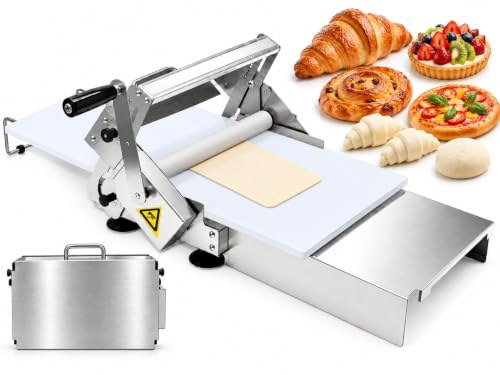
The fixed-frame with a carrying handle sets this model apart from the foldable machines. Its 0–25 mm adjustment and approximately 56 settings suit a range of doughs, including pasta, crepes, pastries, dumpling wrappers, pizza and cookies. Dough-contact parts are food-grade stainless steel, and the frame is high-strength alloy with an electroplated exterior. This option fits a kitchen that can leave a sheeter set up or store a rigid frame. The size notation gives only one dimension, so confirm the full counter footprint before choosing it for a tight work area.
Bottom line: Choose this if you prefer a fixed-frame and can accommodate its full footprint.
15.5-Inch Folding Sheeter

The 15.5-inch board gives this model a defined working width, unlike the larger-frame options whose titles emphasize overall machine dimensions. It has 55 thickness options and is described for pizza, croissants, puff pastry, fondant, tortillas and laminated dough. Its overall dimensions are 40.5 by 22.8 by 9.8 inches, and the product is identified as folding. This may suit a baker who wants the specified board width for pastry work. The adjustment range is not given, so it is harder to match precisely to a target dough thickness.
Bottom line: Choose this if a 15.5-inch board suits your batches and workspace.
12-Inch Folding Manual Sheeter

The 12-inch size is the narrowest format here, which can make it easier to plan around a compact prep area or smaller batches. It is a foldable manual roller with 0–25 mm thickness adjustment, and the maker identifies it for home kitchens and small bakeries. The specifications describe stainless steel construction and food-contact-safe rollers. A narrower board means less dough width per pass than a wider board; bakers working with broad pastry sheets may need to divide dough or make additional passes.
Bottom line: Pick this for a 12-inch working format and smaller batches.
How to choose a home dough sheeter
Choose by working width, adjustment range and storage footprint, not by the number of recipes named. A wider board handles broader sheets in fewer passes, while a narrower board is easier to fit into a small prep area. The 0–25 mm range on several models covers substantial variation, but the thinnest setting and the finest adjustment step are separate measures: a range alone does not tell you how precisely the gap changes. Check that distinction if you need repeatable pastry thickness. Measure the machine open and folded, and leave room for the hand crank to turn and for dough to feed straight through the rollers. A countertop footprint that fits on paper may still be awkward if it crowds a wall or sink.
Working width and counter fit
Working width determines how wide a sheet can pass through in one run, while overall machine length and width determine whether the frame fits your counter. The 12-inch and 15.5-inch board sizes are useful width clues; dimensions around 40 inches describe a much larger machine footprint, not necessarily roller width. Measure the clear counter area in both directions, then leave space to guide the dough and turn the crank without striking nearby objects. If you have less than 24 inches of clear depth, a frame listed at roughly 22.8 inches deep may leave too little operating room; measure the actual setup before choosing it. For storage, measure the folded machine rather than assuming it will fit a drawer or cabinet.
Use this distinction to match the format to the work area.
| Need | Format to consider | Tradeoff |
|---|---|---|
| Smaller batches | 12-inch board | Narrower sheet per pass |
| Defined mid-size width | 15.5-inch board | Adjustment range is not given |
| Large work surface with compact storage | Foldable large frame | Needs substantial counter space open |
| Fixed setup | Rigid frame | Does not fold for storage |
Manual sheeter use and dough handling
Feed dough through the rollers in manageable portions and keep hands clear of the roller gap and gears while turning the crank. A hand-cranked machine has no motor, but the rollers still create pinch points. Dusting the dough and work surface lightly with flour can help reduce sticking; excess flour can make layered dough dry and harder to seal. For laminated pastry, keep the butter and dough cool enough to remain firm rather than letting the butter soften and smear during repeated passes. Begin with a wider roller gap and reduce thickness in stages instead of forcing a thick piece through a narrow setting. That approach also makes it easier to spot tearing, sticking or uneven edges before the sheet becomes too thin.
Cleaning and storage between baking sessions
Clean a dough sheeter after each session, because dried dough in the roller gap or gear area can interfere with smooth feeding. Brush or scrape away loose flour and dough first, then wipe food-contact surfaces with a damp cloth and dry them thoroughly; avoid soaking a geared or metal mechanism. Do not assume a machine is dishwasher-safe unless its maker specifically says so. Store a foldable frame only after it is dry, and secure any moving parts before carrying it. A fixed-frame unit needs a stable, dry storage spot where its handle and exposed rollers will not be knocked or contaminated. Keep the appliance away from children during use, especially while the crank and rollers are moving.
Frequently Asked Questions
How wide should a home dough sheeter be?
Choose a width based on the sheet size you regularly need and the counter space available. A 12-inch board makes a narrower sheet per pass than a 15.5-inch board, so larger pastries may require more passes or smaller portions.
Can a manual dough sheeter roll pasta dough?
Yes, manual sheeters can roll pasta dough when the dough is portioned and fed through the rollers without forcing it. A 0–25 mm range is broad, but check whether the machine has a suitably thin setting for the pasta you make.
Why does dough stick to sheeter rollers?
Dough commonly sticks when it is too moist, warm, or insufficiently dusted. Use a light flour coating and keep laminated dough cool; heavy flouring can dry the dough and affect its layers.
How much counter space does a folding sheeter need?
Allow room for the entire open frame plus clearance to turn the crank and guide dough. A frame about 40.6 by 22.8 inches already occupies most of a typical counter depth, so measure the actual work area before setting it up.
How do you clean a manual dough sheeter?
Brush off loose flour and dough, wipe food-contact parts with a damp cloth, and dry them fully after each use. Keep water away from gears and joints unless the maker specifically allows wet cleaning.