
Best Ankle Straps for Cable Machine: 4 Compared

FITGIRL 8 mm Ankle Strap suits most cable-machine users because its 8 mm padding, nylon construction and steel D-rings support common lower-body cable exercises. Choose Fitgriff V1 Ankle Straps, 2-Piece instead if you want a pair for switching between ankles, or DMoose Padded Single Ankle Strap if you prefer its compact single-cuff dimensions.
Ankle straps are padded cuffs that connect an ankle to a cable attachment for exercises such as kickbacks and leg curls; match the strap’s closure and fit to your ankle before loading the cable.
We earn a commission if you buy through links on this page. As an Amazon Associate I earn from qualifying purchases. Products are compared on manufacturer specifications, not hands-on testing.
- Best overall: FITGIRL 8 mm Ankle Strap – Combines 8 mm padding, nylon, reinforced stitching and steel D-rings in one cuff.
- Best for a pair: Fitgriff V1 Ankle Straps, 2-Piece – Includes two cuffs with double D-rings and reinforced seams.
- Best for compact sizing: DMoose Padded Single Ankle Strap – A single padded cuff measures 10 inches long and 4 inches high.
| Product | Best for | Padding | Pack size | Construction | Shop |
|---|---|---|---|---|---|
| FITGIRL 8 mm Ankle Strap | Padded single cuff | 8 mm | 1 cuff | Nylon; steel D-rings | Check Price on Amazon |
| DMoose Padded Single Ankle Strap | Compact single cuff | 8 mm | 1 cuff | Nylon; neoprene padding | Check Price on Amazon |
| Fitgriff V1 Ankle Straps, 2-Piece | Pair for transitions | — | 2 cuffs | Reinforced seams; double D-rings | Check Price on Amazon |
Ankle Straps for Cable Machine Workouts
Compare padding, pack contents and construction to find the cuff that fits your lower-body routine.
FITGIRL 8 mm Ankle Strap

FITGIRL 8 mm Ankle Strap stands out for pairing 8 mm cushioning with steel D-rings in a single cuff. Its nylon body and reinforced stitching suit cable kickbacks, leg extensions, hip abductions, lunges and hamstring curls. The single-cuff format is useful when you train one side at a time, but it does not provide a second cuff for alternating sides without changing the attachment. Check that the cuff’s closure secures comfortably around your ankle before increasing cable resistance; a strap that shifts can distract from controlled movement.
Bottom line: Choose this if you want a padded, reinforced single cuff with steel D-rings.
DMoose Padded Single Ankle Strap
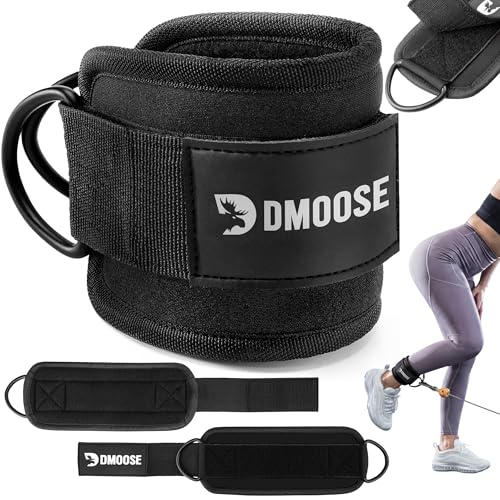
DMoose Padded Single Ankle Strap is a single cuff with 8 mm neoprene padding and a 10-inch length, making its dimensions the clearest distinction from the other one-cuff options. The brand says its nylon construction uses precision stitching, and it is intended for cable kickbacks, glute work and leg extensions. Its 4-inch height may appeal to shoppers comparing cuff proportions, though measurements alone cannot establish ankle fit. Because the package contains one strap, users wanting a pair ready for both ankles should look at a two-piece option instead.
Bottom line: Pick this when a single 10-inch cuff and neoprene padding suit your setup.
Fitgriff V1 Ankle Straps, 2-Piece

Fitgriff V1 Ankle Straps, 2-Piece is the only pair in this group, providing two cuffs for faster side-to-side transitions during unilateral cable work. Its industrial-strength hook-and-loop closure, reinforced seams and double D-rings are designed around secure attachment and weight distribution. The product is suited to kickbacks, hip abduction, leg lifts and standing leg curls. A pair can also be unnecessary if you only need one ankle attachment.
Bottom line: Pick this if you want two cuffs and a hook-and-loop closure.
How to choose ankle straps for cable machines
Choose by cuff count, padding and closure before focusing on appearance. A single cuff works for one-side-at-a-time cable sets; a pair keeps a second cuff ready when alternating legs. Padding spreads contact around the ankle, while a hook-and-loop closure needs enough overlap to stay secure without pinching. D-rings connect the cuff to the cable’s clip, so check that the gym’s carabiner or cable clip fits through the rings. For ordinary lower-body training, use a controlled load that lets you keep the cuff aligned and move through the exercise without swinging. If you cannot keep the strap from slipping at the ankle, adjust it or choose a different cuff before adding weight.
Single cuff or pair for cable work
A single cuff is adequate for many unilateral movements, while a pair reduces the need to remove and reinstall the attachment between sides. Kickbacks, standing leg curls and hip abductions are commonly performed one leg at a time, so a second cuff is a convenience rather than a requirement. The table compares the available formats and the main reason to choose each.
| Format | Useful when | Trade-off |
|---|---|---|
| Single cuff | Training one side at a time | Move the cuff to switch sides |
| Pair of cuffs | Alternating sides with less setup | Second cuff may go unused |
| Cuff with tube bands | Adding band exercises | Band add-on is unnecessary for cable-only work |
Choose the pair if you plan to alternate sides repeatedly; choose a single cuff if storage and a one-at-a-time routine matter more.
How ankle straps attach to a cable machine
Cable ankle cuffs usually connect by a metal ring to a cable’s clip or carabiner, then transfer cable tension through the cuff as the leg moves. D-rings should sit at the side or front intended by the cuff design, not twisted under the ankle. Start with a light load and test a few slow repetitions before working normally; cable tension rises throughout the movement and can pull a loose cuff out of position. Keep the machine’s clip fully closed and use only the attachment points designed for the cable station. A cable machine’s own weight stack limits still apply, and the cuff should not be treated as a lifting or suspension strap.
Fit and safety checks before lower-body exercises
A properly fitted ankle cuff stays in place during a slow repetition without cutting into the skin or sliding toward the foot. Fasten hook-and-loop closures across their full intended contact area, then tug gently on the D-ring before clipping into a loaded cable. Begin with low resistance and stop if the cuff shifts, causes numbness or creates sharp pressure. Keep the cable path clear of the standing leg and avoid jerking the leg at the end of a kickback; controlled motion is easier to manage and places less sudden force on the attachment. Inspect stitching, hook-and-loop material and metal rings before use, and retire a cuff if a seam separates or a ring bends.
Frequently Asked Questions
Can I use one ankle strap for both legs?
Yes, a single cuff can be moved between legs for unilateral cable exercises such as kickbacks or standing curls. A pair is more convenient if you switch sides often and want to avoid removing and reattaching one cuff.
How tight should a cable ankle cuff be?
Fasten the cuff snugly enough that it does not slide during a slow repetition, while avoiding pinching or numbness. Recheck the closure after a few light repetitions before increasing resistance.
What exercises use cable ankle straps?
Cable ankle cuffs are commonly used for kickbacks, hip abductions, leg extensions and standing leg curls. Start with a light stack setting and keep the cable path clear of your other leg.
How do I clean padded ankle straps?
Wipe sweat from the cuff after use and let it air-dry fully before storing it. Damp padding and folded hook-and-loop closures can retain odor and wear more quickly.
How can I tell if an ankle strap is worn out?
Stop using a cuff if stitching separates, hook-and-loop material no longer holds securely or a D-ring bends. Inspect the attachment before each session, especially after repeated heavy cable use.