
DeWalt 3300 PSI Pressure Washer and Alternatives Compared

The DeWalt 3300 PSI gas pressure washer suits homeowners who want a gas-powered washer rated at 3300 PSI and 2.4 GPM. Choose a different model if you need the Simpson’s 2.5 GPM flow, the Westinghouse gas washer’s higher stated pressure and flow, or an electric unit.
A pressure washer combines water pressure with flow; nozzle choice and spray distance also affect cleaning. Gas models must be operated outdoors, never in a home or enclosed garage, because their engines produce carbon monoxide.
We earn a commission if you buy through links on this page. As an Amazon Associate I earn from qualifying purchases. Products are compared on manufacturer specifications, not hands-on testing.
- Best overall: DeWalt DXPW3300-S 3300 PSI – The homeowner-oriented gas model pairs a 3300 PSI with 2.4 GPM and includes a 25-foot hose.
- Best for higher flow: Simpson PowerShot PS3228 3300 PSI – The Simpson pairs 3300 PSI with 2.5 GPM and uses a Honda GX200 engine and triplex pump.
- Best for higher stated output: Westinghouse WPX3400 Gas Washer – The Westinghouse gas model is rated at 3400 PSI and 2.6 GPM.
- Best for electric power: Westinghouse WPX3000e Electric Washer – The electric model has 2600 rated PSI and 1.1 rated GPM, with 3000 max PSI listed separately.
| Product | Best for | Pressure and flow | Power | Pump | Shop |
|---|---|---|---|---|---|
| DeWalt DXPW3300-S 3300 PSI | Home gas cleaning | 3300 PSI; 2.4 GPM | 208cc gas engine | Axial cam | Check Price on Amazon |
| Simpson PowerShot PS3228 3300 PSI | Professional gas use | 3300 PSI; 2.5 GPM | Honda GX200 gas engine | Triplex plunger | Check Price on Amazon |
| Westinghouse WPX3400 Gas Washer | Higher gas output | 3400 PSI; 2.6 GPM | 212cc gas engine | Axial cam | Check Price on Amazon |
| Westinghouse WPX3000e Electric Washer | Electric cleaning | 2600 rated PSI; 1.1 rated GPM | 120V AC electric motor | Axial 3-piston auto-stop | Check Price on Amazon |
DeWalt 3300 PSI pressure washer and alternatives
Compare the power source, pressure and flow figures, and pump type to find the right fit for your cleaning tasks.
DeWalt DXPW3300-S 3300 PSI

The DeWalt is the only model here specifically positioned for homeowner use, with a 208cc engine and welded steel frame. DeWalt says its OEM Technologies axial cam pump delivers 3300 PSI at 2.4 GPM; the package includes a 25-foot abrasion-resistant hose, five nozzles and a spray gun. Ten-inch pneumatic tires and a 64-pound stated weight are useful considerations when moving it around a property. This gas washer is a fit for decks, patios and siding, but it is not the electric option for buyers avoiding engine exhaust or gas-engine operation.
Bottom line: Choose this for homeowner-oriented gas cleaning with a 3300 PSI and 2.4 GPM.
Simpson PowerShot PS3228 3300 PSI

The Simpson differs from the DeWalt through its Honda GX200 engine and AAA triplex plunger pump, alongside a slightly higher 2.5 GPM flow figure. Simpson specifies a maintenance-free pump with an integrated unloader and thermal relief; its 25-foot MorFlex hose has a non-marring polyurethane jacket. The 74.8-pound washer is described for contractor use and cleaning jobs such as driveways, fencing and equipment. Pick it if the engine and flow matter more than a homeowner-focused design; this gas model is explicitly not for sale in California.
Bottom line: Choose this if you prefer a Honda-powered gas washer and 2.5 GPM flow.
Westinghouse WPX3400 Gas Washer

The Westinghouse WPX3400 raises the output above the DeWalt, with a 212cc engine and an axial cam pump. Westinghouse specifies 3400 PSI and 2.6 GPM, plus a half-gallon onboard soap tank and a 25-foot abrasion-resistant hose. Its five-nozzle set includes 0°, 15°, 25°, 40° and soap tips; the 0° tip concentrates the spray, so keep it away from people, delicate finishes and fragile materials. At about 63 pounds, it is a gas alternative for buyers prioritizing the higher listed pressure and flow, not an electric-powered choice.
Bottom line: Choose this for a gas washer with the highest pressure and flow among these options.
Westinghouse WPX3000e Electric Washer
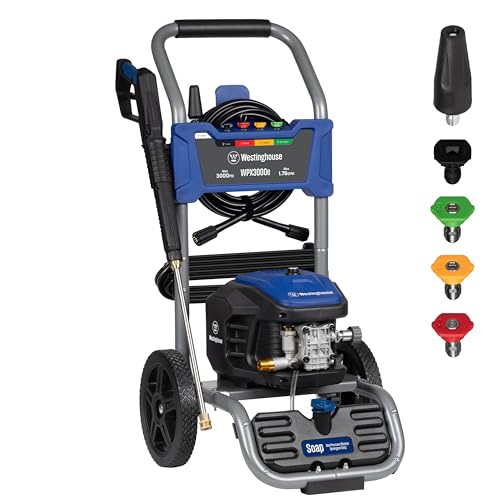
The Westinghouse WPX3000e is the only electric model in this group, with a 120V AC induction motor and a steel frame. Its key comparison figures are 2600 rated PSI and 1.1 rated GPM; the separate 3000 max PSI and 1.76 max GPM figures are maximum ratings, not its rated output. Westinghouse includes a 0.45-gallon soap tank, 25-foot hose and five nozzles, including turbo. Choose it when electric power is the priority; its rated flow is below the gas models’ stated flow figures.
Bottom line: Choose this if you want electric power and understand its rated output differs from its maximum figures.
How to choose a 3300 PSI pressure washer
Compare rated pressure and water flow together: PSI measures pressure, GPM measures volume, and multiplying the two gives cleaning units. That product is a comparison aid, not a guarantee of cleaning speed; nozzle pattern, distance, soil and surface all change the result. Gas models here range from 2.4 to 2.6 GPM, while the electric model’s rated flow is 1.1 GPM, so compare rated figures rather than a maximum rating against a working rating. For routine home cleaning, favor a wider nozzle and lower impact before reaching for a concentrated spray.
Choose power by work location and runtime needs. Gas pressure washers must run outdoors because small engines produce carbon monoxide; never operate one in a home or enclosed garage. Electric washers avoid engine exhaust but require a suitable outlet and cautious cord handling around water. A 25-foot hose is included on the gas options and the electric option here, but hose routing and access to water still affect how easily a job can be reached.
| Need | Compare |
|---|---|
| Gas work | Rated flow, engine and hose reach |
| Electric work | Rated PSI and rated GPM |
| Delicate surface | Wide spray and test distance |
Choosing a nozzle for the surface
Nozzle angle changes how concentrated the spray is: a 0-degree tip creates a narrow, forceful stream, while 25- and 40-degree tips spread water across a wider area. Use a wider pattern for painted siding, vehicles and other finishes, and test an inconspicuous spot before cleaning the full surface. A turbo nozzle rotates a concentrated jet to cover more area, but it is still too aggressive for delicate materials. Keep the spray pointed away from people, animals, windows and electrical equipment, and never use a pressure washer to clean skin.
Distance is a practical control: begin several feet from the surface, keep the wand moving, and move closer only if the material tolerates it. A narrow jet can gouge soft wood, strip paint or force water behind siding. Soap tips are for applying detergent at lower pressure; switch to a rinse nozzle for washing it away. Do not assume every nozzle is safe for every job just because it fits the quick-connect coupling.
Rated pressure, maximum pressure and flow
Rated output is the useful basis for comparison because maximum figures describe peak capability rather than the washer’s regular working output. The electric Westinghouse is rated at 2600 PSI and 1.1 GPM, while its separate maximum figures are 3000 PSI and 1.76 GPM. The gas models list pressure and flow figures of 3300 PSI at 2.4 or 2.5 GPM and 3400 PSI at 2.6 GPM. Compare pressure and flow as a pair, and do not treat a higher PSI alone as proof that a machine is the better fit.
Cleaning units, often written as PSI multiplied by GPM, summarize pressure and volume in one number, but the calculation does not account for surface sensitivity, nozzle angle or detergent. A surface cleaner attachment can help cover broad flat areas more evenly than a wand, while a narrow nozzle is better reserved for durable, localized grime. Accessory fittings matter too: the WPX3400 and WPX3000e specify M22 compatibility, so verify attachment fit before adding accessories.
Safe setup and storage for gas washers
Gas pressure washers belong outdoors and on stable ground; exhaust can contain carbon monoxide, an odorless gas that can become deadly in enclosed or partly enclosed spaces. Keep the machine away from doors, windows and air intakes, and never run it in a garage even with the door open. Wear eye protection and closed-toe footwear, keep bystanders clear of the spray, and point the wand away before starting or changing accessories.
Water left under pressure can stress the hose and connections, so shut the washer down and release pressure from the trigger before disconnecting equipment. Follow the engine and pump maintenance schedule for oil checks, air-filter service and winterization; many pumps can be damaged by freezing water. If storage temperatures can fall below freezing, drain the pump and hose or use the manufacturer’s winterizing procedure. Keep fuel handling outdoors and away from flames, hot surfaces and smoking.
Frequently Asked Questions
What do PSI and GPM mean on a pressure washer?
PSI measures pressure and GPM measures water flow. A washer’s cleaning-unit figure is calculated by multiplying PSI by GPM, but surface and nozzle choice still determine how forcefully the spray acts on a material.
Is 3300 PSI safe for washing a car?
A concentrated pressure-washer jet can damage paint, trim or seals even when the machine is marketed for home use. Use a wide-angle nozzle, keep the spray moving, start several feet away and test a hidden area before cleaning the vehicle.
Can a gas pressure washer run in a garage?
No: operate a gas pressure washer outdoors, not in a garage or other enclosed space. Small gas engines produce carbon monoxide, which can build up to dangerous levels indoors.
What does rated PSI mean compared with maximum PSI?
Rated PSI is the washer’s operating pressure, while maximum PSI is a peak figure and should not be treated as the regular working rating. Compare rated PSI and rated GPM when both are provided, as on the WPX3000e.
How far away should a pressure washer nozzle be?
There is no single safe distance for every nozzle and surface; a narrow spray at close range can gouge wood or damage finishes. Start several feet away with a wider pattern, test an inconspicuous spot and move closer only if the surface tolerates it.