
Quansheng UV K5 8: Models Compared by Kit and Charging

For most buyers, Quansheng UV-K5(8)/K6 V3 is the clearest starting point: it identifies the UV-K5(8)/K6, supports CHIRP and includes USB-C among its features. Choose Quansheng UV-K5(8) Two-Radio Kit instead if you need two radios and 1600mAh batteries; Quansheng UV-K6 USB-C Powered suits cable-powered use because it must stay connected to USB-C.
The UV-K5(8) is a handheld dual-band radio family, but similar model names do not establish identical firmware, frequency coverage or kit contents. Before transmitting, verify the radio’s configuration and your authorization for the frequency and service you plan to use.
We earn a commission if you buy through links on this page. As an Amazon Associate I earn from qualifying purchases. Products are compared on manufacturer specifications, not hands-on testing.
- Best overall: Quansheng UV-K5(8)/K6 V3 – Identifies the UV-K5(8)/K6, supports CHIRP and includes USB-C among its features.
- Best for two radios: Quansheng UV-K5(8) Two-Radio Kit – Includes two radios, two 1600mAh batteries and two USB-C cables.
- Best for cable-powered use: Quansheng UV-K6 USB-C Powered – Its USB-C charging setup requires the cable to remain connected.
| Product | Best for | Radio count | Battery and charging | Shop |
|---|---|---|---|---|
| Quansheng UV-K5(8)/K6 V3 | CHIRP programming | 1 radio | USB-C; battery capacity — | Check Price on Amazon |
| Quansheng UV-K5(8)/UV-K6 200-Channel | Keypad programming | 1 radio | Rechargeable; Type-C and charging base | Check Price on Amazon |
| Quansheng UV-K5(8) Two-Radio Kit | Two-radio teams | 2 radios | 2 × 1600mAh; USB-C cables | Check Price on Amazon |
| Quansheng UV-K6/UV-K5(8) 5W | Simple 5W option | 1 radio | Type-C charging; battery capacity — | Check Price on Amazon |
| Quansheng UV-K6 USB-C Powered | Tethered operation | 1 radio | USB-C cable must stay connected | Check Price on Amazon |
Quansheng UV K5 8 Radios
Compare the included radios, power arrangements and channel claims before choosing a UV-K5(8) or UV-K6 package.
Quansheng UV-K5(8)/K6 V3

CHIRP support is the distinguishing practical feature of this UV-K5(8)/K6 V3 option. The functions also include cross-band intercom, aviation-band reception, NOAA weather reception, frequency metering and channel copying, so it can suit an owner who wants multiple radio functions alongside computer programming. Its dimensions are 115 × 60 × 37.5 mm, with a weight of 0.88; the weight unit is not given, so compare size rather than weight when planning carry space.
Bottom line: Choose this if CHIRP support and a compact stated size matter more than a specified battery capacity.
Quansheng UV-K5(8)/UV-K6 200-Channel
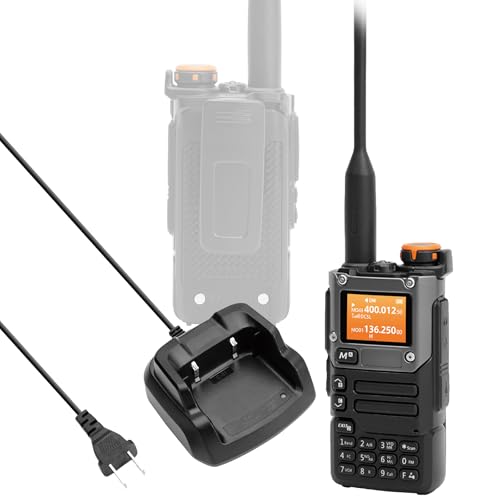
This UV-K5(8)/UV-K6 option emphasizes keypad programming and channel-management functions, including scan, channel add and a one-key call channel. Its maker gives 200 channels, while the product name says 128, so treat channel capacity as something to confirm before relying on a fixed memory count. It also lists VOX, dual-band display, CTCSS/DCS and CHIRP support, making it a possible fit for someone comparing programming approaches. The package mentions a rechargeable battery, Type-C and a charging base, but gives no battery capacity; buyers prioritizing long intervals between charges should verify that before choosing.
Bottom line: Pick this if keypad controls and a charging base appeal, after confirming its channel count.
Quansheng UV-K5(8) Two-Radio Kit

This is the only package here that explicitly includes two radios, making it the direct choice for a pair that needs matching handhelds. The kit includes two 1600mAh batteries, two USB-C cables, two high-gain antennas and two belt clips. Its frequency ranges are 144–148MHz and 420–450MHz, and its features include DTMF, NOAA weather alarm and aviation-band reception. The main limitation is that the package is identified as a two-pack, not as proof that transmissions are automatically authorized or interoperable with every other radio; check your operating permissions and the other radio’s programmed frequencies before use.
Bottom line: Choose this when you need two radios and want the battery capacity stated.
Quansheng UV-K6/UV-K5(8) 5W

This UV-K6/UV-K5(8) option makes the 5W output and Type-C charging the clearest points of comparison. The feature set is more concise than the other packages, naming fast copying of one channel and NOAA weather alert reception alongside UHF/VHF, DTMF and FM functions. That can suit a buyer who wants a basic single-radio package without selecting for the extra features emphasized elsewhere. Its limitation is the sparse package specification: battery capacity and included accessories are not established, so it is a weaker fit if you need a defined runtime or a complete multi-radio kit.
Bottom line: Pick this if stated 5W output and Type-C charging are your main filters.
Quansheng UV-K6 USB-C Powered

This UV-K6 differs most because its USB-C power arrangement is not described as portable battery operation: the cable must remain connected while it runs. That can suit a stationary setup or an activity where a power source and cable can stay within reach. The important limitation is the tether: a cable-dependent radio is a poor match for hiking or other movement away from power. Choose it only if continuous USB connection fits the way you plan to use it.
Bottom line: Choose this for stationary use where continuous USB-C power is practical.
How to choose a Quansheng UV K5 8
Start with package needs, then compare power and programming. For two people who need separate handhelds, Quansheng UV-K5(8) Two-Radio Kit explicitly includes two radios; for computer programming, Quansheng UV-K5(8)/K6 V3 and Quansheng UV-K5(8)/UV-K6 200-Channel name CHIRP support. Channel capacity also needs care: Quansheng UV-K5(8)/UV-K6 200-Channel gives conflicting counts of 128 and 200, so confirm the version and memory count before choosing based on channel storage.
Radio output power alone does not determine usable range. Terrain, buildings, antenna placement and interference can change coverage substantially, and an unobstructed-range claim is not a guarantee in a city or indoors. If 5W output is your threshold, Quansheng UV-K6/UV-K5(8) 5W names it directly; do not treat that number as a promise of a particular distance.
Radio compatibility and legal transmitting
Matching frequency bands and channel numbers do not guarantee that two radios can communicate; both must use the same frequency, bandwidth, tone settings and compatible signaling. NOAA Weather Radio broadcasts on seven VHF frequencies from 162.400 to 162.550 MHz, and receiving those broadcasts is different from transmitting on them.
In the United States, transmitting on amateur-radio frequencies generally requires an FCC amateur license, and GMRS operation has its own licensing rules. These specifications do not establish a radio’s approval for a particular service, so confirm the radio’s authorization and configuration before transmitting. If you cannot verify both the frequency’s service rules and your authorization, use receive-only functions until you can.
USB-C, batteries and portable use
Charging connector and operating power are separate considerations: a USB-C port does not by itself establish that a radio can operate while charging or how long its battery lasts. Quansheng UV-K5(8) Two-Radio Kit specifies 1600mAh batteries, while Quansheng UV-K6 USB-C Powered requires its USB-C connection to remain attached during use.
For mobile use, favor a battery-powered package whose spare-battery or runtime needs are clear; for stationary use, a tethered device may be acceptable if the cable can stay connected without creating a snag or trip hazard. Lithium-ion radio batteries should be charged with a compatible charger and kept away from excessive heat. Do not rely on a weather-receiver function as a substitute for checking a forecast or emergency instructions.
What separates the UV-K5(8) packages
Package type changes the buying decision more than the shared model-family wording. Use this table to narrow choices by the need each package explicitly addresses; confirm channel capacity where figures conflict.
| Need | Closest match | Decision point |
|---|---|---|
| Two handhelds | Quansheng UV-K5(8) Two-Radio Kit | Includes two radios and 1600mAh batteries |
| CHIRP programming | Quansheng UV-K5(8)/K6 V3 or Quansheng UV-K5(8)/UV-K6 200-Channel | Both name CHIRP support |
| Continuous USB-C power | Quansheng UV-K6 USB-C Powered | Cable must stay connected |
| Stated 5W output | Quansheng UV-K6/UV-K5(8) 5W | 5W appears in its name and features |
UV-K5(8) and UV-K6 appear together in several package names, but buyers should not assume every firmware version or accessory is interchangeable. Confirm fit and included accessories before selecting a package for a specific antenna, charger or programming workflow.
Frequently Asked Questions
Can a Quansheng UV-K5(8) receive NOAA weather radio?
Several packages here name NOAA weather reception or weather alerts. NOAA Weather Radio uses seven VHF frequencies between 162.400 and 162.550 MHz; weather reception is not permission to transmit on those frequencies.
Do UV-K5(8) and UV-K6 radios share channels?
They can communicate only when both radios are configured for the same frequency and compatible settings. Matching channel numbers alone is insufficient because channel memories can be programmed differently.
Does a 5W handheld radio always reach three miles?
No; wattage alone cannot guarantee a range. Buildings, terrain, antenna position and interference all affect handheld radio coverage, so an unobstructed-range claim should not be treated as an urban prediction.
Can I transmit with a UV-K5(8) without a license?
The applicable US authorization depends on the frequency and radio service. Amateur-band transmitting generally requires an FCC amateur license, so verify service rules and authorization before transmitting.
What does 1600mAh mean for radio runtime?
A 1600mAh rating describes battery capacity, not a fixed number of operating hours. Transmit time, receive time, power setting and standby behavior affect runtime, so capacity alone cannot predict how long the radio will last.