
Hanging Pans on Wall: 5 Racks Compared by Fit

For hanging pans on a wall, KES 30-Inch Wall Rack suits most kitchens with its 30-inch rack, 12 hooks and mounting holes spaced for 16-inch studs. Choose a smaller rack if wall space is tight, or a two-tier organizer if you need room for lids and more cookware.
A wall-mounted pot rack keeps cookware visible and within reach; measure the wall and plan the mounting points before choosing a width.
We earn a commission if you buy through links on this page. As an Amazon Associate I earn from qualifying purchases. Products are compared on manufacturer specifications, not hands-on testing.
- Best overall: KES 30-Inch Wall Rack – Its 30-inch width, 12 hooks and 16-inch stud mounting points suit a typical cookware setup.
- Best for small walls: Felibeaco 17-Inch Shelf Rack – The 17-inch rack has eight movable hooks for a more compact setup.
- Best for cookware volume: Planimar 32-Inch Two-Tier Rack – Two tiers, 20 hooks, three lid holders and eight dividers organize more than pans alone.
- Best for a simple rail: Toplife 31.5-Inch Hanging Rail – The 31.5-inch single bar has 14 hooks and a 30-pound maximum load.
| Product | Best for | Width | Hooks | Load capacity | Shop |
|---|---|---|---|---|---|
| KES 30-Inch Wall Rack | Everyday cookware | 30 in | 12 | 88 lb | Check Price on Amazon |
| Planimar 32-Inch Two-Tier Rack | Large cookware sets | 32 in | 20 | 100 lb | Check Price on Amazon |
| VyGrow 28-Inch Two-Tier Rack | Tiered pan storage | 28 in | 20 | 50 lb per tier | Check Price on Amazon |
| Felibeaco 17-Inch Shelf Rack | Small wall spaces | 17 in | 8 | — | Check Price on Amazon |
| Toplife 31.5-Inch Hanging Rail | Simple hanging rail | 31.5 in | 14 | 30 lb | Check Price on Amazon |
Wall racks for hanging pans
Compare the rack width, storage layout and load rating against your wall and cookware before choosing.
KES 30-Inch Wall Rack
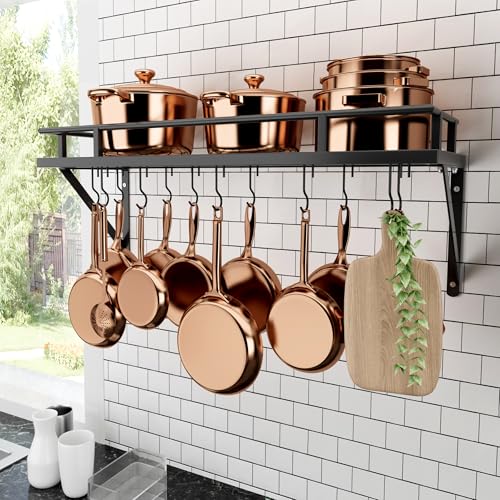
For a single wall rack with a load rating, KES 30-Inch Wall Rack combines a 30-inch shelf with 12 hooks and mounting points spaced for 16-inch wall studs. The maker gives an 88-pound capacity and includes heavy-duty stainless steel screws and dual-use anchors. That combination may suit a kitchen with a moderate pan collection and a wall framed on standard stud spacing. Its one-tier format offers less vertical separation than a two-tier rack, so measure the space needed for large pans and handles before choosing.
Bottom line: Choose this if you want a single rack with 12 hooks and a 88-pound capacity.
Planimar 32-Inch Two-Tier Rack
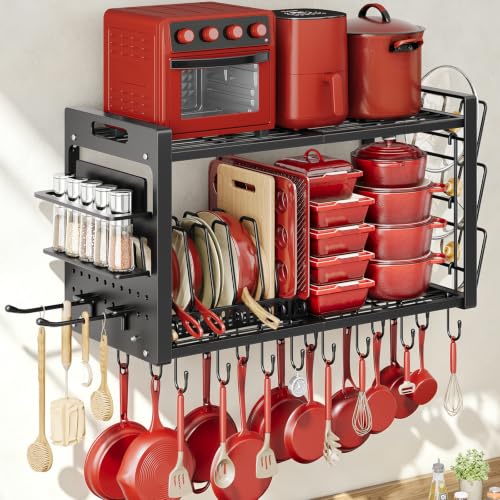
Planimar 32-Inch Two-Tier Rack adds adjustable dividers and lid holders to its two-tier, 32-inch layout, making it the most compartmentalized option here. It has 20 hooks, three pot-lid holders and eight adjustable dividers; the maker gives it a 100-pound load capacity. Its dimensions are 32 × 12.5 × 16 inches. This setup suits kitchens storing cookware and lids together, but its 16-inch height and 12.5-inch depth need more wall clearance than a single rail. Check that nearby cabinets and doors will not obstruct the rack.
Bottom line: Pick this when you need two tiers and separate storage for lids and cookware.
VyGrow 28-Inch Two-Tier Rack

Unlike the other two-tier option, VyGrow 28-Inch Two-Tier Rack specifies a 28-inch shelf tier with 11.8 inches of clearance between levels. The maker gives each tier a capacity of 50 pounds, and the rack includes 20 movable hooks and six lid holders. That layout works for separating pans from lids while using vertical wall space. Its overall stated dimensions are 34.7 × 13 × 26.4 inches, so plan for the full height and width rather than judging by the 28-inch tier measurement. The tall frame can be a poor fit beneath low cabinets.
Bottom line: Choose this for two levels with 11.8 inches between tiers and dedicated lid holders.
Felibeaco 17-Inch Shelf Rack

Felibeaco 17-Inch Shelf Rack is the compact choice: its 17-inch-wide shelf measures 12.5 inches deep and 7 inches high, with eight movable hooks. The shelf-and-hook format gives a small kitchen a place for cookware and utensils without taking up the width of a longer rail. It may fit a narrow wall section, but the 12.5-inch depth still needs clearance from counters, doors and nearby cabinets. The maker gives no load rating, so this option is better for buyers who can confirm its intended capacity before hanging heavy cookware.
Bottom line: Pick this for a narrow wall section and a small cookware collection.
Toplife 31.5-Inch Hanging Rail

Toplife 31.5-Inch Hanging Rail is a straightforward single-bar option rather than a shelf or two-tier organizer. Its 31.5-inch rail has 14 hooks and a maximum load of 30 pounds, with a detachable design. The narrow profile may suit a wall where a deeper shelf would project too far, and the hooks can hold pans and utensils. Its lower load rating makes it a better match for a lighter collection than for heavy cookware stored all together. Account for the combined weight of the rail, hooks and hanging items when planning the load.
Bottom line: Choose this for a simple rail and lighter cookware rather than a heavy collection.
How to choose a wall rack for hanging pans
Start with cookware weight and wall structure, then compare width, depth and hook layout. Rack load limits range from 30 pounds on Toplife 31.5-Inch Hanging Rail to 100 pounds on Planimar 32-Inch Two-Tier Rack, while VyGrow 28-Inch Two-Tier Rack gives a separate 50-pound rating for each tier. A rack’s capacity does not mean every wall can support that load: fasten into framing where possible, and do not assume drywall anchors are suitable for a heavy cookware setup. Measure the wall, including cabinet clearance and the space pans need to hang freely. For a small collection, a single rail or compact shelf can be simpler; choose two tiers when lids and pans need separate storage. Keep the heaviest pieces near mounting points and distribute weight across the rack rather than concentrating it on one hook.
Wall and pan clearance to measure
Measure the rack’s full width, projection from the wall and vertical clearance before drilling. The compact rack is 12.5 inches deep, while the two-tier racks need 16 or 26.4 inches of height depending on the model. Allow extra space below the hooks for the longest pan and its handle, and check that cabinet doors, windows and walkways remain clear. A useful rule is to avoid placing a rack where a hanging pan would intrude into a walking path or sit over a hot cooking surface. Mark the rack’s mounting points on painter’s tape first, then hold a pan beneath the planned position to test clearance. For framed walls, locate studs and verify that the rack’s holes align with them before installation.
Single rails versus shelves and two tiers
A single rail uses less depth, a shelf adds a surface for cookware, and a two-tier rack separates storage vertically. This table matches common needs to the layouts among these options.
| Need | Layout to consider | Trade-off |
|---|---|---|
| Narrow wall section | Compact shelf with hooks | Less room for a large collection |
| Simple hanging storage | Single rail | Limited to hook-based storage |
| Pans plus lids or utensils | Two-tier rack with accessories | Needs more height and clearance |
Count the items you plan to hang and compare that number with hook count, but do not treat hook count as a load rating. Larger pans also need more lateral spacing than utensils, so a rack with many hooks may still feel crowded when every hook holds a wide pan.
Mounting and loading a cookware rack safely
Mount a cookware rack into wall studs when the design and hole spacing allow it, especially when the combined load is substantial. The KES rack has mounting points 16 inches apart, a spacing that matches many conventional stud layouts, but verify actual stud locations because framing can differ. Use the hardware only where it suits the wall material; anchors designed for drywall are not interchangeable with masonry fasteners. After installation, load the rack gradually and check for movement before adding the heaviest pans. Keep cookware balanced across the frame, and avoid exceeding the maker’s capacity. Recheck fasteners periodically, particularly after moving the rack or changing the cookware arrangement.
Frequently Asked Questions
How high should a wall pot rack be mounted?
Mount a rack high enough to keep the longest pan clear of counters and walkways, while keeping hooks reachable without stretching. Test the position with the largest pan before drilling; leave extra clearance for its handle and any cabinet doors nearby.
Can a wall-mounted pan rack go into drywall?
A heavy cookware rack should be fastened to wall framing when possible, because drywall alone is not a dependable support for concentrated loads. If studs do not align with the rack’s holes, use hardware rated for the wall material and intended load, or select another mounting location.
How much weight can a hanging pan rack hold?
Capacity varies by design: the options here range from 30 pounds to 100 pounds, and one two-tier rack is rated at 50 pounds per tier. Treat that as the rack’s limit, not a guarantee that the wall or fasteners can safely support the same load.
How much space should pans have between hooks?
Leave enough lateral room for each pan’s widest point and handle to avoid collisions; large skillets need more spacing than small saucepans. Before mounting, mark hook positions and check that the largest pans can hang without overlapping neighboring cookware.
Is a two-tier rack better for storing pan lids?
A two-tier rack can separate pans from lids, and some models include dedicated lid holders. Choose one only if the wall has enough vertical clearance for its frame and the cookware below the lower hooks.