
Glow in the Dark Rubik’s Cube: 3 Models Compared

For most people, Fluorescent Speed Cube 3×3 is the best starting point because it combines a 3×3 format with a compact 2.20-inch size and a short UV-light charging claim. Choose Fluorescent Speed Cube Green or AMAZA Blue Luminous 3×3 instead if you prefer their smooth-turning features or want the larger 2.7-inch cube.
Glow-in-the-dark cubes use light-absorbing material that emits a visible afterglow in darkness; they do not illuminate like an electronic light-up puzzle.
We earn a commission if you buy through links on this page. As an Amazon Associate I earn from qualifying purchases. Products are compared on manufacturer specifications, not hands-on testing.
- Best overall: Fluorescent Speed Cube 3×3 – Its 2.20-inch size and maker’s claim of several seconds under UV light suit quick setup.
- Best for a longer glow charge: Fluorescent Speed Cube Green – The maker recommends placing it under light for about 10 minutes before dark play.
- Best for a larger cube: AMAZA Blue Luminous 3×3 – Its 2.7-inch length and width exceed the other cubes’ dimensions.
| Product | Best for | Cube size | Glow preparation | Shop |
|---|---|---|---|---|
| Fluorescent Speed Cube 3×3 | Quick UV charging | 2.20 in | Several seconds under UV | Check Price on Amazon |
| Fluorescent Speed Cube Green | Longer light charging | 2.22 in | About 10 minutes under light | Check Price on Amazon |
| AMAZA Blue Luminous 3×3 | Larger cube size | 2.70 in | About 10 minutes under light | Check Price on Amazon |
Glow in the Dark Rubik’s Cube Options
Compare cube dimensions and the light exposure each maker recommends before choosing a 3×3 puzzle.
Fluorescent Speed Cube 3×3

Fluorescent Speed Cube 3×3 is the smallest of these options by dimensions, measuring about 2.20 inches on each side. Its black color and fluorescent finish distinguish it from the blue- and green-labeled cubes, while the 3×3 layout keeps the familiar six-face puzzle format. The maker says several seconds under a UV flashlight can charge its afterglow and describes the turning feel as smooth and fast. Choose it if compact size and fast light preparation matter most. The limitation is that the glow depends on prior light exposure, so it will not act as a self-powered lamp in a dark room.
Bottom line: Pick this cube if you want a compact 3×3 and plan to charge it briefly with UV light.
Fluorescent Speed Cube Green

Fluorescent Speed Cube Green gives the most explicit longer charging routine: the maker recommends about 10 minutes under light before dark play. It measures 2.22 inches on each side and is identified as green fluorescent, although the maker describes a blue glow effect. The maker also claims an anti-pop structure and smooth cornering, which may appeal to someone seeking speed-cube-style turning rather than a display piece. Consider it when you can prepare the cube ahead of time. Its longer recommended exposure is less convenient for spontaneous play than a cube whose maker describes a charge of only several seconds.
Bottom line: Choose this one if you can set aside about 10 minutes for light exposure before play.
AMAZA Blue Luminous 3×3
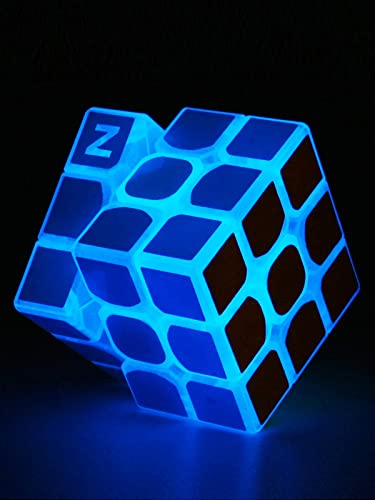
AMAZA Blue Luminous 3×3 stands out for its larger listed footprint: its length and width are 2.7 inches, compared with about 2.2 inches for the other two cubes. The maker recommends about 10 minutes under light and also says a UV flashlight can produce a glow after several seconds. Its frosted surface, ABS construction and adjustable structure distinguish its feature set from the simpler compact option. Choose it if a larger cube is easier for your hands to handle. Its extra size may be less convenient for carrying or for players who prefer a compact speed-cube format.
Bottom line: Pick this cube if you prefer a larger 2.7-inch body and can expose it to light before use.
How to Choose a Glow in the Dark Rubik’s Cube
Choose by charge routine, cube size and turning claims, not by the word “glow” alone. Phosphorescent plastic stores energy from light and releases it gradually; a stronger initial charge generally makes the afterglow more visible, but brightness fades in darkness. A UV flashlight can charge some materials faster than ordinary room light, while the exact time depends on the cube’s material and the light source. Standard 3×3 puzzles have six faces and use the same basic layer-turning challenge regardless of glow finish. If you want a puzzle that lights itself on a timer, look for an electronic light-up design instead; a glow cube has no active illumination. Compare the maker’s prep claim with how much advance setup you are willing to do.
Cube Size and Hand Fit
A cube around 2.2 inches across is a common compact size for a 3×3, while a 2.7-inch body feels substantially larger in the hand. The dimensions here span roughly 2.20 to 2.70 inches, so players with smaller hands or a preference for quick finger turns may favor the smaller end. A larger body can be easier to grip, but it also occupies more space in a bag and may feel slower to turn. A measurable rule: if your comfortable grip spans less than 2.7 inches, favor a cube near 2.2 inches rather than assuming a larger body will be easier. Check all three dimensions where possible, since height, width and length can be reported inconsistently.
Glow Cubes Versus Light-Up Cubes
A glow cube needs an external light charge and then shines passively; an electronic light-up cube uses powered LEDs or another active light source. That distinction determines whether the puzzle can provide ongoing illumination: passive glow fades, while an electronic design depends on its batteries and operating timer. Most glow-in-the-dark plastics are charged by ambient light, but UV exposure can shorten the preparation step for some products. Use the following choice rule: pick a passive glow cube when you want a regular 3×3 puzzle with a visible afterglow, and choose an electronic model when timed lighting is the feature you need. Do not treat either kind as room lighting; their purpose is puzzle play, and a dark setting still reduces visibility.
| Need | Choose | Reason |
|---|---|---|
| Passive afterglow | Glow-in-the-dark cube | Charges under light, then glows without an active light source |
| Timed active illumination | Electronic light-up cube | Uses powered lighting rather than stored light |
| Compact hand fit | About 2.2-inch cube | Smaller footprint than a 2.7-inch body |
Charging and Playing Safely
Charge a glow cube before turning it in a dark room, because phosphorescent material loses visible brightness as its stored energy runs down. Ordinary light can charge these materials, while a UV flashlight may work faster when the cube’s maker permits it. Avoid shining UV light into eyes or at skin; use the flashlight briefly and direct it at the cube. A glowing finish is not a substitute for enough room light to see nearby objects or keep track of small pieces. Keep the puzzle away from heat sources and do not force a jammed layer, since added pressure can damage plastic parts. For children, supervise UV-light use and keep the light source inaccessible when play ends.
Frequently Asked Questions
How long should I charge a glow-in-the-dark cube?
Many glow materials benefit from several minutes under bright light, and one cube here recommends about 10 minutes. UV light can charge some finishes faster, but exposure time varies with the material and light intensity.
Will a glow cube stay bright all night?
No, passive glow fades as stored light energy is released. A well-lit charge before play can make the initial afterglow more visible, but it is not continuous lighting.
Can regular room light charge a glowing cube?
Yes, phosphorescent materials can absorb ordinary visible light, though a dim room may provide a weaker charge than bright light. Give the cube time under a brighter source before moving to darkness.
Is a glow cube the same as a light-up cube?
No, a glow cube emits stored light passively, while an electronic light-up cube uses powered lighting. Pick the passive type for afterglow and an electronic type for active, timed illumination.
What cube size works best for smaller hands?
A 3×3 near 2.2 inches across is a practical compact target, while 2.7 inches is notably larger. If your comfortable grip is under 2.7 inches, choose the smaller format.