
Best Golf Training Aid for Flat Left Wrist Compared

Ambidextrous Wrist Brace and Arm Band Kit suits most golfers seeking a flat lead-wrist cue because it is designed for either hand and includes an arm band. Right-handed golfers use the left wrist as the lead wrist; left-handed golfers use the right. Choose GAIARENA Wrist Hinge Trainer, Large instead if you are right-handed and want a brace with a wrist-size guide.
We earn a commission if you buy through links on this page. As an Amazon Associate I earn from qualifying purchases. Products are compared on manufacturer specifications, not hands-on testing.
- Best overall: Ambidextrous Wrist Brace and Arm Band Kit – Ambidextrous design and an included arm band support wrist-position and arm-connection drills.
- Best for right-handed beginners: GAIARENA Wrist Hinge Trainer, Large – Made for right-handed golfers and gives wrist-size ranges for its sizes.
- Best for arm connection: CUBEDAY Wrist Brace and Arm Band Kit – Pairs wrist support with an elastic arm band intended to keep the arms working together.
| Product | Best for | Hand fit | Wrist-size fit | Included training pieces | Shop |
|---|---|---|---|---|---|
| Ambidextrous Wrist Brace and Arm Band Kit | Either-hand practice | Left or right | One size | Brace and arm band | Check Price on Amazon |
| GAIARENA Wrist Hinge Trainer, Large | Right-handed beginners | Right-handed | 7.1–8.6 in | Wrist brace | Check Price on Amazon |
| CUBEDAY Wrist Brace and Arm Band Kit | Arm connection | — | — | Wrist brace and arm band | Check Price on Amazon |
| ALLCIFP Adjustable Mesh Wrist Trainer | Adjustable practice | Left or right | — | Wrist trainer | Check Price on Amazon |
| Adjustable Wrist Brace with Support Strip | Internal support | Left or right | One size | Wrist brace | Check Price on Amazon |
Golf Training Aids for a Flat Left Wrist
Compare each aid’s hand fit and training setup before choosing a practice cue.
Ambidextrous Wrist Brace and Arm Band Kit

Ambidextrous Wrist Brace and Arm Band Kit is the only option here explicitly designed for either hand, which makes it the most flexible pick for golfers who need a lead-wrist cue. Its rigid support on the back of the hand gives a physical reminder when the wrist starts to cup or break down, while the included arm band adds an arm-connection drill. Use the brace to rehearse the wrist hinge and impact position rather than assuming a practice aid will change every swing fault. The one-size fit may matter to golfers who prefer a size chart before choosing.
Bottom line: Choose this if you want a wrist cue that accommodates either hand and an arm band drill.
GAIARENA Wrist Hinge Trainer, Large

GAIARENA Wrist Hinge Trainer, Large is tailored to right-handed golfers who want the lead wrist held straight during swing practice. The large size covers wrists from 7.1 to 8.6 inches, and the maker describes the brace as covering the lead wrist. That specific sizing and orientation make it a clear choice for right-handed beginners whose wrist measures in range. Measure around the wrist before selecting a size: the medium, large, and XL ranges overlap, so compare your measurement with the size options rather than relying on a general fit assumption. This choice is not designed for left-handed golfers.
Bottom line: Choose this if you are right-handed, new to swing practice, and your wrist fits the large range.
CUBEDAY Wrist Brace and Arm Band Kit

CUBEDAY Wrist Brace and Arm Band Kit combines lead-wrist support with an elastic arm band, making it the most directly focused option for golfers who want to practice wrist position and arm connection together. The maker says its support strip helps hold a flat lead-wrist position and its band helps keep the arms and body moving as one unit. That combination may suit a golfer working on more than wrist angle alone. The features do not establish left- or right-hand fit, so confirm the orientation before ordering if you need a specific lead wrist supported.
Bottom line: Choose this if your practice routine needs both wrist-position and arm-connection cues.
ALLCIFP Adjustable Mesh Wrist Trainer
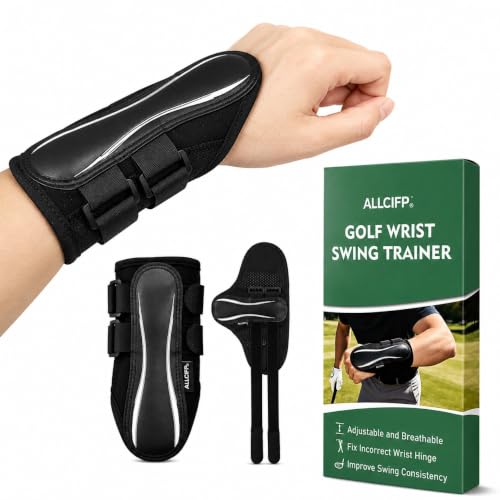
ALLCIFP Adjustable Mesh Wrist Trainer stands out for its breathable mesh construction and adjustable wrist trainer format, with support for either hand. The maker says it is intended to limit unwanted wrist movement and reinforce alignment through repeated practice, including at impact. Its broad hand compatibility is useful for golfers who switch sides or need the opposite lead wrist supported. The product facts give no wrist measurement range, so golfers who need a precise fit should confirm adjustability against their wrist size before choosing; the mesh material alone does not establish how snugly it will fit.
Bottom line: Choose this if adjustable, breathable support and either-hand use are your priorities.
Adjustable Wrist Brace with Support Strip

Adjustable Wrist Brace with Support Strip uses an internal support strip and is described as adjustable for left- or right-handed golfers. Its focus is a restrained wrist position during practice, so it may suit someone looking for a simple brace rather than a brace-and-band combination. The maker also describes it as useful for injury recovery, but that is not a substitute for clinical advice or a reason to swing through pain. A one-size design is the main trade-off for golfers who want a measurable wrist-size range before purchase.
Bottom line: Choose this if you want an adjustable one-size brace with an internal support strip.
How to Choose a Flat Left-Wrist Training Aid
Choose by lead-hand fit first, then by the movement cue you want to rehearse. For a right-handed golfer, the left hand is the lead hand; for a left-handed golfer, it is the right. A brace that supports the wrong wrist will not provide the intended lead-wrist cue. Wrist aids commonly work by restricting wrist motion or giving tactile feedback when the wrist changes angle. A flat lead wrist is one swing position, not a guarantee of solid contact, so use an aid for short rehearsals and then practice without it to check whether the cue transfers. If a brace causes pain, numbness, or tingling, stop using it rather than tightening it.
Wrist Fit and Hand Orientation
Measure the wrist where a watch normally sits and compare the measurement with the aid’s range. GAIARENA Wrist Hinge Trainer, Large gives a large-size range of 7.1 to 8.6 inches, while one-size or adjustable formats do not provide the same numeric fit check in the specs. Do not assume that “left/right” means the device fits every wrist circumference; hand orientation and circumference are separate fit questions. With a measurement outside the range, choose another product or verify its fit before ordering. Also check that a brace leaves enough room to hold the grip normally, since a cue that changes your grip can change the swing you are trying to practice.
Wrist Braces and Arm Band Training Kits
Wrist-only aids focus practice on the angle of the lead wrist, while a brace-and-band kit adds a cue for keeping the arms connected. The band is useful when the drill target includes arm movement, but it does not replace a wrist-fit check. Use the following distinctions to match the aid to the practice target:
| Practice need | What to prioritize | Relevant option |
|---|---|---|
| Lead-wrist position | Brace or support cue on lead wrist | Wrist trainer or brace |
| Wrist plus arm connection | Brace with included arm band | Brace-and-band kit |
| Either swing orientation | Explicit left- and right-hand design | Ambidextrous aid |
Start with slow rehearsal swings and a few repetitions at a time; a training aid is a movement cue, not a reason to force the wrist into an uncomfortable angle.
Practice Safely With a Wrist Training Aid
Use a wrist aid for controlled rehearsals before hitting full-speed shots. Golf clubs can generate substantial force, and a stiff brace can alter how the hands move; stop if you feel pain, tingling, or loss of circulation. Keep the grip comfortable and do not tighten straps to force a position. A practical sequence is a few slow swings without a ball, then relaxed half-swings, followed by normal practice without the aid to see whether the movement cue carries over. A brace cannot diagnose an injury or determine the right rehabilitation plan. Anyone using a wrist trainer because of an injury should ask a qualified clinician when to resume golf swings.
Frequently Asked Questions
Which wrist is the lead wrist in golf?
The left wrist is the lead wrist for a right-handed golfer, and the right wrist is the lead wrist for a left-handed golfer. Confirm the aid’s hand orientation before practicing.
How should a golf wrist brace fit?
A brace should feel secure without pain, tingling, or restricted circulation. Measure at the wrist and compare with the size range when one is provided; do not force a too-small brace tighter.
Can a wrist training aid fix a slice?
A wrist aid can provide a cue for wrist position, but a slice can have causes beyond the wrist, including swing path and face orientation. Use the aid for a specific wrist drill rather than expecting it to correct every ball-flight issue.
How long should I practice with a wrist trainer?
Begin with a few slow rehearsal swings, then remove the aid and repeat the motion normally. Stop immediately if the brace causes pain, numbness, or tingling.
Can left-handed golfers use a right-handed wrist trainer?
A trainer labeled for right-handed golfers is intended for right-handed swing orientation, where the left wrist leads. Left-handed golfers should select an aid explicitly designed for their orientation or for either hand.