
Solar Ultrasonic Animal Repellent: 3 Models Compared

For most yards, Solar Ultrasonic Animal Repellent, 2-Pack is the strongest starting point because its motion sensor is specified to detect movement up to 30 feet across a 150-degree zone. Choose Solar Ultrasonic Animal Repellent, 5 Modes instead if you want five selectable operating modes, or Solar Ultrasonic Animal Repellent, 2-Pack (2026 Upgraded) if a 2-pack is your priority and exact sensor coverage is less important.
We earn a commission if you buy through links on this page. As an Amazon Associate I earn from qualifying purchases. Products are compared on manufacturer specifications, not hands-on testing.
- Best overall: Solar Ultrasonic Animal Repellent, 2-Pack – Its PIR sensor has a detection distance of up to 30 feet and a 150-degree zone.
- Best for mode control: Solar Ultrasonic Animal Repellent, 5 Modes – Five modes let you switch between ultrasonic frequencies and an audible alarm with strobe lights.
- Best for two locations: Solar Ultrasonic Animal Repellent, 2-Pack (2026 Upgraded) – The package includes two units for placing in separate areas.
| Product | Best for | Pack size | Shop |
|---|---|---|---|
| Solar Ultrasonic Animal Repellent, 2-Pack | Specified sensor range | 2 units | Check Price on Amazon |
| Solar Ultrasonic Animal Repellent, 5 Modes | Selectable deterrent modes | 1 unit | Check Price on Amazon |
| Solar Ultrasonic Animal Repellent, 2-Pack (2026 Upgraded) | Two-area placement | 2 units | Check Price on Amazon |
Solar Ultrasonic Animal Repellents
Compare sensor coverage, mode selection, and pack size to match the device to your yard layout.
Solar Ultrasonic Animal Repellent, 2-Pack

Solar Ultrasonic Animal Repellent, 2-Pack is the only option here with a sensor range and angle: its PIR motion detector reaches up to 30 feet across a 150-degree zone. The maker says detection triggers high-frequency ultrasonic sound and flashing LED strobe lights, and the unit is solar powered and waterproof. This two-pack suits a yard where you want to position devices in more than one area. Its operating modes are not enumerated, so it is a less fitting choice if switching among several specific sound settings is central to your plan.
Bottom line: Choose this if a defined sensor range matters more than selectable modes.
Solar Ultrasonic Animal Repellent, 5 Modes

Solar Ultrasonic Animal Repellent, 5 Modes stands apart with five operating modes, including one that combines an audible alarm and strobe lights; the other modes use different ultrasonic frequencies. The maker recommends testing modes consistently for 10 to 15 days because animal responses differ. Its single-unit package is suited to one focused area where you can adjust the setting as needed. The available sensor coverage is not given, so buyers planning placement around a precise detection radius should verify that measurement before ordering.
Bottom line: Pick this when mode flexibility matters and one unit covers your target area.
Solar Ultrasonic Animal Repellent, 2-Pack (2026 Upgraded)
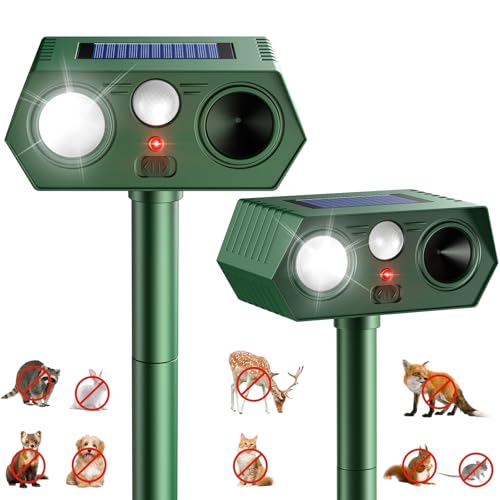
Solar Ultrasonic Animal Repellent, 2-Pack (2026 Upgraded) is the other two-unit option, distinguished by its broad target list, which includes snakes, moles, and gophers as well as deer, squirrels, cats, dogs, chipmunks, skunks, raccoons, and rabbits. Its PIR sensor activates ultrasonic waves and LED strobe lights when it detects movement. The two-pack suits separate garden or lawn zones.
Bottom line: Choose this when a two-pack and its broad target list suit your yard.
How to choose a solar ultrasonic animal repellent
Start with the area you need to cover, then compare sensor reach, angle, and control options. A motion-triggered device only activates when an animal enters its detection zone, so a wide angle does not compensate for a short range if the target approaches from farther away. As a practical placement rule, when a target path is more than 30 feet from the unit, do not rely on a model with a 30-foot maximum; position it closer or verify a longer range. Also consider whether sound modes can be changed: animals may respond differently, and changing settings gives you an option if one frequency is ineffective. Pack count matters when separate approach paths need separate sensors.
Sensor placement and yard coverage
Place a motion-sensing repellent facing the route animals use, with a clear view of the approach; shrubs, fences, and other obstructions can interfere with detection. A 150-degree sensor zone covers a broad front-facing arc, but the device still has a maximum distance, so arrange units around actual paths rather than assuming one unit covers a whole property. For a long fence line or a yard with separate entry points, a multi-unit pack can let you cover distinct zones. Point the device toward the area to protect, not toward a walkway where people or pets will repeatedly trigger it.
Ultrasonic sound is high-frequency sound beyond typical human hearing, but it is not a guaranteed barrier: animal hearing and behavior differ, and an animal may ignore a sound source. A strobe or audible alarm is a separate deterrent approach, not proof that every target will leave.
Ultrasonic modes and animal response
Selectable frequencies are useful when a device offers more than one sound setting, because different animals can react differently to sound. Change one setting at a time and give it a consistent trial period; the five-mode unit recommends 10 to 15 days of testing before deciding whether a setting is working. Mode 4 on that unit adds an audible alarm and strobe lights, while other modes use ultrasonic frequencies. Consider nearby people and pets before using an audible alarm, and avoid aiming a flashing light toward a neighbor’s windows. Do not treat a repellent as a substitute for repairing gaps, securing garbage, or removing food sources that attract wildlife.
Solar power and outdoor use
Solar operation avoids a wired power connection, but performance still depends on the panel receiving enough daylight. Place the panel where it is not shaded for much of the day, and keep it clear of dirt and leaves. Waterproof ratings use the IP code: IP65 generally indicates dust-tight construction and protection against water jets, not immersion. The five-mode unit specifies an IP65 rating and ABS material. For any outdoor device, aim it away from standing water and inspect the housing and panel after severe weather; a waterproof rating does not mean damage-proof.
Frequently Asked Questions
Do ultrasonic animal repellents work on every animal?
No, response varies by species and individual animal, and ultrasonic sound is not a guaranteed barrier. A multi-mode device can be adjusted, but combine it with removing attractants and closing access points.
How far away can the motion sensor detect animals?
The model with specified coverage detects movement up to 30 feet across a 150-degree zone. Place the device closer if an animal route is beyond that maximum, and avoid assuming the angle alone guarantees coverage.
How long should I test an ultrasonic setting?
Allow 10 to 15 days of consistent use before judging a mode, as recommended for the five-mode unit. Keep placement stable during that period so you are evaluating the setting rather than a different sensor position.
Can rain damage a solar animal repellent?
The five-mode model specifies IP65 waterproofing, which protects against water jets but not submersion. Keep units out of standing water and check the panel and casing after harsh weather.
Where should I place a motion-activated animal repellent?
Aim the sensor toward a known animal approach path and keep its view unobstructed. For routes farther than 30 feet, position a sensor closer or verify that its coverage reaches the path.