
Laser Stripping Machine for Wood: 3 Models Compared

For wood cleaning, WTTTOOLS LPC-500 500W is the strongest match in this group because it is a 500W pulsed cleaner designed for wood and has a scan width up to 100 mm. Choose LYXC APC-300 300W for a 300W wood-and-mold cleaner, or 200W Pulsed Wood/Metal Cleaner if you want a 200W pulsed machine described for wood and metal.
Laser stripping uses a focused beam to remove surface layers; wood species, coating, and beam settings affect the result, so test on an inconspicuous area before treating a visible surface.
We earn a commission if you buy through links on this page. As an Amazon Associate I earn from qualifying purchases. Products are compared on manufacturer specifications, not hands-on testing.
- Best overall: WTTTOOLS LPC-500 500W – Its 500W pulsed design is specifically intended for wood cleaning and offers up to 100 mm scan width.
- Best for remote controls: LYXC APC-300 300W – It combines a 300W wood-and-mold cleaner with IoT remote control and a 5 m cable.
- Best for wood and metal: 200W Pulsed Wood/Metal Cleaner – Its 200W pulsed design is specified for removing paint, oil, and rust from wood or metal.
| Product | Best for | Laser power | Scan width | Laser class | Shop |
|---|---|---|---|---|---|
| WTTTOOLS LPC-500 500W | Wood surface cleaning | 500W | 0–100 mm | Class 1 | Check Price on Amazon |
| LYXC APC-300 300W | Remote adjustment | 300W | 0–100 mm | Class 1 | Check Price on Amazon |
| 200W Pulsed Wood/Metal Cleaner | Wood and metal | 200W | — | Class 2 | Check Price on Amazon |
Laser stripping machines for wood
Compare the wood-focused options by power, scan width, and the work each is meant to handle.
WTTTOOLS LPC-500 500W
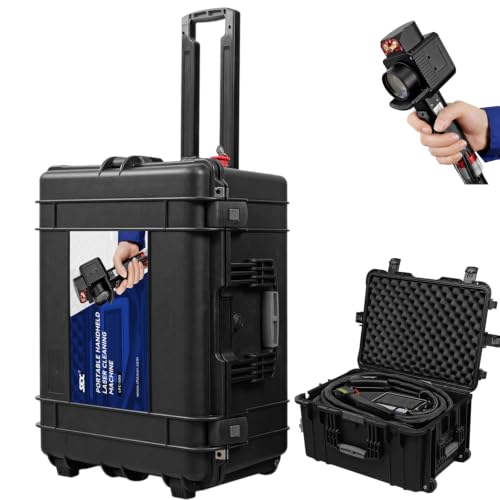
WTTTOOLS LPC-500 500W stands out for its 500W pulsed output and explicit focus on wood cleaning. It has a 1070±10 nm wavelength, air cooling, and a 0–100 mm scan width, with AC 110–220V±10% input. The machine weighs 79.4 lb and measures 26 × 19.7 × 13 in. The maker says its pulsed operation provides gentler cleaning than continuous laser cleaners. That makes it a fit for someone prioritizing wood cleanup, but its 79.4 lb weight is a drawback if frequent carrying or moving between rooms is part of the job.
Bottom line: Choose this for a wood-focused cleaner when 500W output and a 0–100 mm scan range suit the work.
LYXC APC-300 300W

LYXC APC-300 300W is the wood-and-mold option with phone-based IoT control, rather than the higher-power wood cleaner in this group. It is a 300W pulsed, air-cooled machine with a 0–100 mm scan width, 10–500 ns pulse width, 1–3000 kHz modulation frequency, and a 5 m cable. Input is AC 110–220V±10%. The maker says it can clean paint, stains, graffiti, and other dirt from wood. The ambient range is -5°C to 37°C; buyers working outside that range should verify operating suitability before purchase.
Bottom line: Choose this if remote parameter adjustment and a wood-and-mold focus matter more than higher listed power.
200W Pulsed Wood/Metal Cleaner

200W Pulsed Wood/Metal Cleaner is the lower-power choice intended for both wood and metal, with a Class 2 laser classification and 0.874 mW output power. Its maker describes a pulsed laser and an electronic control system intended to reduce excessive ablation at the ends of a cleaning pass. The compact design is presented for narrow spaces and outdoor use, but the machine weighs 132.3 lb, so portability should not be confused with easy one-person carrying.
Bottom line: Choose this for wood and metal tasks where its 200W output fits and scan width is not a deciding factor.
How to choose a laser stripping machine for wood
Start with the coating and the wood, not wattage alone: a thin stain on softwood needs a more cautious approach than thick paint on hardwood. Pulsed lasers deliver energy in short bursts, while continuous-wave machines deliver a steady beam; pulse width, frequency, scan speed, and overlap all affect heat and removal. In this group, the three wood-focused options are pulsed, so compare their power and scan width as starting points rather than guaranteed removal rates. Choose a machine with a scan width suited to the area: a 0–100 mm span can cover a wider pass than an unspecified span. Test a small hidden area first and check for scorching, raised grain, or remaining finish before expanding the work.
Wood, coatings, and surface preparation
Wood is not a uniform substrate: grain direction, resin, moisture, and species change how a surface responds to heat. Paint, clear finish, oil, and stain can also require different settings, so a machine that removes one coating may mark another wood-and-finish combination. Keep the surface clean of loose dust and debris, and use short, controlled passes rather than dwelling on one point. A practical decision rule is to stop and reassess if a test patch darkens or chars; lowering exposure or using a non-laser method may be safer for that finish. Do not assume “without damage” means every coating and species is safe at every setting. Use extraction and appropriate eye protection for the beam wavelength, and control access to the work area.
Laser class and safe operation
Laser classification is a safety label, not a reason to look into the beam or ignore protective measures. A 1070 nm beam is near-infrared and is not visible to the eye, so an apparent lack of light does not establish that the beam is off or safe. Class 1 and Class 2 labels describe accessible emission under defined conditions; they do not eliminate the need to follow the equipment maker’s safety procedures for setup and operation. Use eyewear specifically rated for the operating wavelength and suitable optical density, keep bystanders out of the controlled area, and avoid reflective surfaces near the beam. Before purchase, confirm that the safety controls and eyewear match the machine’s laser wavelength and intended use.
Frequently Asked Questions
Can a laser cleaner remove paint from wood?
Yes, a laser cleaner can remove some paint from wood, but results depend on the coating, species, and settings. Begin with a small hidden test patch and stop if the wood darkens or chars.
What does pulsed mean on a wood laser cleaner?
A pulsed laser delivers energy in short bursts rather than as a continuous beam. Pulse width and frequency influence how energy reaches a surface, so adjust settings cautiously and inspect a test area before cleaning a larger section.
What eye protection does a 1070 nm laser need?
Use protective eyewear rated for 1070 nm and appropriate optical density for the machine. Because this near-infrared wavelength is invisible, also control access to the work area and follow the machine’s safety procedures.
How wide should the laser scan be for wood?
A wider scan covers more area per pass, but it does not by itself determine removal speed or finish quality. A 0–100 mm range is one stated specification here; match the working width to the area and maintain consistent, overlapping passes.