
Bucket Lid Mouse Traps: 5 Options Compared by Setup

RinneTraps Flip N Slide is the clearest fit for most buyers who want a reusable bucket lid trap, with an included ramp and a counter-weighted plank that resets after a catch. Choose another option if you need four lids in one pack or prefer a design with a different bait approach.
Bucket lid traps use a ramp and moving lid or plank to drop mice into a bucket; check whether a compatible bucket is included before ordering.
We earn a commission if you buy through links on this page. As an Amazon Associate I earn from qualifying purchases. Products are compared on manufacturer specifications, not hands-on testing.
- Best overall: RinneTraps Flip N Slide – Includes two ramps, and its counter-weighted plank resets after a catch.
- Best for four locations: Yellow Auto-Reset Bucket Trap, 4-Pack – The pack contains four bucket lids.
- Best for bait-on-lid setup: Yellow Flip-Lid Bucket Trap – Its instructions place bait on the flip lid rather than inside a tunnel.
| Product | Best for | Pack size | Bucket included | Maker-stated capacity | Shop |
|---|---|---|---|---|---|
| RinneTraps Flip N Slide | Resetting after catches | 2 traps | No | 40+ mice per trap | Check Price on Amazon |
| Yellow Auto-Reset Bucket Trap, 4-Pack | Multiple locations | 4 traps | Check before ordering | Up to 10 mice and 5 medium rats | Check Price on Amazon |
| Yellow Auto-Reset Bucket Trap, 2-Pack | Two-lid setup | 2 traps | No | 10+ mice and 5+ medium rats | Check Price on Amazon |
| Owl-Style Bucket Trap, 2-Pack | Owl-style design | 2 traps | No | 10+ mice or 5+ medium rats | Check Price on Amazon |
| Yellow Flip-Lid Bucket Trap | Bait-on-lid setup | — | No | — | Check Price on Amazon |
Bucket Lid Mouse Traps Compared
Compare the trap count, bucket requirements and stated catch capacity before choosing a setup.
RinneTraps Flip N Slide

RinneTraps Flip N Slide stands out for its counter-weighted plank and included ramp: when a mouse moves past the plank’s center point, the plank flips and resets. The two-pack provides two lids and two ramps, but requires two standard 5-gallon buckets that are sold separately. The maker says each trap can capture 40 or more mice between empties and can also catch small to medium-sized rats. This setup suits anyone who wants a defined reset mechanism and a ramp for each lid. Its main limitation is the separate bucket requirement, which matters if you expected a complete bucket assembly.
Bottom line: Choose this if you want two ramp-equipped lids with a counter-weighted reset.
Yellow Auto-Reset Bucket Trap, 4-Pack
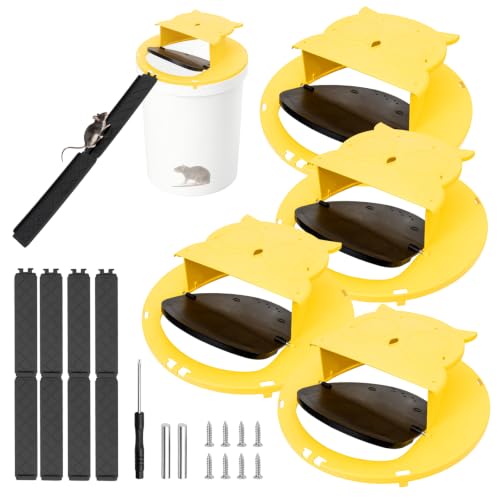
Yellow Auto-Reset Bucket Trap, 4-Pack is the only four-lid pack among these options, making it useful when you want to set traps in several locations. Its metal roller and screw assembly distinguish it from designs described around a plank or flip lid. The maker says each trap can hold up to 10 mice plus five medium-sized rats. The non-electric mechanism avoids glue and snap components, but that alone does not make a bucket trap safe to leave accessible: keep traps away from children and pets. The specifications do not establish whether the pack includes buckets, so verify that before planning a complete setup.
Bottom line: Choose this when four lids matter more than a clearly specified bucket arrangement.
Yellow Auto-Reset Bucket Trap, 2-Pack

Yellow Auto-Reset Bucket Trap, 2-Pack offers two yellow auto-reset lids and explicitly requires a separate standard 5-gallon bucket. The maker says the traps hold upwards of 10 mice and five or more medium-sized rats, and describes clipping a lid onto the bucket as the setup. Its capacity makes this a match for buyers comparing multi-catch claims, rather than a single-catch trap. The fields do not give a distinct reset mechanism or ramp, so buyers who prioritize those setup features may prefer another design. Plan for the separate bucket when choosing where the pair will be used.
Bottom line: Choose this if you already have a standard 5-gallon bucket for each lid.
Owl-Style Bucket Trap, 2-Pack

Owl-Style Bucket Trap, 2-Pack differs from the other choices by its owl-style design and two-lid pack. The maker says the traps can hold upwards of 10 mice or five or more medium-sized rats, and instructs users to apply butter inside the trap before attaching it to a standard 5-gallon bucket. The buckets are not included, so this is best for someone who already has compatible buckets or can source them separately.
Bottom line: Choose this if you want an owl-style two-pack and have buckets ready.
Yellow Flip-Lid Bucket Trap

Yellow Flip-Lid Bucket Trap differs in its bait placement: its setup calls for food such as peanut butter or cookies on the flip lid, rather than bait inside a tunnel. It is described as reusable and intended for indoor or outdoor placement, and the 5-gallon bucket is not included. The product name presents it as lethal, while its features also use live-capture language, so the catch outcome is not clear from those claims alone. That ambiguity matters to anyone who needs a particular handling method. Confirm the catch outcome before choosing it, and keep any bucket trap inaccessible to children and pets.
Bottom line: Choose this only if bait-on-lid placement suits your setup and the catch outcome fits your needs.
How to choose bucket lid mouse traps
Start with bucket fit, then compare the ramp and reset mechanism. Many bucket-lid systems are made to sit on a standard 5-gallon bucket, but not every package includes one; an incompatible rim can leave gaps or prevent the lid from sitting securely. A ramp helps mice reach an elevated lid, while a plank or roller mechanism determines how the entry surface moves and resets. Choose a multi-catch design if you want successive catches without manually resetting after each one, but do not treat a maker’s capacity claim as a guarantee. If you need a complete setup and the package does not clearly include a bucket, verify bucket inclusion before ordering.
Setting up a bucket trap safely
Place a bucket trap on a stable, level surface and use the ramp or approach path supplied for that design. A shifting bucket or unsupported ramp can interfere with entry and may tip the assembly; avoid locations where people can kick it or pets can reach it. Food bait is commonly used in mouse traps, and peanut butter is a familiar option, but follow the particular trap’s bait placement: some designs direct bait inside a tunnel and others on the lid. Bucket traps can expose captured rodents, so keep them away from children and pets and decide in advance how you will handle a catch. Never assume a trap is child- or pet-proof because it has no glue or snap.
Bucket trap designs and catch capacity
Bucket traps use gravity or a moving entry surface to drop rodents into a container, but designs differ in how the entry resets and where bait goes. A counter-weighted plank can flip back after a catch; a roller or flip lid uses a different moving surface. Maker-stated capacities are not directly comparable unless the maker defines the same conditions and whether the figure applies per lid. Use the table to match the described mechanism to your preference, not as a promise of equal results.
| Design or need | What to look for |
|---|---|
| Automatic reset | Moving plank or flip mechanism described as resetting after a catch |
| Guided approach | A ramp for the lid |
| Bait-on-lid setup | Instructions that place bait directly on the flip lid |
| Multi-location setup | Pack count and one compatible bucket per lid |
Bucket size, placement and upkeep
A standard 5-gallon bucket is the common fit referenced by these products, but check the lid’s rim compatibility rather than assuming every bucket has the same shape. A secure fit matters because a loose lid can shift during use. Keep the bucket upright and inspect the approach path and moving parts regularly for debris, damage or bait buildup that could obstruct movement. Emptying intervals depend on catch rate and the trap’s capacity; inspect traps often, especially in warm conditions or where children and pets are present. Reusable equipment still needs cleaning between uses, and gloves reduce direct contact when handling a trap or bucket.
Frequently Asked Questions
Do bucket lid mouse traps need a bucket?
Most bucket-lid designs need a compatible container, commonly a standard 5-gallon bucket. Several of these options explicitly exclude the bucket, so confirm inclusion and rim fit before setting up.
How often should I check a bucket mouse trap?
Check a bucket trap at least daily, and more often in warm weather or in a place accessible to children or pets. Frequent checks reduce the time a captured rodent remains in the bucket and let you spot a jam or unstable setup.
Where should I put a bucket mouse trap?
Place a bucket trap on a stable, level surface along a route where mice travel, such as near a wall, while keeping it away from children and pets. Avoid damp or exposed areas if they could make the ramp or lid slippery or unstable.
What bait works in a bucket mouse trap?
Peanut butter is a commonly used mouse-trap bait, but placement depends on the design: some traps call for bait in a tunnel and others on the lid. Use the placement intended for the specific mechanism.
Can a bucket mouse trap catch rats too?
Some bucket trap makers claim their designs can catch small or medium-sized rats, but the claim does not apply to every lid or rat size. Check the trap’s target and use a suitable setup rather than assuming a mouse-sized mechanism handles larger animals.