
EMI Filter for LED Lights: 4 Options Compared by Fit

For LED-light power-line noise, choose E-outstanding CW1B-10A-L when the circuit is within its 10A rating and a compact wired filter suits the installation. Choose a 20A option for a higher-rated circuit, or ferrites for noise on a cord rather than a panel-mounted line filter.
Line filters connect in series with power wiring, while clip-on ferrites clamp around a cable; electrical installation should be done only with power disconnected and by someone qualified.
We earn a commission if you buy through links on this page. As an Amazon Associate I earn from qualifying purchases. Products are compared on manufacturer specifications, not hands-on testing.
- Best overall: E-outstanding CW1B-10A-L – Its 1–10A rating and 115/250VAC range suit lower-current line-filter applications.
- Best for component specs: 120V 20A EMI Line Filter – It has a 20A rating and gives inductor and capacitor values.
- Best for cable clamping: Tamicy 60-Piece Ferrite Clip Set – The set includes ferrite clips sized for cords from 3 mm to 13 mm.
| Product | Best for | Voltage | Form | Shop |
|---|---|---|---|---|
| E-outstanding CW1B-10A-L | Lower-current circuits | 115/250VAC | Wired line filter | Check Price on Amazon |
| 120V 20A EMI Line Filter | Component values | 120/250V | Wired line filter | Check Price on Amazon |
| Uxcell CW4L2-20A-S | Metal housing | 115/250V AC | Wired line filter | Check Price on Amazon |
| Tamicy 60-Piece Ferrite Clip Set | Cable suppression | — | Clip-on ferrites | Check Price on Amazon |
EMI filters for LED lights
Match the filter type and current rating to where the noise appears and how the circuit is wired.
E-outstanding CW1B-10A-L

For a lower-current power line, this compact wired filter covers a 1–10A rated-current range at 115/250VAC and 50/60Hz. Its applications include lighting along with automation, communications and other equipment, making it the closest fit here for a light circuit within its rating. The practical limit is the 10A ceiling: choose a 20A-rated unit if the circuit requires more current, and confirm compatibility with the LED driver and wiring before installation. The product is a line filter, not a clip-on cable suppressor.
Bottom line: Choose this for a lighting power line rated no higher than 10A.
120V 20A EMI Line Filter
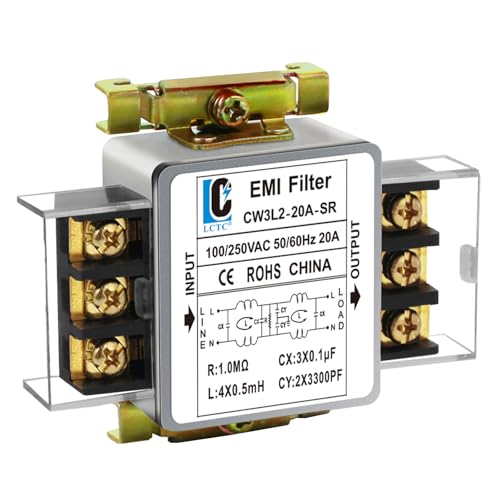
For a higher-current line-filter option with component values provided, this unit is rated 20A at 120/250V and 50/60Hz. It specifies four 0.5mH inductors, three 0.1μF CX capacitors and two 3300pF CY capacitors, useful when comparing an existing filter’s electrical design. Those values alone do not establish fit for a particular LED driver or enclosure, and its physical dimensions are 3.35 × 2.95 × 1.38 inches. Choose it only where the circuit and installation requirements match; the maker does not describe mounting hardware.
Bottom line: Choose this when 20A capacity and component values are priorities.
Uxcell CW4L2-20A-S

Unlike the 10A choice, this Uxcell line filter is rated 20A at 115/250V AC and has an external metal housing. Its 6 × 5.5 × 3cm body weighs 176g; installation holes are 7.5cm apart and 5mm in diameter. These physical measurements help assess whether an existing mounting location can accommodate it. It remains a wired AC filter rather than a clamp-on ferrite, and a 20A rating does not by itself verify compatibility with a specific LED driver or circuit. Confirm electrical and enclosure fit before selecting it.
Bottom line: Choose this when a metal-bodied 20A line filter matches the installation.
Tamicy 60-Piece Ferrite Clip Set
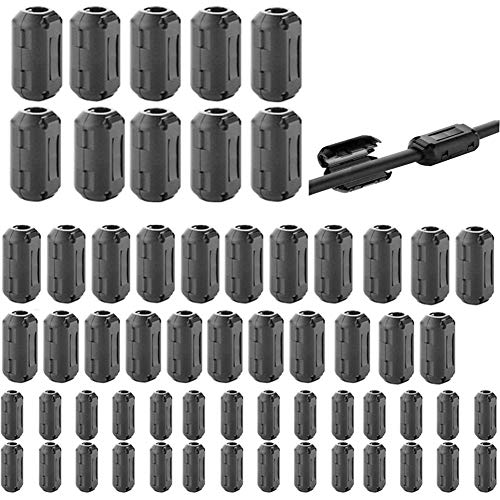
For cable-level suppression rather than a wired line filter, this set includes 60 clip-on Ni-Zn ferrite cores in five sizes for cables with 3, 5, 7, 9 or 13mm inner diameters. The cores open and close with an elastic clip, so they can be fitted around a compatible cord without replacing the cord. This makes the set relevant when interference is associated with a cable, but it is not a substitute for a mains line filter and has no current or voltage rating in its specifications. Measure the cable diameter before choosing a size.
Bottom line: Choose these when the cable, not the AC line, is the suppression target.
How to choose an EMI filter for LED lights
Choose a line filter for noise traveling through the AC supply, and a ferrite for interference associated with a cable. A line filter is wired in series with the supply path; its current rating must meet or exceed the load current, and its voltage rating must suit the circuit. For example, a 10A-rated filter is not the choice for a circuit requiring 12A. Ferrites clamp around a conductor and do not replace overcurrent protection, grounding, or a correctly rated filter. LED drivers can create conducted electrical noise, but a filter’s rating alone does not confirm it will solve a particular fixture’s interference. Match the filter to the driver, wiring arrangement and enclosure.
Line filter versus clip-on ferrite
A line filter handles interference on power wiring, while a ferrite core clamps around a cable. The table separates these approaches by installation and the kind of match to check. Neither type replaces a circuit breaker or safe wiring practices. Line filters are electrical components that may expose hazardous mains voltage; disconnect power and use a qualified electrician for installation.
| Type | Installation | Deciding fit |
|---|---|---|
| Wired line filter | Connected in the AC power path | Rated current and voltage suit the circuit |
| Clip-on ferrite | Clamped around a cable | Core opening fits the cable diameter |
Match current, voltage and mounting
Current rating is the first sizing check for a power-line filter: select a unit rated at least for the circuit’s intended load, not merely the LED lamp’s nominal wattage if other loads share that circuit. Voltage and frequency must also match; the wired filters here specify 50/60Hz and AC ranges around 115/250V. Physical fit matters as well: compare body dimensions, hole spacing and terminal orientation with the installation space. A filter’s component values or current rating cannot establish safe suitability on their own. Before buying, verify the LED driver’s compatibility and installation requirements with the driver or fixture documentation.
Install filters safely
AC line filters connect to mains wiring, so installation requires power isolation and correct line, neutral and ground connections; a qualified electrician should handle the work if you are not trained for mains wiring. Never place a component in a sealed or hot location unless its ratings permit that use, because LED drivers and filters can generate heat. A clip-on ferrite is lower-complexity but still needs the correct cable size and should not pinch, abrade or obstruct a cord. If the issue is flicker, first distinguish electrical noise from dimmer or driver incompatibility: filtering cannot correct every cause of LED flicker.
Frequently Asked Questions
Can an EMI filter stop LED lights from flickering?
An EMI filter can reduce conducted electrical noise when that noise is the cause, but flicker can also come from a mismatched dimmer or LED driver. Identify the cause before selecting a filter; a filter rating by itself does not prove it will correct flicker.
What current rating should an LED line filter have?
Choose a filter rated at least for the current the circuit is intended to carry. A 10A unit is not appropriate where the required current exceeds 10A; also match the circuit voltage and frequency.
Can I put a ferrite clip on an LED power cord?
A clip-on ferrite can fit an LED power cord if its opening matches the cord’s outside diameter. Measure the cord in millimeters and select the closest suitable core size; ferrites are not replacements for line filters or electrical protection.
Do EMI filters need to be grounded?
Grounding depends on the filter’s design and connection terminals, so do not assume every filter uses the same wiring. Mains filters can expose hazardous voltage; have a qualified electrician confirm the wiring and grounding arrangement before installation.