
Olympus FL-LM3 Flash: Fit and Features Compared

The Olympus FL-LM3 flash is the direct match for buyers seeking a genuine, moveable-head replacement for the flash bundled with the OM-D E-M5 Mark II. Choose Olympus FL-900R, OM SYSTEM FL-700WR or Olympus FL-600R instead if you need specified wireless controls or guide-number output; Olympus FL-LM1 is a different camera-specific compact flash.
A camera flash adds brief illumination for still photography, and a bounce-capable head can direct light toward a nearby ceiling or wall instead of straight at the subject.
We earn a commission if you buy through links on this page. As an Amazon Associate I earn from qualifying purchases. Products are compared on manufacturer specifications, not hands-on testing.
- Best overall: Olympus FL-LM3 – The matching genuine accessory has a moveable head and supports bounce shooting.
- Best for high output: Olympus FL-900R – Its maker specifies a guide number of 58 and high-speed sequential shooting.
- Best for radio wireless: OM SYSTEM FL-700WR – It supports radio-wave communication up to 30 m (98 ft), including in bright or obstructed areas.
| Product | Best for | Guide number | Wireless function | Bounce-head movement | Shop |
|---|---|---|---|---|---|
| Olympus FL-LM3 | E-M5 Mark II match | — | — | Moveable; bounce-capable | Check Price on Amazon |
| Olympus FL-900R | High output | 58 | Advanced wireless controls | — | Check Price on Amazon |
| OM SYSTEM FL-700WR | Radio wireless | 42 | Radio; up to 30 m (98 ft) | — | Check Price on Amazon |
| Olympus FL-600R | Bounce flexibility | — | Wireless commander or slave | Tilts 90° up, 7° down; swivels 180° each way | Check Price on Amazon |
| Olympus FL-LM1 | Compact camera match | 10 at ISO 200 | Wireless TTL | — | Check Price on Amazon |
Olympus FL-LM3 Flash and Related Olympus Flashes
Compare the direct FL-LM3 match with related units by output, wireless features and head movement.
Olympus FL-LM3
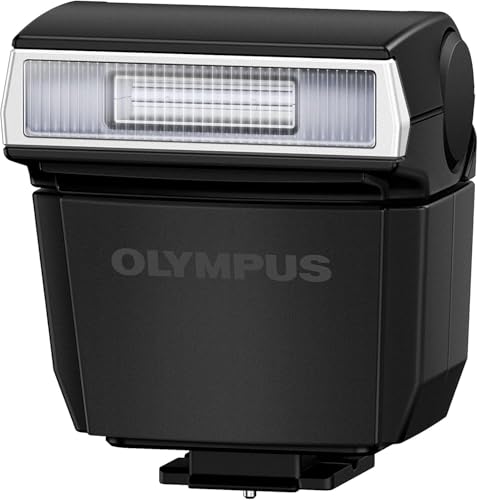
The FL-LM3 is the direct match for replacing the flash bundled with the OM-D E-M5 Mark II. This genuine Olympus accessory has a moveable head for bounce shooting and is dust- and splashproof. Its role is straightforward: a compact replacement rather than a unit specified here with wireless controls or a guide number. Choose it when the bundled-flash replacement and bounce capability are the deciding needs. Buyers seeking a specific output rating or remote wireless operation should compare the other units instead.
Bottom line: Pick this when you need the specified OM-D E-M5 Mark II bundled-flash replacement.
Olympus FL-900R

The FL-900R stands apart with a maker-specified guide number of 58, high-speed sequential shooting and advanced wireless controls. Its dust- and splashproof design and 100-lux LED that serves as a video light or focus-assist lamp add functions beyond the FL-LM3’s described replacement role. Choose it if output and wireless features matter more than matching the E-M5 Mark II bundled accessory.
Bottom line: Choose this for the GN 58 output and wireless-control features.
OM SYSTEM FL-700WR

The FL-700WR is the radio-wireless option, with communication up to 30 m (98 ft), including bright locations and areas with obstructions. Its maker gives a guide number of 42 and 12–75 mm equivalent coverage (24–150 mm in 35 mm equivalent terms); it also has a dust-, splash- and freezeproof design rated to -10°C (14°F). It can act as commander or receiver, while the FC-WR commander and FR-WR receiver are sold separately. It is a different type of choice from the FL-LM3 bundled-flash replacement.
Bottom line: Choose this when radio triggering and the specified coverage range fit your setup.
Olympus FL-600R

The FL-600R has the clearest specified head adjustment of these alternatives: it tilts up to 90 degrees, down to 7 degrees and swivels 180 degrees in either direction. Its built-in commander can fire other wireless units without firing itself, and it can also serve as a slave. The unit includes a built-in LED for AF illumination or movie lighting, plus a wide panel and catch-light plate. Choose it for those stated positioning and control options; it is not identified as the E-M5 Mark II bundled-flash replacement.
Bottom line: Pick this when extensive head positioning and commander/slave modes are priorities.
Olympus FL-LM1

The FL-LM1 is a dedicated flash for E-PM1 and E-PL3 Micro Four Thirds cameras, rather than the E-M5 Mark II replacement. Its guide number is 10 at ISO 200, and TTL as well as wireless TTL operation are supported. The flash draws power from the camera, so it requires no separate batteries. That camera-specific fit and low stated guide number make it a distinct option from the FL-LM3; choose it only when the named camera compatibility and camera-powered design match your setup.
Bottom line: Choose this for an E-PM1 or E-PL3 when camera-powered operation is useful.
How to Choose an Olympus Camera Flash
Start with camera fit, then decide whether you need bounce, wireless triggering or a guide number. A guide number is a measure of flash output: at a fixed ISO and flash-to-subject distance, a higher guide number supports a smaller aperture; doubling the distance requires roughly four times the light output to hold exposure. The FL-900R specifies GN 58, while the FL-700WR specifies GN 42 and the FL-LM1 specifies GN 10 at ISO 200. These figures are not directly interchangeable unless ISO and coverage conditions match. For bounce, the head must tilt toward a nearby reflective surface; a dark or very high ceiling absorbs or scatters light, so direct flash or a more powerful setup may be preferable.
Check Camera Compatibility Before Choosing
Camera fit is the first decision because a flash must communicate with the camera’s shoe and exposure system, not merely attach physically. The FL-LM3 is identified as the replacement for the flash bundled with the OM-D E-M5 Mark II, while the FL-LM1 is dedicated to E-PM1 and E-PL3 cameras. Wireless features also differ: radio communication, optical or TTL control, and commander/slave modes are not interchangeable terms. Before purchasing any alternative, confirm its compatibility with your exact camera model and the functions you plan to use. If wireless control is essential, distinguish the FL-700WR’s radio range from the FL-600R’s commander and slave operation; neither fact establishes compatibility with every Olympus body.
When Bounce Flash Helps
Bounce flash redirects light off a ceiling or wall, which can spread illumination and soften hard-edged shadows compared with aiming the flash directly at a nearby subject. A white or neutral-colored surface is preferable because colored walls can tint reflected light, while dark surfaces absorb more of the flash. Height and distance matter: a high ceiling or a subject far from the reflecting surface uses more light than a low, nearby surface. The FL-LM3 is specifically described as bounce-capable, and the FL-600R gives explicit tilt and swivel ranges. Keep a direct-flash option available when there is no suitable surface; bounce is not an automatic improvement in every room.
Understanding Guide Numbers and Coverage
Guide number and lens coverage answer different questions: guide number describes output, while coverage describes the angle of view the flash can illuminate. A flash with adequate output can still leave the edges of a wide-angle frame dark if its coverage is too narrow. The FL-700WR gives a 12–75 mm equivalent coverage range and also provides the 35 mm equivalent range of 24–150 mm. Its wireless reach of 30 m (98 ft) is a communication range, not a promise that the flash will illuminate a subject at that distance. Match coverage to the lens angle you use most, and treat wireless range and exposure range as separate limits.
Frequently Asked Questions
What does a flash guide number tell me?
A guide number indicates flash output under a specified ISO and coverage condition. At the same ISO, doubling subject distance requires about four times the light to maintain the same exposure, so guide numbers should be compared only when their conditions match.
Can I bounce a flash off a colored wall?
Yes, but reflected light can take on the wall’s color and tint the subject. A white or neutral surface usually preserves color better, while dark surfaces absorb more light.
Does wireless flash range equal lighting distance?
No, wireless range describes communication between controls and flash, not how far the flash can properly illuminate a subject. The FL-700WR specifies communication up to 30 m (98 ft), while exposure still depends on output, distance and camera settings.
Why does flash coverage matter with a wide lens?
Coverage determines how wide an area the flash can illuminate, while guide number concerns output. A lens angle wider than the flash coverage can leave frame edges dark, so compare the flash’s coverage with the focal lengths you use.
Do dust- and splashproof flashes tolerate immersion?
Dust- and splashproof wording does not establish waterproofing or permission to submerge a flash. Keep flash equipment out of standing water, and do not use it in conditions beyond the camera and flash makers’ stated limits.