
Car FM Modulator With Bluetooth: 5 Options Compared

The Nulaxy 54W Bluetooth adapter suits most drivers who want wireless audio and four charging ports in one car FM modulator. Choose a different option if a screen, flexible display angle, or music playback from a USB drive or memory card matters more.
We earn a commission if you buy through links on this page. As an Amazon Associate I earn from qualifying purchases. Products are compared on manufacturer specifications, not hands-on testing.
- Best overall: Nulaxy BC91 54W Bluetooth Adapter – Combines Bluetooth FM audio with four charging ports and up to 54W output.
- Best for a display: Nulaxy KM18 Bluetooth Adapter – Adds a 1.44-inch LCD screen and flexible gooseneck for viewing angle adjustment.
- Best for stored music: LENCENT T25 FM Transmitter – Supports music from USB drives and microSD cards up to 32GB.
- Best for switchable lights: Bluetooth 5.4 54W FM Transmitter – Offers a control to turn off the ambient lighting.
| Product | Best for | Charging output | Display | Other playback | Shop |
|---|---|---|---|---|---|
| Nulaxy BC91 54W Bluetooth Adapter | Multi-device charging | 54W max; PD 36W + QC 3.0 18W | — | Bluetooth | Check Price on Amazon |
| Nulaxy KM18 Bluetooth Adapter | Visible controls | — | 1.44-inch LCD | Bluetooth; aux input/output | Check Price on Amazon |
| LENCENT T25 FM Transmitter | Stored music playback | 5V/2.4A + 5V/1A | — | Bluetooth; USB drive; microSD | Check Price on Amazon |
| Bluetooth 5.4 54W FM Transmitter | Four-port charging | 54W max; four ports | — | Bluetooth | Check Price on Amazon |
| Syncwire 48W Bluetooth Adapter | Controllable lighting | 48W max; PD 36W + 12W | LED display | Bluetooth; USB drive | Check Price on Amazon |
Car FM Modulators With Bluetooth
Compare how each adapter sends audio to the car radio and what extras distinguish it.
Nulaxy BC91 54W Bluetooth Adapter

Four charging ports and a combined maximum output of 54W set this adapter apart for drivers powering several devices. Nulaxy says its Bluetooth 5.3 connection supports auto-pairing and wireless music streaming, and its features include hands-free calls, bass enhancement, and five switchable LED effects. The charging mix is PD 36W and QC 3.0 18W. It suits a shared car where charging access matters as much as radio audio. The tradeoff is that the feature set does not identify a display or USB-drive playback, so drivers who want those functions should consider another option.
Bottom line: Pick this for up to four simultaneous charges alongside Bluetooth audio.
Nulaxy KM18 Bluetooth Adapter
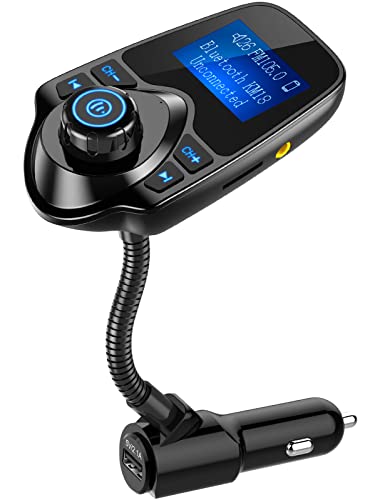
A 1.44-inch LCD and flexible gooseneck distinguish this adapter from simpler plug-in transmitters. The screen can show calls, FM channels, music, and vehicle battery voltage; the adjustable neck helps aim it toward the driver. Nulaxy says its noise-cancellation feature is intended to improve hands-free call clarity. This is a practical fit for drivers who want channel and call information visible at a glance, particularly in an older car using FM radio. Its charging output is not among the features, so it is a weaker match when charging multiple devices is the main priority.
Bottom line: Choose this when a readable screen and adjustable viewing angle matter.
LENCENT T25 FM Transmitter
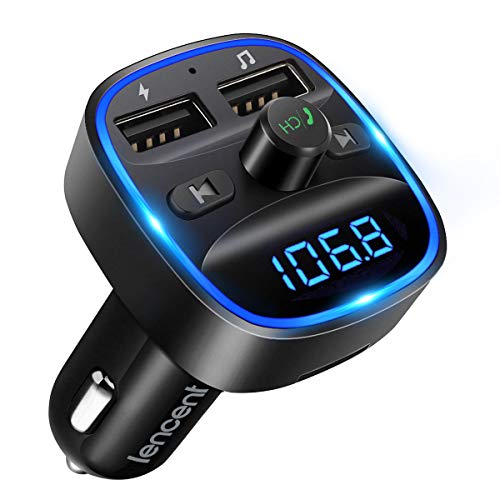
Playback from USB drives and microSD cards separates the LENCENT T25 from Bluetooth-only choices. It supports USB and microSD media up to 32GB, with MP3, WMA, WAV, APE, and FLAC formats, as well as Bluetooth streaming. Its two USB ports provide 5V/2.4A and 5V/1A output, and the features include hands-free calling and voice navigation. That combination suits drivers who keep music files offline or use a phone for navigation. The limitation is the lower-output charging arrangement compared with the 54W, four-port options; it is less suited to charging several power-hungry devices at once.
Bottom line: Pick this if local USB or microSD music playback is useful.
Bluetooth 5.4 54W FM Transmitter

Four charging ports, split between two USB-C and two USB-A, are the key distinction on this Bluetooth 5.4 transmitter. The maker claims up to 54W maximum output and lists fast-charge profiles including 5V/3A, 9V/3A, and 12V/3A, with actual charging dependent on the device. A blue LED ring provides visibility and indicates power status. This option suits drivers who want several port types for a mix of phones and accessories. Its feature set centers on Bluetooth-to-FM audio and charging, rather than a screen or card playback, so those seeking visible channel information should look elsewhere.
Bottom line: Choose this for four USB-C and USB-A charging ports.
Syncwire 48W Bluetooth Adapter

A light-off control and a display make the Syncwire distinct from the other options. Syncwire says a double press of the red B button turns off the ambient lights, while the display and USB-drive support add utility beyond Bluetooth streaming. Its charging output is 48W, split between PD 36W and 12W; the maker also describes Bluetooth 5.4 connectivity and bass enhancement. This suits drivers who want to reduce cabin lighting at night without giving up a visible display. At 48W, it has less maximum total output than the 54W adapters, which matters if several devices are charging together.
Bottom line: Pick this if light control and USB-drive support are priorities.
How Bluetooth FM Modulators Work
A Bluetooth FM modulator sends phone audio over a short-range radio signal that the car stereo receives on a selected FM frequency. The phone pairs with the adapter; then the car radio is tuned to the same frequency. This method is useful when a stereo lacks Bluetooth or an auxiliary input, but the car still needs an FM radio and a compatible power connection. FM radio occupies 88.1–107.9 MHz in the United States, with stations spaced in 0.2 MHz steps. Start by choosing an unused frequency on the car stereo, then set the transmitter to match it. If a station or static becomes audible, try another clear frequency; reception changes by location.
How to Choose a Clear FM Frequency
A clear frequency with no strong nearby station usually gives the cleanest transmitter audio. Scan the FM band while parked and listen for quiet gaps rather than choosing a frequency that only sounds empty for a moment. Stations can become stronger or weaker as the car moves, especially near cities and hills, so interference may require a new setting during a drive. Keep the radio and transmitter tuned to the same channel; even a small mismatch can make audio weak or noisy. FM transmitters do not replace the stereo, and their sound can be affected by broadcast interference. Set the channel before driving rather than handling the controls in traffic.
What Features Matter for a Car FM Modulator
Charging output, port mix, display, and playback sources are the meaningful differences between these adapters. For one phone, a single fast-charge port may be enough; for multiple devices, compare the number and type of ports as well as the combined maximum output. A USB-C port alone does not guarantee fast charging: the phone and adapter must support a compatible charging protocol. An LCD can make channel and call information easier to check, while USB-drive or microSD playback can provide music without phone streaming. Compare those functions against what the car stereo lacks. A model with more features is useful only if its particular port, screen, or media input solves a real need.
| Need | Feature to prioritize |
|---|---|
| Several devices charging | Port count and combined output |
| Channel or call visibility | LCD or LED display |
| Offline music files | USB-drive or card playback |
| Phone audio without an aux cable | Bluetooth-to-FM transmission |
Power Socket Fit and Safe Setup
Most plug-in FM adapters are intended for a vehicle accessory socket, but socket location and clearance vary by car. Before choosing a larger adapter, check that its body, screen, or gooseneck will not obstruct gear controls, cup holders, or the driver’s view. Charging output is shared across ports on many multi-port chargers, so multiple connected devices may not each receive the maximum output simultaneously. Keep cables secured away from pedals and steering controls. Pair the phone and tune the FM channel while parked; avoid adjusting a screen or transmitter while the vehicle is moving. If the socket becomes unusually hot or charging repeatedly cuts out, disconnect the adapter and check vehicle and device guidance.
Frequently Asked Questions
Why does my Bluetooth FM transmitter sound static?
Static usually means the selected frequency is being affected by a broadcast station or interference. Choose a quieter frequency within the U.S. FM band of 88.1–107.9 MHz and retune both the car radio and transmitter to match.
Can an FM transmitter work in a car without Bluetooth?
Yes, if the car has an FM radio and a compatible power socket. The phone pairs to the transmitter, which sends audio to the radio over an FM frequency.
How do I pair a phone with an FM modulator?
Park first, power the adapter, select its Bluetooth device from the phone’s Bluetooth settings, and tune the radio to the matching FM frequency. If pairing fails, remove an old saved pairing and try again.
Will an FM transmitter charge a phone quickly?
Fast charging depends on the adapter’s output, the phone’s supported protocol, and the cable. A port marked PD or QC can only use that charging mode when the phone and cable are compatible.