
Best Shoulder Brace for Lifting Weights: 4 Compared

For most people lifting weights, Anaconda Fightwear Shoulder Brace, Large is the clearest fit because it is designed for training and includes a detachable gel pad for impact absorption. Choose a brace with broader adjustment or a different sleeve style if its large size does not match your shoulder.
Shoulder braces provide compression or limit movement to varying degrees; they are not a substitute for medical assessment when pain is severe or follows an injury.
We earn a commission if you buy through links on this page. As an Amazon Associate I earn from qualifying purchases. Products are compared on manufacturer specifications, not hands-on testing.
- Best overall: Anaconda Fightwear Shoulder Brace, Large – Designed for athletes and training, with a detachable gel pad for impact absorption.
- Best for adjustable straps: Sparthos Rotator Cuff Shoulder Brace – Universal fit with adjustable chest and arm straps and moderate stabilization.
- Best for stronger support: FIGHTECH Rotator Cuff Shoulder Brace, Large – Offers medium-to-strong support in a wrap-style design.
| Product | Best for | Fit | Support style | Extra feature | Shop |
|---|---|---|---|---|---|
| Anaconda Fightwear Shoulder Brace, Large | Training with padding | Large | 3D compression | Detachable gel pad | Check Price on Amazon |
| Sparthos Rotator Cuff Shoulder Brace | Adjustable compression | Universal | Moderate stabilization | Chest and arm straps | Check Price on Amazon |
| FIGHTECH Rotator Cuff Shoulder Brace, Large | Wrap-style support | Large/X-Large | Medium to strong | Adjustable shoulder wrap | Check Price on Amazon |
| Komoko Shoulder Brace | Durable neoprene | Adjustable | Compression sleeve | Neoprene rubber | Check Price on Amazon |
Shoulder Braces for Lifting Weights
Compare each brace’s fit and support style with the movements and loads in your training plan.
Anaconda Fightwear Shoulder Brace, Large

For training-oriented support, this large brace pairs 3D compression with a detachable gel pad intended to absorb shock. The maker positions it for athletes and training, making it the most directly aligned option here for lifting weights. The left/right shoulder adjustment broadens placement, but the large size is a meaningful limitation: check that its fit works for your shoulder before relying on it during a workout. A brace can add compression, but it cannot make a painful lift safe; reduce or stop a movement that worsens symptoms.
Bottom line: Choose this if training use and the detachable pad matter and the large fit suits you.
Sparthos Rotator Cuff Shoulder Brace

Unlike the large, training-focused brace, this universal model uses an adjustable chest strap and arm strap to tailor the fit. It is designed for either shoulder and offers gentle compression with moderate stabilization while allowing movement. That makes it a possible option for lifting only when its universal fit stays secure without restricting the exercise. The maker says it is not intended for severe immobilization, and the product is aimed at mild to moderate discomfort rather than heavy support needs.
Bottom line: Pick this when adjustable straps and a universal fit matter more than impact padding.
FIGHTECH Rotator Cuff Shoulder Brace, Large

This wrap-style brace is described as providing medium-to-strong support, a step up from the moderate stabilization of the universal sleeve. The size is Large/X-Large, with a bicep fit range of 12 to 17 inches, so it gives a concrete sizing check before purchase. Its wrap design may suit someone seeking a more secure-feeling shoulder support, but that degree of support can be limiting during overhead or full-range lifting; do not assume it will suit every exercise.
Bottom line: Choose this if your bicep measures 12 to 17 inches and you want a wrap-style fit.
Komoko Shoulder Brace
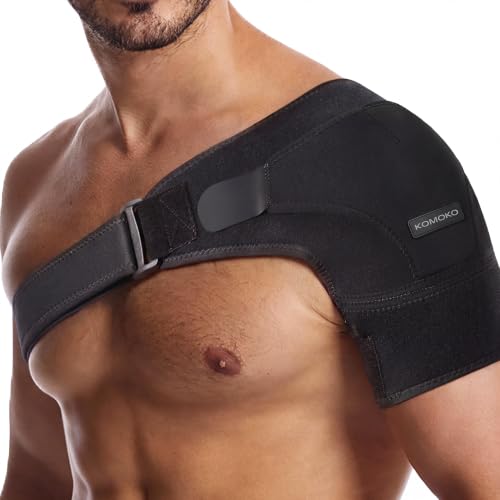
Neoprene construction distinguishes this brace from the adjustable-strap and padded options, and the maker describes it as abrasion- and tear-resistant with stitching intended for repeated washing. It is adjustable, fits either arm, and is designed to retain mobility while providing support. Those traits may suit general athletic use, but its features do not identify a specific support level or a lifting-specific fit. Confirm the sleeve sits securely and comfortably before using it under load.
Bottom line: Pick this if neoprene construction and an adjustable, either-arm fit are your priorities.
How to choose a shoulder brace for lifting weights
Match the brace’s support style to the motion you need rather than choosing the strongest-feeling option. Compression sleeves mainly provide pressure and warmth; straps and wraps can add positioning support, but may limit range of motion. For pressing overhead, confirm that the brace allows your arm to reach the position without pinching or slipping. If a movement causes sharp or increasing pain, stop that lift rather than using a brace to push through it.
Size matters under load: measure where the manufacturer directs, and check that straps stay secure through a full, unloaded range of motion before adding weight. A brace should not cause numbness, tingling, coldness, or color change in the arm; loosen or remove it if those occur.
Compression sleeves and shoulder wraps compared
Compression sleeves and wraps serve different needs: sleeves tend to prioritize coverage and movement, while wrap-style designs use straps to adjust pressure or positioning. Neither style should be treated as a substitute for technique or a diagnosis. The table gives a practical starting point for matching design to a training concern.
| Training need | Design to consider | Tradeoff |
|---|---|---|
| Movement with light compression | Compression sleeve | Less adjustable positioning |
| Adjustable fit around torso and arm | Strap-based brace | Straps need careful fitting |
| More secure wrap feel | Shoulder wrap | May restrict full range of motion |
Warm up with unloaded or light repetitions before increasing weight, especially after time away from training. A brace that shifts or compresses the arm during warmups is a poor fit for the session.
Getting the fit right before a workout
A shoulder brace should stay in place without cutting off circulation or forcing the shoulder into an awkward position. Follow the product’s own size guidance; for the wrap with a 12-to-17-inch bicep range, measure your bicep and compare it with that interval before choosing the size. Universal sizing is convenient, but it does not guarantee the same fit on every torso or arm.
Try the brace through the exact movements planned, first without weight: reach overhead, bring the arm across the chest, and rotate as the exercise requires. If fabric bunches, straps loosen, or movement becomes painful, do not add load. A poorly fitted brace can distract from stable positioning rather than help it.
When to stop lifting with shoulder pain
Stop a lift that produces sharp pain, sudden weakness, a sense of instability, or symptoms that worsen from repetition to repetition. A brace may provide compression or support, but it cannot establish whether a shoulder injury is safe to load. New pain after a fall, a visible change in shoulder shape, or inability to raise the arm warrants prompt medical evaluation rather than a brace-led workout.
For ordinary soreness, reduce load and range of motion instead of forcing a painful rep. Return gradually only when daily movement and light warmup repetitions are comfortable; recurring pain with pressing or pulling deserves assessment by a qualified clinician.
Frequently Asked Questions
Can I lift weights while wearing a shoulder brace?
You can consider light, pain-free lifting if the brace fits securely and does not limit the movement. Test the full range with no weight first, and stop if pain increases or the brace causes numbness or tingling.
Should a shoulder brace feel tight during exercise?
A brace should feel secure, not constricting. Loosen or remove it if your hand becomes numb, tingly, cold, or changes color.
How do I measure for a shoulder brace?
Use the measurement named by the specific brace, such as bicep circumference, and compare it with the maker’s size range. For a 12-to-17-inch bicep range, measure at the same location the sizing guidance specifies.
Can a shoulder brace prevent lifting injuries?
A brace does not guarantee injury prevention or make a painful lift safe. Use controlled loads and stop a movement that causes sharp or worsening pain.
When should I stop training with shoulder pain?
Stop when pain is sharp, worsening, or paired with sudden weakness or instability. Pain following a fall or an inability to raise the arm calls for medical evaluation rather than continued lifting.