
2 Inch Carb Spacer Options Compared by Material and Bore

For a 2 inch carb spacer, Open Phenolic Spacer for Holley 4150/4160 is the clearest fit for a Holley 4150 or 4160 square-bore four-barrel because it pairs an open bore with phenolic construction. Choose another option if you need aluminum, a combination-bore, or a broader stated fit range; verify the carburetor’s bolt pattern and available hood clearance before ordering.
We earn a commission if you buy through links on this page. As an Amazon Associate I earn from qualifying purchases. Products are compared on manufacturer specifications, not hands-on testing.
- Best overall: Open Phenolic Spacer for Holley 4150/4160 – Its 2-inch open phenolic design is specified for Holley 4150 and 4160 square-bore four-barrel carburetors.
- Best for combination bore: CNC Aluminum Combination-Bore Spacer – The aluminum spacer combines a four-hole section with an open plenum.
- Best for included gaskets: Spectre Performance 5769 Open Plastic Spacer – The open phenolic spacer includes gaskets and hardware.
| Product | Best for | Material | Bore design | Included parts | Shop |
|---|---|---|---|---|---|
| Open Phenolic Spacer for Holley 4150/4160 | Holley square-bore | Phenolic resin | Open | Gaskets | Check Price on Amazon |
| Ported Phenolic Spacer, 2 Inch | Broad square-bore fit | Phenolic | Open | Bolts, washers, nuts, 2 gaskets | Check Price on Amazon |
| CNC Aluminum Combination-Bore Spacer | Combination-bore | Aluminum | Four-hole and open | Spacer only | Check Price on Amazon |
| Spectre Performance 5769 Open Plastic Spacer | Open phenolic spacer | Phenolic | Open | Gaskets and hardware | Check Price on Amazon |
| Tall Aluminum Open Square-Bore Spacer | Hardware included | Aluminum | Open | Mounting hardware and gaskets | Check Price on Amazon |
2 Inch Carb Spacer Options
Compare spacer material and bore layout first, then confirm the mounting pattern matches your carburetor and intake.
Open Phenolic Spacer for Holley 4150/4160

Open Phenolic Spacer for Holley 4150/4160 stands out with a fully open bore and a specific fit for Holley 4150 and 4160 four-barrel square-bore carburetors. Its 2-inch phenolic resin body sits between the carburetor and intake manifold, and the maker says its low heat transfer helps limit heat reaching the intake air. The open layout has no internal divider, which suits buyers seeking an unobstructed plenum passage. The limitation is fit scope: owners of other carburetor patterns should confirm compatibility rather than assume a universal fit.
Bottom line: Choose this for a 4150 or 4160 square-bore setup that calls for an open phenolic spacer.
Ported Phenolic Spacer, 2 Inch

Ported Phenolic Spacer, 2 Inch differs by claiming fit across Holley, Chevy, Ford, and Mopar square-bore carburetors, while retaining a 2-inch phenolic body. Its package includes bolts, washers, nuts, and two gaskets, useful when the existing mounting hardware or seals are not being reused. The maker characterizes the spacer as ported and open; buyers should match its actual bore and port shape to both the carburetor base and intake opening. The broad fit claim is less specific than a model-by-model pattern, so check the bolt spacing before choosing it for a non-Holley application.
Bottom line: Pick this when broad square-bore compatibility and supplied mounting hardware matter.
CNC Aluminum Combination-Bore Spacer

CNC Aluminum Combination-Bore Spacer is the distinct choice for an aluminum body and a combination layout that transitions from four holes to an open plenum. The maker specifies CNC-machined construction, a 2-inch height, and fitment across several Chevy, Ford, and GM LS applications; the package contains the spacer alone. That makes it a different option from phenolic open spacers when the bore layout is the deciding feature. Aluminum conducts heat readily, so buyers prioritizing heat isolation should consider a phenolic alternative. Check the carburetor and intake dimensions carefully, since broad engine-family fitment does not guarantee every combination matches.
Bottom line: Choose this when aluminum construction and a four-hole-to-open layout suit your intake.
Spectre Performance 5769 Open Plastic Spacer
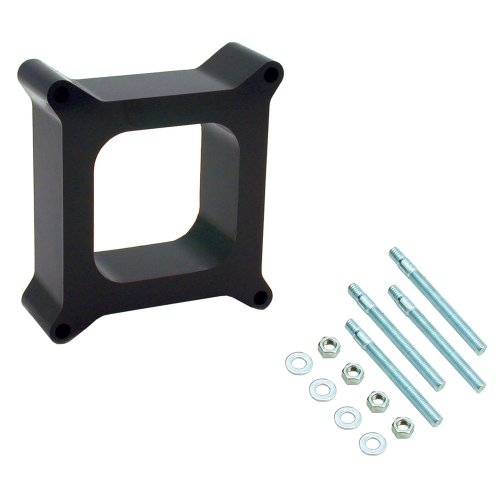
Spectre Performance 5769 Open Plastic Spacer offers an open 2-inch design in heat-insulating phenolic, with gaskets and hardware included. The package contents can simplify assembly when replacing both seals and fasteners. Its limitation is that the carburetor pattern is not identified here; confirm bolt spacing, bore alignment, and available clearance before committing to this option.
Bottom line: Pick this for an open phenolic spacer when its dimensions match your setup.
Tall Aluminum Open Square-Bore Spacer

Tall Aluminum Open Square-Bore Spacer combines a 2-inch open square-bore spacer with mounting hardware and gaskets, and its fit claim names both Holley 4150 and 4160 carburetors as well as other four-barrel square-bore applications. The broader intended use and complete package distinguish it from the more narrowly identified phenolic option. The body is aluminum, unlike the insulating phenolic choices, so it is not the pick for buyers whose main goal is to reduce heat transfer at the carburetor base. Confirm that the spacer’s openings align with both mating surfaces before installation.
Bottom line: Choose this when you want an open aluminum square-bore spacer with hardware and gaskets.
How to choose a 2 inch carb spacer
Start with bore layout and material, because a two-inch height alone does not establish compatibility. An open spacer creates a shared plenum passage, while a four-hole design keeps each throttle bore more separated; a combination design transitions between those layouts. Phenolic is used where lower heat transfer is desired, while aluminum conducts heat more readily and provides a rigid metal body. Match the spacer opening to the carburetor base and intake opening, not just the nominal four-barrel label. A practical rule: if your carburetor is a Holley 4150 or 4160, prioritize a spacer whose fit claim names that pattern; for any other square-bore, confirm bolt spacing and port shape before purchase.
Spacer height, hood clearance, and fit
A 2-inch spacer adds approximately 2 inches of vertical stack height between the carburetor and intake, before accounting for gaskets or other components. Measure from the carburetor mounting face to the underside of the hood with the air cleaner installed; if clearance is under the added spacer height plus the gasket stack, a 2-inch part will not fit without changing the setup. Check both mounting faces for bolt alignment and ensure no opening is partly blocked by the manifold or carburetor base. Square-bore describes a common four-barrel mounting pattern, not a guarantee that every carburetor, gasket, and intake share identical openings. Confirm the engine and carburetor combination before ordering.
Open, four-hole, and combination bores compared
Open-bore spacers connect the four throttle openings through one shared cavity, while four-hole spacers preserve separate passages; combination spacers use both shapes. Bore design affects how the spacer interfaces with the carburetor and manifold, so choose by the intended setup rather than assuming one layout improves every engine. Use this quick comparison to identify what to verify at the mounting faces.
| Design | Layout | Check before choosing |
|---|---|---|
| Open | Shared cavity | Opening alignment and plenum shape |
| Four-hole | Separate passages | Hole spacing and gasket cutouts |
| Combination | Four-hole plus open section | Both carburetor and manifold transitions |
Gaskets should seal the entire mounting face without covering a passage. Recheck fastener engagement after adding spacer thickness.
Installation and heat considerations
Carburetor spacers sit in the fuel-and-air path and must seal securely at both interfaces. Phenolic is commonly selected as a thermal barrier because it transfers less heat than aluminum; aluminum transfers heat readily and should not be mistaken for an insulating material. Before assembly, compare the spacer’s openings with the carburetor and intake, use compatible gaskets, and ensure the fasteners do not bottom out or interfere with surrounding parts. A poor seal can create an intake vacuum leak, so inspect the mating surfaces and verify the installation after assembly. The 2-inch height also raises the carburetor and air cleaner, making hood clearance a fit and safety concern to resolve before driving.
Frequently Asked Questions
Does a 2 inch carb spacer add exactly 2 inches?
A nominal 2-inch spacer adds about 2 inches between the carburetor and intake, with gaskets adding a small amount to the stack. Measure clearance with the air cleaner installed, especially if hood clearance is tight.
Are open and four-hole carb spacers interchangeable?
They are different bore layouts, not automatic substitutes. Match the spacer openings to the carburetor base and intake, since a mismatched edge can obstruct a passage or compromise the seal.
Does phenolic insulate better than aluminum?
Phenolic generally transfers less heat than aluminum, which conducts heat readily. If reducing heat transfer at the carburetor base is the priority, favor a phenolic design with a compatible bore and fit.
How do I check square-bore spacer fitment?
Compare the bolt pattern, bore openings, and gasket cutouts against both the carburetor base and intake. A 4150/4160-specific fit claim is more targeted than a general four-barrel label.
Can a carb spacer cause an intake leak?
Yes, a poor seal at either spacer face can create a vacuum leak. Use properly aligned gaskets, check that the surfaces are clean and flat, and verify fastener engagement after adding the spacer.