
Best Lawn Mower Deck Scraper: 5 Tools Compared

For most mower owners, Good Vibrations Grass Hawk is the strongest choice because its rotating flat and curved blades suit different deck contours. Choose a long-handle scraper if you want more reach, or a scraper-and-brush kit if you also need a brush for crevices.
A deck scraper removes stuck grass and debris from beneath the mower deck; always make the mower safe before reaching near the blade.
We earn a commission if you buy through links on this page. As an Amazon Associate I earn from qualifying purchases. Products are compared on manufacturer specifications, not hands-on testing.
- Best overall: Good Vibrations Grass Hawk – Rotating flat and curved blades handle different deck contours.
- Best for extra reach: SYDERWE Long-Handle Deck Scraper – Its 15.94-inch long handle is designed to reduce bending.
- Best for brush cleaning: Heavy-Duty Scraper and Stiff Brush – The scraper-and-stiff brush combination addresses both heavy buildup and crevices.
- Best for stainless steel: MoJack Stainless Steel Deck Scraper – Its curved stainless-steel blade measures 10.25 inches long and 2 inches wide.
| Product | Best for | Blade or cleaning design | Length | Weight | Shop |
|---|---|---|---|---|---|
| Good Vibrations Grass Hawk | Varied deck contours | Rotating flat and curved blades | 14 in | 0.51 lb | Check Price on Amazon |
| MoJack Stainless Steel Deck Scraper | Curved blade reach | Curved stainless-steel blade | 10.25 in | 0.2 lb | Check Price on Amazon |
| SYDERWE Long-Handle Deck Scraper | Long-handle reach | Scraper blade | 15.94 in | — | Check Price on Amazon |
| Heavy-Duty Scraper and Stiff Brush | Scraping and brushing | Scraper plus stiff-bristle brush | 15 in | — | Check Price on Amazon |
| Mower Deck Cleaning Scraper and Brush Kit | Riding mower kits | Scraper and cleaning brush | 15.8 in | 0.7 lb | Check Price on Amazon |
Lawn Mower Deck Scrapers
Compare blade shape, included cleaning tools and dimensions to match the scraper to your mower deck and reach needs.
Good Vibrations Grass Hawk

Unlike single-edge scrapers, Good Vibrations Grass Hawk switches between a flat blade and a curved blade for different areas of the deck. Its 14-inch tool has a rotating blade knob, and the maker says it can attach to an extension for use under lawn tractors. That flexibility suits owners whose decks have both flat and curved surfaces. The trade-off is that switching blade positions adds a step compared with a fixed scraper, and an extension is not included among the features.
Bottom line: Pick this if you want two blade shapes in one deck-cleaning tool.
MoJack Stainless Steel Deck Scraper
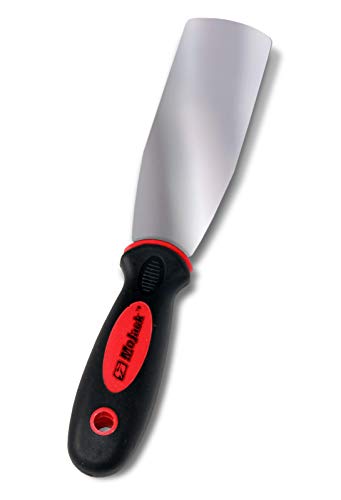
MoJack Stainless Steel Deck Scraper stands apart for its specified 10.25-by-2-inch curved stainless-steel blade and non-slip handle grip. The curved profile is intended to keep the knuckles farther from the deck while maintaining blade contact, making it a fit for concentrated scraping. The maker also says the tool can be used for paint, adhesive and other heavy scraping tasks. Its blade is shorter than the long-handle option, so buyers seeking additional reach or less bending should compare handle length before choosing.
Bottom line: Choose this for a curved stainless-steel blade and a grippy handle.
SYDERWE Long-Handle Deck Scraper

SYDERWE Long-Handle Deck Scraper has the longest overall length among these tools at 15.94 inches, with a handle designed to reduce bending. Its scraper blade is intended to cut through packed grass and debris, and the maker says it works across a wide range of mower deck sizes and styles. This design suits people who prioritize reach over a brush or interchangeable blade.
Bottom line: Pick this if a longer handle matters more than a brush or blade options.
Heavy-Duty Scraper and Stiff Brush

Heavy-Duty Scraper and Stiff Brush pairs a scraper with a stiff-bristle brush, unlike the single-scraper tools. The 15-inch tool is intended to remove heavier debris with the scraper and reach crevices with the brush; the maker also describes an arched handle and a hanging hole. This combination suits owners who want a second cleaning surface for corners and gaps.
Bottom line: Choose this if you want a brush alongside the scraper.
Mower Deck Cleaning Scraper and Brush Kit

Mower Deck Cleaning Scraper and Brush Kit is presented as a scraper-and-brush kit for under-deck cleaning, with dimensions of 15.8 by 3.3 by 2 inches and a weight of 0.7 pound. The maker says it suits riding, zero-turn and push mower decks, so it may suit owners looking for a general-purpose kit rather than a specific blade shape.
Bottom line: Pick this if you want a scraper-and-brush kit for varied mower types.
How to Choose a Lawn Mower Deck Scraper
Choose by the kind of buildup and the shape of the deck: a scraper edge tackles stuck clippings, while a brush can work into crevices. A curved blade can follow rounded surfaces; a flat blade is useful where the deck surface is flatter. A dual-blade tool offers both profiles, while a single-edge scraper keeps the tool simpler. Handle length also matters: a 15-inch tool gives a different reach than a 10.25-inch blade, but overall tool length and blade length are not interchangeable measurements. If you want less bending, prioritize a long handle; if a tight area is the concern, compare the blade width and profile. Confirm those measurements when they determine access under your mower.
Use the table to match a cleaning need with a design rather than treating every scraper as the same shape.
| Need | Design to consider | Trade-off |
|---|---|---|
| Flat and curved deck areas | Rotating flat-and-curved blades | Requires changing blade position |
| Crevices and heavy buildup | Scraper with stiff brush | More than one cleaning surface |
| Less bending | Long-handle scraper | Blade dimensions may still matter |
How to Clean Under a Mower Deck Safely
Make the mower unable to start before scraping: switch it off, remove the ignition key, and disconnect the spark plug wire on a gas mower; remove the battery on a battery-powered mower. Wait for all moving parts to stop, and never put a hand beneath a deck to check for debris. Use the scraper from outside the blade area, following the mower maker’s safe access procedure. A scraper and brush can dislodge packed clippings without reaching in by hand, but they do not make an unsecured mower safe. For riding mowers, use only a lift or access method rated for that mower’s weight, and secure it as directed before working underneath.
Keep the tool edge away from the blade itself: a scraper is for the deck surface, not blade sharpening or blade removal. If the blade must be handled, use the mower manual’s separate blade-service procedure.
When to Remove Grass Buildup
Clear stuck clippings when buildup is visible or after mowing wet or lush grass; damp clippings adhere more readily than dry, loose material. The right interval depends on grass conditions, deck design and how much material the mower discharges, so a fixed calendar schedule is less useful than checking the underside after demanding mowing sessions. Scrape residue while it is accessible rather than letting repeated layers accumulate. A brush can help loosen material in corners after the scraper breaks up the packed layer. Avoid forcing a metal edge into paint or deck surfaces: use controlled strokes and stop if the tool catches, since gouges can damage the finish.
Cleaning can help limit trapped moisture and debris, but it does not replace inspecting the deck for damage or following the mower maker’s maintenance schedule.
Scraper and Brush Tool Differences
A scraper focuses force along an edge, while a brush loosens debris with bristles; a combined tool offers both approaches. A curved edge is shaped for rounded deck contours, and a flat edge suits flatter surfaces. Blade material and width affect the contact area and feel, but this comparison only provides those measurements for some options, so match known dimensions to the access you need. A longer handle can reduce bending, although it may be less convenient in confined storage. Do not assume a scraper fits every deck simply because it is marketed for mower cleaning; check clearance and tool reach against your mower’s layout.
Choose the simplest arrangement that covers your deck: one scraper for straightforward buildup, a brush combination for crevices, or multiple blade profiles when the deck contours vary.
Frequently Asked Questions
How often should I scrape grass from under my mower deck?
Check for buildup after mowing, especially when grass is wet or growing quickly. Remove stuck clippings when they appear rather than waiting for repeated layers to harden.
Can I use a deck scraper with the mower running?
No. Switch the mower off, remove the key, and disconnect the spark plug wire or battery before cleaning. Wait until all moving parts stop, and keep hands out from beneath the deck.
Is a curved scraper better for every mower deck?
A curved edge can follow rounded deck contours, while a flat edge suits flatter areas. If your deck has both shapes, a tool with both blade profiles can address each without relying on one edge.
Can a mower deck scraper replace a cleaning brush?
A scraper edge is useful for stuck layers, while bristles can reach crevices and loosen residue. If your cleaning routine includes both tasks, consider a combined scraper-and-brush tool.
Should I use a pressure washer under my mower deck?
Avoid directing high-pressure water at bearings, seals, electrical parts or the engine, where water can force its way into components. A scraper and controlled cleaning method reduce the risk of spraying sensitive areas.