
Terrarium Kits for Adults: 5 DIY Kits Compared

PYEF CRAFTS 34 fl oz Jar Kit is the closest match for a closed-jar terrarium project because it includes a 34 fl oz glass jar, cork lid, materials, and tools. Choose 13-Piece 5.5 × 9 in Glass Jar Kit for a second jar option; choose a supply-only set if you already have a container or want to select one yourself.
Terrariums are planted displays in clear containers: closed builds retain humidity, while open builds allow more airflow. Match the setup to the plants, since mosses and many small tropical plants suit humid conditions, while succulents generally need an open, dry environment.
We earn a commission if you buy through links on this page. As an Amazon Associate I earn from qualifying purchases. Products are compared on manufacturer specifications, not hands-on testing.
- Best overall: PYEF CRAFTS 34 fl oz Jar Kit – Includes a 34 fl oz jar, cork lid, materials, tools, and an illustrated guide; plants are separate.
- Best for a larger jar: 13-Piece 5.5 × 9 in Glass Jar Kit – Includes a 5.5 × 9 inch glass jar with a fitted lid, plus tools and landscaping supplies.
- Best for your own container: DUSPRO Medium Supply Kit – Supplies are intended for roughly 5–7 inch containers, with the jar and plants supplied separately.
| Product | Best for | Container | Intended setup | Shop |
|---|---|---|---|---|
| PYEF CRAFTS 34 fl oz Jar Kit | Closed jar builds | 34 fl oz glass jar | Closed | Check Price on Amazon |
| 13-Piece 5.5 × 9 in Glass Jar Kit | Wide-mouth jar builds | 5.5 × 9 in glass jar | Closed | Check Price on Amazon |
| DUSPRO Medium Supply Kit | Existing containers | Not included | Open | Check Price on Amazon |
| Alphatool Terrarium Accessories Kit | Decorative accents | Not included | Open or closed | Check Price on Amazon |
| Cute Farms Large Terrarium Kit | Reusing a container | Not included | Open | Check Price on Amazon |
Terrarium kits for adults
Compare each set by whether it supplies the glass container, the intended build style, and the materials you will need to add.
PYEF CRAFTS 34 fl oz Jar Kit

For a closed-jar build, this set supplies the glass jar as well as the planting materials and tools, unlike the supply-only options. The 34 fl oz jar has a cork lid; the kit also includes a coconut soil brick, decorative stones, sphagnum moss, activated charcoal, tweezers, spoon, rake, trowel, and illustrated guide. Plants are not included, so choose plants suited to a humid, enclosed environment rather than adding a dry-climate succulent. The jar makes this a ready-to-assemble option, but buyers wanting a container-free kit may prefer supplies intended for their own vessel.
Bottom line: Choose this if you want a lidded jar and tools in one set and will source suitable plants separately.
13-Piece 5.5 × 9 in Glass Jar Kit
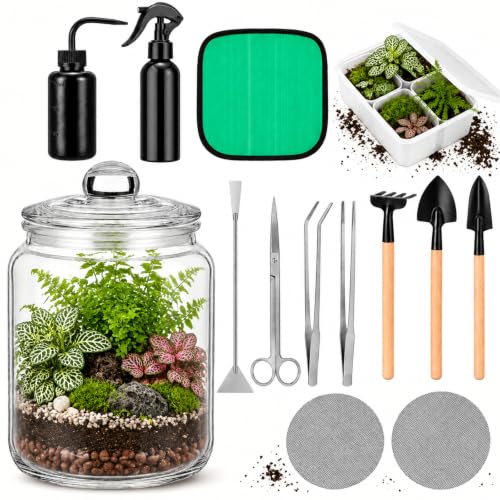
The included 5.5 × 9 inch glass jar and fitted lid distinguish this set from kits that require you to bring your own container. Its wide mouth is intended to make layering and access easier, and the kit includes landscaping, planting, and care tools. Add your own moss, fern, or other suitable small plants; live plants are not included. This is a practical match for someone who wants a closed-container starting point, but the dimensions may not suit a shelf or display area with limited room. Measure the intended spot and make sure the opening can accommodate your planned planting.
Bottom line: Pick this for a lidded jar with a wide opening, provided its dimensions fit your space.
DUSPRO Medium Supply Kit

This supply-only set is aimed at approximately 5–7 inch glass containers, making it a fit for a buyer who already has a vessel or wants to choose one separately. The kit includes potting mix, pumice, zeolite, green moss, sphagnum moss, decorative stone, mesh, care tools, and a layer-by-layer guide. The container and plants are separate purchases, so this is less ready-to-build than the jar kits. Its container range is approximate because container shape and layer thickness affect fit; check the opening and usable interior volume before assembling the layers.
Bottom line: Choose this if you have a roughly 5–7 inch container and want a guided supply set.
Alphatool Terrarium Accessories Kit

Six mushroom ornaments set this accessories kit apart from the more functional supply sets. It also provides pumice, dried moss, activated charcoal, soil, white pebbles, two tools, and step-by-step instructions. The glass container and live plants are separate, so you can choose the vessel and planting style yourself. Use the contents with plants suited to that setup: a closed humid vessel and an open dry arrangement call for different plants. The decorations are an added design element rather than a substitute for choosing compatible plants or a container with enough room for the intended arrangement.
Bottom line: Pick this if you want mushroom ornaments and already have a suitable container.
Cute Farms Large Terrarium Kit

This large supply kit is built around reusing a container you already own, and includes a build-and-care guide, succulent care guide, bamboo tongs, a natural-hair brush, and three miniature dinosaurs. Its materials include moss, potting soil blended with activated charcoal, vermiculite, pea pebbles and river stones, plus plant food. You supply both the container and plants. Because the set is positioned for succulent terrariums, pair it with an open container rather than sealing moisture-loving plants inside; succulents generally need airflow and soil that dries between watering. The kit is not the right fit if you need glass included.
Bottom line: Choose this for a supply set with succulent-focused guidance and decorative dinosaurs.
How to choose a terrarium kit for adults
Start with the plants and container style: humid, closed terrariums suit many mosses and small tropical plants, while succulents and cacti generally need open airflow. A closed setup retains moisture, so watering should be sparse once it reaches a stable cycle; an open setup loses moisture faster and needs plant-specific watering. Next, check whether the set includes a container. A jar kit is more complete for building, while a supply kit lets you choose the vessel but leaves its size and opening to you. Match the container to the planting plan, not just the decorations: plants need room to grow, and narrow openings can make arranging and later trimming harder.
Closed and open terrariums compared
Closed and open terrariums are different growing environments, not interchangeable display styles. A closed container traps humidity and recycles much of its moisture through condensation; an open container exchanges air and dries more readily. Use this guide to match the plant group to the build before selecting supplies.
| Build style | Plant fit | Water and placement |
|---|---|---|
| Closed with lid | Mosses and many humidity-loving tropical plants | Water sparingly; keep out of direct sunlight |
| Open container | Succulents and cacti | Allow soil to dry between watering; provide suitable light |
These are broad plant-group guidelines, not a guarantee that every species fits. Avoid combining plants with sharply different moisture needs in one vessel.
Container size and opening to check
Measure the space available and the container opening before building. A wide mouth gives hands and tools more room for arranging layers and retrieving dead leaves; a narrow-neck vessel can make planting and maintenance awkward. For a kit intended for roughly 5–7 inch containers, use a vessel in that approximate range and account for its shape and the thickness of each layer. A jar’s capacity alone does not show how much planting area it offers, so check both usable interior dimensions and opening width. Keep the finished terrarium away from direct sun: sunlight through glass can heat the interior quickly and stress plants.
Terrarium layering and maintenance basics
Use a restrained amount of water when establishing a closed terrarium: the growing medium should be damp, not waterlogged. A drainage layer can hold excess water below the planting medium, but it does not drain through a sealed jar; adding too much water can still leave roots sitting in soggy conditions. Activated charcoal is commonly included in terrarium kits, but it does not replace clean materials or appropriate watering. After closing a humid terrarium, light condensation can appear as moisture cycles; persistent heavy droplets or saturated soil are cues to vent the lid briefly and reassess watering. Remove decaying leaves promptly, and handle glass carefully because a dropped jar can break and leave sharp fragments.
Frequently Asked Questions
Can succulents grow in a closed terrarium?
Succulents generally do better in an open container because they need airflow and soil that dries between watering. A sealed, humid jar can keep the growing medium wet for too long.
How often should a closed terrarium be watered?
A stable closed terrarium usually needs little supplemental water because moisture cycles inside the container. Start with damp rather than saturated soil, and add water only if the medium dries and condensation is absent over time.
Does a terrarium need a drainage hole?
A closed glass jar commonly has no drainage hole, so use very little water and avoid saturating the soil. A gravel or pumice layer can provide space for excess water, but it cannot remove water from a sealed vessel.
Where should I place a glass terrarium?
Place a glass terrarium in bright indirect light rather than direct sun. Sunlight can heat a glass enclosure and expose plants to excessive heat.
Can I mix different plants in one terrarium?
Combine plants only when they need similar moisture and airflow. Mosses and humidity-loving tropical plants can suit a closed setup, while succulents and cacti are better suited to open containers.