
Barnakl Ceiling Fan Filter: 3 Pads Compared by Media

The Barnakl coconut-shell carbon ceiling fan filter is the clearest starting point because it combines a five-pad set with a universal fit. Choose a different pad if you specifically want zeolite or an XL dust-management option.
Ceiling fan filter pads attach to blades; they are not a substitute for a room air cleaner with a published clean-air delivery rate.
We earn a commission if you buy through links on this page. As an Amazon Associate I earn from qualifying purchases. Products are compared on manufacturer specifications, not hands-on testing.
- Best overall: Barnakl Coconut-Shell Carbon Pads – Five coconut-shell carbon pads with an easy-stick universal fit.
- Best for zeolite: Barnakl Pet Fresh Zeolite Pads – Five unscented zeolite pads with a Velcro attachment.
- Best for XL fit: Barnakl Ultra Fresh XL Filters – Five extra-large pads combining zeolite and coconut-shell carbon.
| Product | Best for | Filter media | Fit | Shop |
|---|---|---|---|---|
| Barnakl Coconut-Shell Carbon Pads | Carbon media | Coconut-shell carbon | Universal | Check Price on Amazon |
| Barnakl Pet Fresh Zeolite Pads | Zeolite media | Zeolite | Universal | Check Price on Amazon |
| Barnakl Ultra Fresh XL Filters | XL dust management | Zeolite and coconut-shell carbon | Extra large | Check Price on Amazon |
Barnakl Ceiling Fan Filters
Compare the pad materials and stated fit before choosing a set for your fan blades.
Barnakl Coconut-Shell Carbon Pads
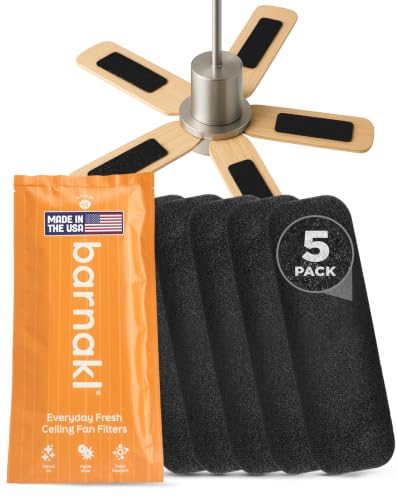
The coconut-shell carbon version stands apart with its renewable carbon media and stated universal fit. Barnakl says the pads are intended to trap dust, odors and allergens, and the five-count set uses an easy-stick attachment. The unscented, odorless design suits buyers who want pads without added fragrance. This is a blade accessory, not a rated room air purifier: the specifications provide no clean-air delivery figure for comparing whole-room particle removal. Confirm the pad sits securely on your blade before running the fan.
Bottom line: Choose this set if you want coconut-shell carbon pads with a universal fit.
Barnakl Pet Fresh Zeolite Pads

Zeolite, rather than carbon, distinguishes this five-pad set. Barnakl describes it as a pet-home accessory and specifies an unscented pad with a Velcro attachment for ceiling fan blades. That combination may suit buyers who prefer zeolite media and a removable fastening style. The pet-focused positioning does not establish a measured reduction in pet allergens or odors, so do not treat it as a replacement for a room purifier or routine cleaning. Check that the attachment can sit flat and secure on your blade.
Bottom line: Pick these pads if zeolite and a Velcro attachment match your preference.
Barnakl Ultra Fresh XL Filters
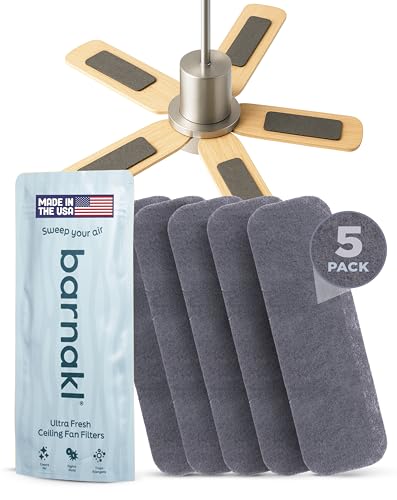
The extra-large size and combination of zeolite with coconut-shell carbon set this five-pack apart from Barnakl’s single-media pads. Barnakl says the fragrance-free filters are designed to help manage dust buildup on fan blades, which may appeal to buyers focused on routine blade maintenance. The specifications do not give a blade-width measurement, so the XL label alone cannot establish a fit for a particular fan. Compare the actual pad dimensions with the available blade surface before ordering; choose another fit if the pad would overhang.
Bottom line: Choose this option when an XL pad and blended media suit your blade and preference.
How to Choose a Ceiling Fan Filter
Choose a ceiling fan filter by matching its media and attachment to the blade, not by assuming it works like a rated air cleaner. Carbon is commonly used to adsorb odors and some gases; it is not the same as a particle filter with a published efficiency rating. Zeolite is a porous mineral used as an adsorbent, while a blended pad combines media types without proving a particular performance level. Check the pad’s full dimensions against the usable blade surface. If the pad cannot sit flat without overhanging, choose a different size or style.
Look for an attachment method before deciding: adhesive-style pads and hook-and-loop fasteners differ in removability. A universal-fit claim still does not guarantee every blade shape or surface will hold a pad securely.
What Fan Filter Pads Can and Cannot Do
Fan blade pads move with the fan and can provide a surface for dust collection, but they do not carry the standardized MERV rating used for many HVAC filters. MERV ratings describe particle capture under a test method; a pad without such a rating cannot be compared on that scale. Likewise, whole-room air cleaners commonly publish a clean-air delivery rate, or CADR, while these pads provide no such comparison figure.
A ceiling fan circulates room air rather than drawing it through a sealed filter housing. Use a properly sized room purifier when measured particle-cleaning performance matters, and treat blade pads as an accessory rather than an equivalent replacement.
Fit and Installation for Ceiling Fan Pads
Fit depends on the blade’s flat usable area and the pad’s actual dimensions. Measure the blade width where the pad will sit and confirm the pad can lie flat without covering a blade edge or hanging over it. Product size labels such as “XL” are not measurements, so compare dimensions directly when choosing a non-universal option.
Turn the fan off at its wall control before attaching or adjusting pads, and wait for the blades to stop completely. After installation, check that every pad is secure and positioned consistently; an unevenly placed or loose pad can affect balance. If the fan wobbles or a pad shifts, stop the fan and correct the fit before using it again.
Maintaining Ceiling Fan Filter Pads
Inspect fan pads about once a month as a practical starting point, especially in dusty rooms or kitchens where particles can accumulate faster. Replace or clean a pad only as its maker directs; accumulated dust can reduce its usefulness and may be released during removal. Turn the fan off and let it stop before handling a pad.
Fan blades still need periodic cleaning because a pad does not cover every blade surface or prevent dust from settling elsewhere. Avoid wetting a pad unless its care instructions allow it, and do not use a pad that no longer stays attached. A loose accessory on a rotating fan is a safety concern, so remove it before running the fan again.
Frequently Asked Questions
Do ceiling fan filter pads replace a HEPA air purifier?
No. A ceiling fan pad is not a HEPA purifier, and HEPA units filter air through a defined filter rather than relying on blade-mounted media. Choose a room purifier with a published CADR when you need a whole-room performance comparison.
How often should I inspect ceiling fan filter pads?
Inspect pads about once a month, then more often in a dusty room or kitchen. Replace or clean them according to their maker’s care directions, and remove any pad that loosens.
Can universal fan filter pads fit every ceiling fan?
No universal label guarantees fit on every blade shape or surface. Measure the usable blade area and check that the pad lies flat without overhanging before running the fan.
Can a loose filter pad make a ceiling fan wobble?
A loose or unevenly positioned pad can affect balance on a rotating fan. Turn the fan off, wait until the blades stop, and secure or remove the pad before use.
Do activated carbon pads remove airborne particles?
Activated carbon is commonly used to adsorb odors and some gases, but it is not a particle-efficiency rating. Look for a MERV rating or a room purifier’s CADR when comparing particle removal.