
Best Drill-Powered Wire Strippers for Copper Cable

StripMeister Original Pro suits most people because its ULTRA GRIP feeder is designed for jam-resistant stripping of residential cable. Choose Trivd Frol Dual-Drive Stripper, StripMeister Original, or CREWORKS Manual Wire Stripper instead if you need a wire-size range or a hand-crank option alongside drill power.
A drill-powered wire stripper uses a drill to turn a blade that removes insulation from wire; confirm the maximum wire diameter before ordering if your cable size is critical.
We earn a commission if you buy through links on this page. As an Amazon Associate I earn from qualifying purchases. Products are compared on manufacturer specifications, not hands-on testing.
- Best overall: StripMeister Original Pro – Its ULTRA GRIP feeder is designed for residential cable, including twisted or kinked cable.
- Best for dual drive: Trivd Frol Dual-Drive Stripper – It supports drill or hand-crank operation and covers wire from 0.06 to 1 inch.
- Best for precision machining: StripMeister Original – Its range is 1/8 to 3/4 inch and it is made with 5-axis CNC milling.
- Best for adjustable sizing: CREWORKS Manual Wire Stripper – Three feed-hole plates cover wire from 0.06 to 1 inch, with a blade-height adjustment knob.
| Product | Best for | Wire range | Drive | Shop |
|---|---|---|---|---|
| StripMeister Original Pro | Residential cable | — | Drill | Check Price on Amazon |
| Trivd Frol Dual-Drive Stripper | Dual-drive flexibility | 0.06–1 in. | Drill or hand crank | Check Price on Amazon |
| StripMeister Original | Machined construction | 1/8–3/4 in. | Drill | Check Price on Amazon |
| CREWORKS Manual Wire Stripper | Adjustable feed sizes | 0.06–1 in. | Drill or hand crank | Check Price on Amazon |
Drill-Powered Wire Strippers
Compare the wire ranges and drive options to match a stripper to your cable and work style.
StripMeister Original Pro
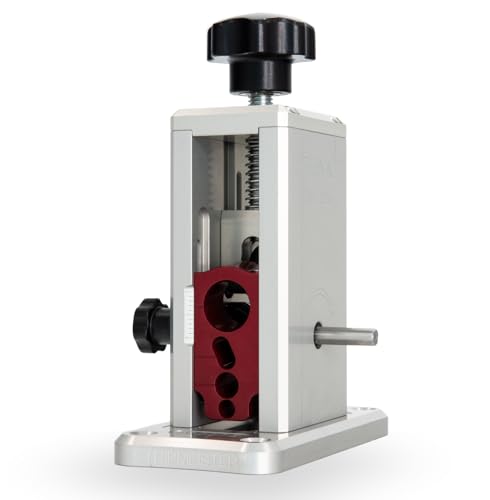
StripMeister Original Pro is the residential-cable option, with a feeder designed to keep twisted or kinked cable moving smoothly. Its body is aircraft-grade aluminum, and the blade is heat-treated tool steel. The maker also says replacement parts are available, which may matter if you plan to keep the machine in service. It weighs 3.8 pounds. This model is a fit for people stripping residential cable who value a feeder intended for difficult cable shapes; buyers who need a confirmed maximum wire diameter should verify that measurement before choosing it.
Bottom line: Choose this for residential cable and a feeder designed for twisted or kinked wire.
Trivd Frol Dual-Drive Stripper
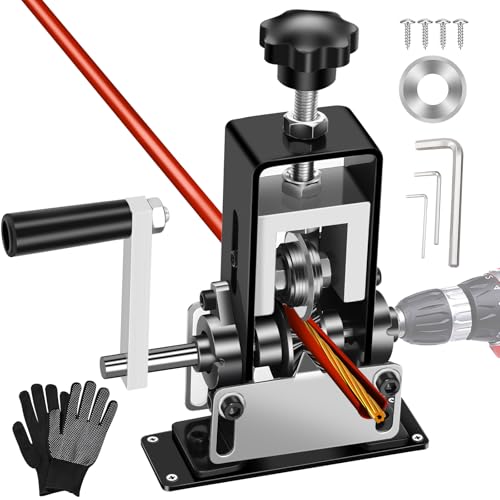
Trivd Frol Dual-Drive Stripper stands out for combining drill power with a hand crank, so it can be operated either way. Its wire range is 0.06 to 1 inch, and the machine uses an aluminum-alloy and stainless-steel construction with a tungsten-steel blade. The maker says the blade can be changed by removing four screws and includes an extra replacement blade. At about 3.3 pounds, it is lighter than the two StripMeister models with weights. The trade-off is that this model uses a manual blade adjustment, so buyers seeking an especially simple setup may prefer a model centered on a narrower use case.
Bottom line: Pick this if you want drill and hand-crank operation across a broad stated range.
StripMeister Original

StripMeister Original differs from the other options with a defined range from 1/8 to 3/4 inch and a body made using 5-axis CNC milling. It attaches to a standard drill, and the maker says the design is intended to prevent slippage and wire jams. Its weight is 3.8 pounds. The range makes it easier to assess for jobs with known cable diameters than a model without a range. Its upper limit is 3/4 inch, so people handling larger wire should compare the broader-range dual-drive machines instead.
Bottom line: Choose this when your wire is within 1/8 to 3/4 inch and you want a defined fit range.
CREWORKS Manual Wire Stripper

CREWORKS Manual Wire Stripper combines an adjustment knob for blade height with three feed-hole plates covering wire from 0.06 to 1 inch. The hand crank can be used directly, or a power drill can provide automatic cranking. This makes it a flexible option for mixed wire sizes when the operator wants to adjust the blade to the insulation and conductor. The dimensions are 12.6 inches high, 8.9 inches long, and 5.1 inches wide. It is the larger-footprint choice among the models with dimensions, so allow room for the machine and cable feed path.
Bottom line: Pick this for multiple wire sizes and a blade-height adjustment knob.
How to Choose a Drill-Powered Wire Stripper
Start with the cable diameter, then choose a machine whose range includes it. Drill-only units suit buyers who want one drive method, while dual-drive models add a hand crank as an alternative. The choice matters for scrap work: frequent changes in cable size make a broad range and adjustable blade useful, while a narrower known range can simplify matching tool to job. Compare the range and drive columns first; then consider construction and serviceability. A stripper removes insulation, not conductor metal, so blade depth needs to be shallow enough to avoid cutting into the copper. Keep scrap wire sorted by size where practical, since mismatched diameters can require resetting the blade or feed position.
Wire Size, Blade Setup, and Fit
Wire diameter—not just a label such as household or scrap wire—determines whether a stripper can accept the cable. The range for StripMeister Original is 1/8 to 3/4 inch, while Trivd Frol Dual-Drive Stripper and CREWORKS Manual Wire Stripper state 0.06 to 1 inch. Before buying, measure the cable across its insulation and compare it with the machine’s range; if a job includes wire over 3/4 inch, a model capped at 3/4 inch is not the fit. Set the blade to score insulation without deeply cutting the conductor, and test the adjustment on a short offcut before processing a longer length. Different insulation thicknesses can change the setting even when cable diameters match.
Using a Drill-Powered Stripper Safely
Always disconnect wire from electrical power before stripping it; a wire stripper is a processing tool, not a voltage detector or live-work tool. Secure the machine on a stable surface and keep hands clear of the blade and feed opening while the drill is turning. Feed wire straight and steadily rather than forcing a kink through the cutter, since poor alignment can interfere with a clean cut. Use eye protection because cut insulation and metal ends can produce small debris. Stop the drill before making blade adjustments, clearing a jam, or changing a blade. For powered operation, use controlled drill speed rather than assuming faster rotation will improve the strip.
Drill-Only and Dual-Drive Strippers Compared
Drill-only models have one drive method, while dual-drive machines can also be operated with a hand crank. The latter can be useful when you want manual control or do not want to run a drill continuously. A broad stated wire range helps with mixed-size scrap, but range alone does not guarantee that every cable shape or insulation type will feed cleanly. Review the manufacturer’s fit for the cable you have and make a short test strip first. Use the table to narrow the drive choice, then check wire range before selecting a machine.
| Need | Choice |
|---|---|
| Drill-only operation | StripMeister Original Pro or StripMeister Original |
| Drill plus hand crank | Trivd Frol Dual-Drive Stripper or CREWORKS Manual Wire Stripper |
| Known wire diameter up to 3/4 inch | StripMeister Original |
| Stated range extending to 1 inch | Trivd Frol Dual-Drive Stripper or CREWORKS Manual Wire Stripper |
Frequently Asked Questions
Can I strip wire while it is connected to power?
No. Disconnect the wire from every power source before stripping; a wire stripper does not verify that a conductor is de-energized. Keep the drill stopped while adjusting the blade or clearing a jam.
How do I avoid nicking copper wire?
Adjust the blade to score the insulation without cutting deeply into the conductor. Test the setting on a short offcut first, since insulation thickness can vary between wires of the same outside diameter.
Is a hand crank useful on a wire stripper?
A hand crank gives you a manual drive alternative to the drill on dual-drive models. It can be useful when you want direct control of feed speed or do not want to power the machine with a drill.
How should I choose a wire stripper for mixed cable sizes?
Measure the cable over its insulation and choose a machine whose range includes that diameter. The broad-range models here state coverage from 0.06 to 1 inch, but blade adjustment may still be needed as insulation thickness changes.