
Boost Converter 12V to 48V: 5 Models Compared

For a general 12V-to-48V boost converter, EAGWELL 12V to 48V 6A offers a 6A, 288W output and accepts 11V to 16V input. Choose a different model if your 48V load needs more than 6A, or if your source voltage falls outside that range.
A boost converter raises DC voltage while drawing more current from its lower-voltage source; the required input current matters as much as the 48V output rating.
We earn a commission if you buy through links on this page. As an Amazon Associate I earn from qualifying purchases. Products are compared on manufacturer specifications, not hands-on testing.
- Best overall: EAGWELL 12V to 48V 6A – Its 11V-to-16V input range and 6A, 288W output suit a conventional 12V source and moderate load.
- Best for high output: XWST 12V to 48V 25A – It is rated for 25A and 1,200W at 48V, with a 12V input.
- Best for dual input voltage: YBBOTT 12V/24V to 48V 5A – It accepts either 12V or 24V input and supplies 5A at 48V.
| Product | Best for | Input voltage | 48V output current | Maximum output power | Shop |
|---|---|---|---|---|---|
| EAGWELL 12V to 48V 6A | Moderate 12V loads | 11–16V | 6A | 288W | Check Price on Amazon |
| XWST 12V to 48V 25A | High-power loads | 12V | 25A | 1,200W | Check Price on Amazon |
| Gebildet 12V to 48V 6A | Sealed installation | 9–16V | 6A | 288W | Check Price on Amazon |
| YBBOTT 12V/24V to 48V 5A | 12V or 24V systems | 12V or 24V | 5A | 240W | Check Price on Amazon |
| MZHOU 12V/24V to 48V 15A | Midrange output | 12V or 24V | 15A | 720W | Check Price on Amazon |
12V to 48V Boost Converters Compared
Compare input voltage and rated output before matching a converter to your source and 48V load.
EAGWELL 12V to 48V 6A

With a specified 11V-to-16V input range and built-in protection features, this 6A model is a straightforward match for a nominal 12V source. It supplies 48V DC at up to 288W. The maker claims up to 97% conversion efficiency; actual efficiency depends on operating conditions and load. The aluminum shell is silicone sealed. This model suits moderate loads that remain within its output rating, but it is not a fit for equipment requiring more than 6A or 288W. Check the load’s startup demand as well as its normal draw.
Bottom line: Choose this for a 12V system and a 48V load rated at no more than 6A and 288W.
XWST 12V to 48V 25A

The 25A output rating sets this model apart for substantially larger 48V loads: its maximum is 1,200W, and it takes 12V DC input. The maker claims at least 95% maximum conversion efficiency and describes the unit as IP67 waterproof. A high output rating demands a robust 12V supply: at 1,200W, ideal input current is already 100A before conversion losses. This converter is unsuitable if the source, wiring, or fuse cannot support that demand.
Bottom line: Pick this only when your 12V source and wiring can support a high-current load.
Gebildet 12V to 48V 6A

This 6A, 288W converter has the broadest low-voltage input range among the 6A models here: 9V to 16V. That can matter in a 12V system whose voltage may move within that window. The aluminum case is silicone sealed, and the maker identifies the unit as IP68 rated and claims up to 96% conversion efficiency. Its output still tops out at 6A, so it does not serve loads above 288W; the maker also excludes Starlink series equipment. Confirm the connected device’s voltage and power needs before selecting it.
Bottom line: Choose this for a 12V installation needing a sealed unit and no more than 6A output.
YBBOTT 12V/24V to 48V 5A

Unlike the 12V-only options, this converter accepts either 12V or 24V input and delivers 48V at up to 5A, or 240W. Its features include short-circuit, overcurrent, and overtemperature protection, plus a fuse. The maker claims conversion efficiency above 95% and gives an operating temperature range of -40°C to +85°C. This model is a fit when input flexibility matters more than maximum output; its 5A ceiling is lower than the 6A and 15A alternatives. Verify that the source is set up for the selected input voltage.
Bottom line: Choose this when you need one converter option for either a 12V or 24V source.
MZHOU 12V/24V to 48V 15A
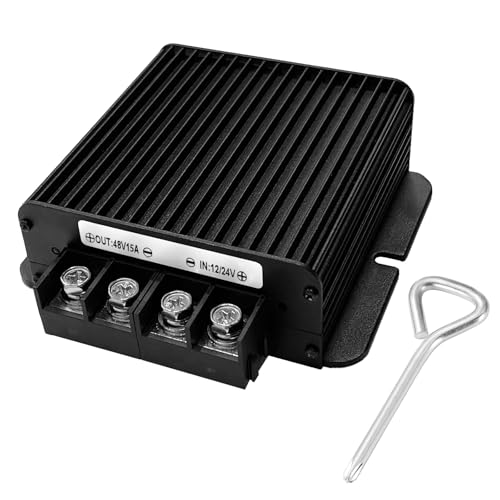
This dual-input model is rated for 15A at 48V and up to 720W, placing it between the 5A–6A units and the 25A model. It accepts 12V or 24V DC input and has a metal/ABS shell described as dustproof and shockproof, but it is not waterproof. The maker presents it for applications including solar equipment and LED drivers. At the full 720W output, ideal input current is 60A at 12V before losses, so source capacity and wiring are important. Avoid damp environments and loads above its rating.
Bottom line: Pick this for a 12V or 24V source and a 48V load within 15A and 720W.
How to choose a 12V to 48V boost converter
Choose by continuous load current, input voltage range, and available source current—not output voltage alone. At 48V, a 5A load uses 240W, while a 15A load uses 720W; allow margin for startup surges and avoid running continuously at a converter’s maximum rating unless its maker permits it. A boost converter trades input current for voltage: at 90% efficiency, a 240W output from 12V requires about 22A on the input side. Measure or find the device’s maximum draw, then confirm the source can deliver the resulting current. Also match the converter’s input range to the voltage the source actually reaches, rather than assuming every nominal 12V system stays at exactly 12V.
Input current, wiring, and fuse sizing
Estimate input current with output watts divided by input volts and efficiency; a 720W load at 12V and 90% efficiency draws about 67A. The 1,200W model would need about 111A under the same assumptions, so a small accessory circuit is not suitable. Use conductors and a fuse sized for the converter’s input current, installation length, and maker’s guidance, with the fuse close to the source to protect the wire. Keep polarity correct and make secure connections; loose high-current terminals can heat up. For long cable runs, voltage drop rises with current and length, so choose an adequately sized wire rather than compensating with a higher converter rating.
The table translates common 48V load ratings into output power; it does not replace checking input supply capacity.
| 48V load current | Output power | Typical fit |
|---|---|---|
| 5A | 240W | Small to moderate loads |
| 6A | 288W | Moderate loads |
| 15A | 720W | Higher-power loads |
| 25A | 1,200W | High-power loads |
Enclosure ratings and installation conditions
Water resistance depends on the enclosure rating, seals, connectors, and installation—not just a sealed-looking case. IP67 generally indicates protection against dust and temporary immersion under defined test conditions, while IP68 immersion conditions depend on the maker’s specification; neither rating guarantees that an exposed cable joint is waterproof. A converter marked not waterproof should be mounted away from moisture. High-power DC converters also generate heat, especially near their maximum output, so leave space for cooling and keep the case clear of insulation and combustible material. Do not place a converter where water can pool or where vibration can loosen its wiring.
Check voltage compatibility before connecting a load
Confirm that the device needs 48V DC and that its normal and startup current stay within the converter’s limits. A 48V battery charger is not interchangeable with a general 48V power supply: charging requires the correct charging profile and controls. Likewise, a device that expects regulated voltage may not tolerate ripple or startup overshoot. Check polarity at both ends and use a meter to verify output voltage before connecting sensitive equipment. Keep the converter disconnected while making wiring changes, and never assume a 12V source can supply a high-wattage converter just because its voltage matches.
Frequently Asked Questions
How much input current does a 12V to 48V converter need?
Input current is approximately output watts divided by input volts and efficiency. For example, 288W from 12V at 90% efficiency takes about 27A, while 1,200W takes about 111A.
Can I use a 12V to 48V converter with a 24V battery?
Only if the converter accepts 24V input; some models are 12V-only. Dual-input models in this comparison accept 12V or 24V, so confirm the actual input range before wiring.
Can a boost converter charge a 48V battery?
A basic boost converter is not automatically a battery charger. A 48V battery needs a charger matched to its chemistry, charge voltage, and current limit; use a converter for charging only if it provides the required charging control.
How much headroom should a boost converter have?
Select a rating above the load’s continuous draw and account for startup surge, which can briefly exceed normal current. If a device draws 5A continuously but surges above 6A at startup, a 6A converter may be undersized.
Does an IP rating protect converter wiring from water?
An enclosure rating applies under defined test conditions and does not make exposed connectors or cable joints waterproof. Keep joints protected and follow the maker’s immersion limits, especially for IP68 equipment.