
Xotic Head Studs for 5.9 Cummins: Fit Compared

For most 5.9 Cummins owners, Xotic CP876 24V Head Stud Kit is the fit to consider when the engine is a 24-valve model; its fit range covers 1998.5–2025 5.9L and 6.7L engines. Owners of 1989–1998 12-valve engines should choose Xotic CP878 12V Head Stud Kit instead.
Confirm the engine’s valve configuration and model year before choosing, since the kits cover different engine generations and 247-4202 24V Head Stud Kit is a non-Xotic alternative for 24-valve applications.
We earn a commission if you buy through links on this page. As an Amazon Associate I earn from qualifying purchases. Products are compared on manufacturer specifications, not hands-on testing.
- Best overall: Xotic CP876 24V Head Stud Kit – Covers 1998.5–2025 5.9L 24-valve engines and specifies Xotic 7200 material rated at 220,000 psi.
- Best for 12-valve engines: Xotic CP878 12V Head Stud Kit – Fits 1989–1998 5.9L 12-valve engines and specifies Xotic 7200 material rated at 220,000 psi.
- Best for 24-valve alternative: 247-4202 24V Head Stud Kit – Fits 1998.5-present 5.9L and 6.7L 24-valve engines and includes 26 studs, washers and nuts.
| Product | Best for | Engine fit | Material | Shop |
|---|---|---|---|---|
| Xotic CP876 24V Head Stud Kit | 24-valve 5.9L | 1998.5–2025 5.9L/6.7L 24V | Xotic 7200 | Check Price on Amazon |
| Xotic CP878 12V Head Stud Kit | 12-valve 5.9L | 1989–1998 5.9L 12V | Xotic 7200 | Check Price on Amazon |
| 247-4202 24V Head Stud Kit | Non-Xotic alternative | 1998.5-present 5.9L/6.7L 24V | 8740 chromoly steel | Check Price on Amazon |
Xotic Head Studs for 5.9 Cummins
Match the engine’s valve configuration and model year first, then compare the fastener material and kit contents.
Xotic CP876 24V Head Stud Kit
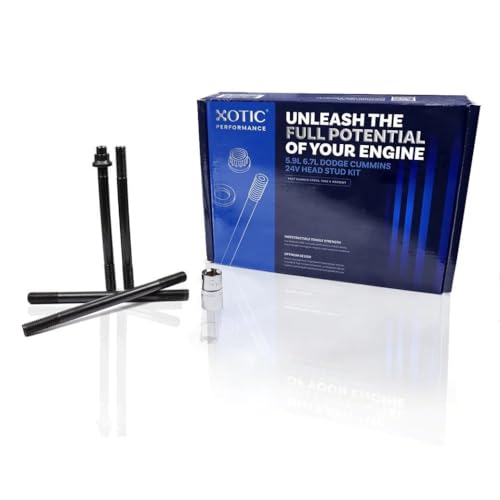
For 24-valve engines, this kit covers 1998.5–2025 5.9L and 6.7L Cummins applications, unlike the 12-valve-specific alternative. Xotic says the studs use 7200 material rated at 220,000 psi, with threads rolled after heat treatment and broached ends for installation. Centerless grinding is intended to maintain concentricity. The broad year range makes this the relevant choice for a later 5.9L 24-valve engine, but it also covers 6.7L engines, so verify exact engine fit before ordering.
Bottom line: Choose this kit for a 1998.5–2025 5.9L 24-valve engine.
Xotic CP878 12V Head Stud Kit
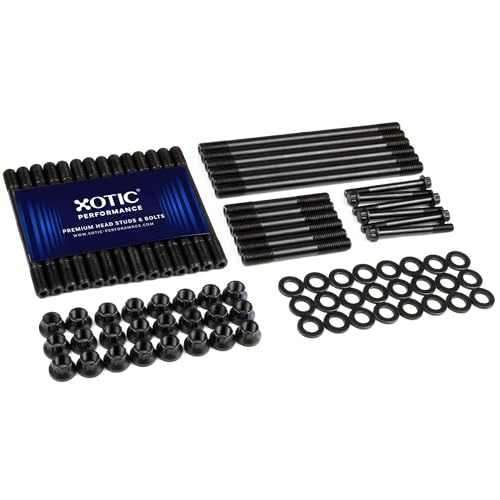
For the earlier 12-valve generation, this kit fits 1989–1998 5.9L Cummins engines rather than the later 24-valve applications covered by Xotic CP876 24V Head Stud Kit. Xotic says its 7200 alloy has a tensile rating of 220,000 psi; the studs are centerless ground and have broached ends. The included installation manual has drawn diagrams, and Xotic says the studs are designed to retain cylinder seals with high-pressure turbo systems. This is the direct match for a 12-valve 5.9L in the range, but the year range alone does not distinguish every engine variation. Confirm valve configuration and application before selecting it.
Bottom line: Pick this kit for a 1989–1998 5.9L 12-valve engine.
247-4202 24V Head Stud Kit

Unlike the Xotic kits, this 24-valve head stud kit uses 8740 high-tensile chromoly steel and is identified as replacement part 247-4202. Its application is 1998.5-present 5.9L and 6.7L 24-valve Cummins engines. The package includes 26 studs, 26 parallel-ground washers and 26 12-point nuts, and the tensile rating is 220,000 psi. It is a relevant alternative if the engine is a 24-valve 5.9L, but it is not an Xotic product and its specified steel differs from Xotic 7200. Compare the exact application and fastener specifications before choosing between them.
Bottom line: Consider it when a non-Xotic 24-valve kit is acceptable.
How to choose 5.9 Cummins head studs
Choose by valve configuration and engine year before comparing stud material or tensile rating. The 5.9L Cummins spans distinct 12-valve and 24-valve applications, so a kit’s fit range is more decisive than a shared tensile-strength figure. For an engine built from 1989–1998 with 12 valves, use a kit listed for that configuration; for a 1998.5-or-later 24-valve engine, match a kit to that generation and its year range. If the engine year or valve count is uncertain, identify the engine before ordering rather than relying on the truck’s registration year. Kits may also cover 6.7L engines, but that does not make every fastener kit interchangeable across engine generations.
12-valve and 24-valve fitment
12-valve and 24-valve 5.9L engines require a kit specifically matched to their application. The 12-valve kit covers 1989–1998 engines, while the 24-valve options cover 1998.5-present or 1998.5–2025 applications. The ranges overlap around model-year transitions, so use valve configuration and exact engine application together; year alone is not a reliable way to settle an ambiguous fit. A 5.9L designation also does not mean a 3.9L 4BT kit fits. Before ordering, verify the engine’s displacement, valve configuration and model year against the kit’s application.
Head stud materials and ratings
Material and tensile rating are useful comparisons, but neither one determines whether a kit fits or how it should be installed. Xotic describes its 7200 material as rated at 220,000 psi; the alternative kit specifies 8740 chromoly steel and a 220,000 psi rating. The rating is a material or fastener specification, not an installation torque value. Head studs are threaded fasteners that clamp the cylinder head to the engine, and the complete system includes nuts and washers in some kits. Do not infer that two kits with the same rating use the same material, thread dimensions or torque procedure.
Installing Cummins head studs safely
Use the instructions supplied for the exact kit and engine; torque sequences and torque values depend on the fastener design and specified lubricant. A generic torque figure can produce incorrect clamping force, so do not substitute one from another stud kit. Clean threaded holes and mating surfaces before assembly, and avoid allowing liquid or debris to remain in blind holes, where it can interfere with proper seating. Tighten in the sequence and stages specified by the engine or fastener instructions, using a calibrated torque wrench. Head fasteners are structural engine components, so anyone unsure of the procedure should have the installation handled by a qualified diesel mechanic.
Frequently Asked Questions
How do I tell if my 5.9 Cummins is 12-valve?
The valve configuration is the key distinction: the earlier 5.9L engines are 12-valve, while later applications use 24 valves. The 12-valve head stud kit covers 1989–1998 engines; confirm the engine configuration rather than relying only on a truck model year.
Are head studs interchangeable with head bolts?
No, a head stud kit is a different fastener system from a bolt set. Studs are threaded into the block and secured with nuts, so use the installation procedure and hardware specified for the exact kit.
Does a 220,000 psi rating give the torque setting?
No, tensile strength is not an installation torque value. Torque depends on the stud kit’s design and specified lubricant, so use the exact kit instructions rather than converting the rating into a torque figure.
Should I replace head studs when changing a gasket?
A head gasket replacement does not by itself establish that a new stud kit is required. The engine’s condition, the fastener manufacturer’s reuse rules and the repair procedure determine whether studs can be reused; inspect and follow the applicable instructions before assembly.
Can I use a 12-valve kit on a 24-valve engine?
Choose a kit whose application matches the engine’s valve configuration. The 12-valve kit here is for 1989–1998 5.9L engines, whereas the 24-valve kits target later applications; do not assume they interchange because both engines are 5.9L.