
Torin Big Red Jacks: 3 Models Compared by Lift Range

For a general-purpose floor jack, choose BIG RED T83006 3-Ton Trolley Jack for its 6,000-pound capacity and 5-7/8-inch minimum height; its extended saddle neck also suits higher vehicles. Choose Big RED 4-Ton Low-Profile Floor Jack instead when low clearance is the deciding factor, or BIG RED TAM91203B 12-Ton Bottle Jack when a compact bottle-jack format and higher capacity fit the job.
These hydraulic jacks lift a vehicle or load, but they do not support it safely for work by themselves. Use properly rated jack stands on a firm, level surface before going under a raised vehicle.
We earn a commission if you buy through links on this page. As an Amazon Associate I earn from qualifying purchases. Products are compared on manufacturer specifications, not hands-on testing.
- Best overall: BIG RED T83006 3-Ton Trolley Jack – A trolley floor jack with a 6,000-pound capacity and 5-7/8-inch minimum height.
- Best for low clearance: Big RED 4-Ton Low-Profile Floor Jack – Its minimum lifting height is 3-7/8 inches.
- Best for higher capacity: BIG RED TAM91203B 12-Ton Bottle Jack – The bottle jack has a 24,000-pound capacity and lifts to 18 inches.
| Product | Best for | Capacity | Minimum height | Maximum height | Shop |
|---|---|---|---|---|---|
| BIG RED T83006 3-Ton Trolley Jack | General vehicle lifting | 6,000 lb | 5-7/8 in | 20-7/8 in | Check Price on Amazon |
| Big RED 4-Ton Low-Profile Floor Jack | Low-clearance vehicles | 8,000 lb | 3-7/8 in | 20 in | Check Price on Amazon |
| BIG RED TAM91203B 12-Ton Bottle Jack | Higher-capacity lifting | 24,000 lb | 9 in | 18 in | Check Price on Amazon |
Torin Big Red jacks compared
Compare these three hydraulic jacks by style, capacity, and the height range that fits your lifting point.
BIG RED T83006 3-Ton Trolley Jack
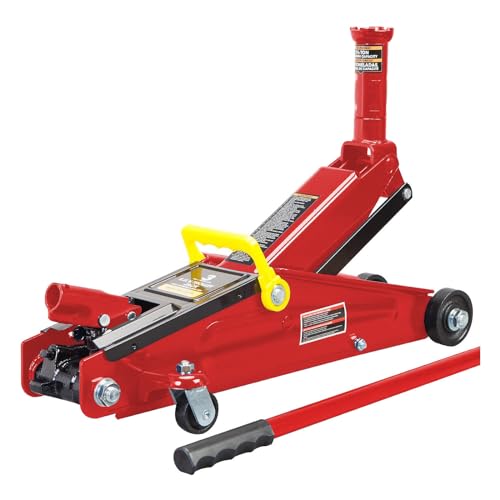
For a conventional floor-jack format, BIG RED T83006 3-Ton Trolley Jack combines a 3-ton capacity with a 5-7/8-inch minimum height. Its lifting range reaches 20-7/8 inches, and the extra-long saddle neck is intended to help reach higher vehicles. Two steel casters and two 360-degree swivel casters aid positioning, while the single-piston quick-lift pump raises the saddle. A safety bypass is included to prevent overloading.
Choose this model for a range of cars, trucks, vans, or SUVs when the 5-7/8-inch clearance fits the lift point. It is not the lowest-profile option here; vehicles with less clearance call for a lower entry height.
Bottom line: Choose it for general vehicle lifting when 5-7/8 inches of clearance is sufficient.
Big RED 4-Ton Low-Profile Floor Jack

The 3-7/8-inch minimum height makes Big RED 4-Ton Low-Profile Floor Jack the low-clearance choice among these floor jacks. Its 4-ton capacity and 20-inch maximum height pair with a dual-piston pump that the maker says lifts loads five times faster than a single-pump design. The wide stance, rubber saddle pad, and caster arrangement support positioning and contact during lifting; the jack also has a safety bypass.
Consider it when a vehicle’s lift point sits too low for a 5-7/8-inch entry height. Its 100.8-pound weight makes it less convenient to move than a smaller jack, so it is better suited to a garage setup than frequent carrying.
Bottom line: Choose it when low vehicle clearance makes a 3-7/8-inch entry height important.
BIG RED TAM91203B 12-Ton Bottle Jack

With a 24,000-pound capacity, BIG RED TAM91203B 12-Ton Bottle Jack is the highest-capacity option here, but its 9-inch minimum height calls for a high lift point. This hydraulic bottle jack reaches 18 inches and has an adjustable screw extension for added height. A heat-treated serrated saddle provides the contact surface, and the welded steel construction encloses the hydraulic mechanism. The maker says its built-in bypass and overload valve protect the system from extending beyond limits.
Choose this upright format for a compatible lifting point and load where its capacity matters. It is not a low-profile substitute for a floor jack: measure the clearance at the lift point before selecting it.
Bottom line: Choose it for a compatible high lift point and a need for up to 24,000 pounds of capacity.
How to choose a Torin Big Red jack
Choose by the lift point’s clearance, the needed height, and the jack’s rated capacity; capacity alone does not determine fit. A floor jack rolls under a vehicle and raises a saddle from a long frame, while a bottle jack lifts vertically from a compact base. These formats have different access needs: among the floor jacks here, minimum heights are 3-7/8 and 5-7/8 inches, while the bottle jack starts at 9 inches.
Measure from the floor to the vehicle’s approved lifting point, then select a jack whose minimum height is below that measurement and whose maximum height reaches the needed lift. Match the jack’s rating to the load it will lift; a vehicle’s total weight is not necessarily the load at one lift point. Use the table to compare the deciding dimensions.
| Need | Format | Minimum height |
|---|---|---|
| Lower vehicle clearance | Low-profile floor jack | 3-7/8 in |
| Higher saddle reach | Trolley floor jack | 5-7/8 in |
| Vertical lift point and high rating | Bottle jack | 9 in |
Floor jacks and bottle jacks compared
Floor jacks suit lifting points with room for a rolling frame, while bottle jacks need a vertical approach and enough clearance for their taller closed height. A trolley jack’s long handle and casters help position it beneath a vehicle; a bottle jack’s compact footprint can suit a confined work area when the lift point is high enough. A low-profile floor jack is the relevant style when underbody clearance is the constraint.
Check both ends of the height range, not just maximum lift: a jack that reaches the desired height may still be too tall to fit beneath the vehicle. Likewise, a jack with a low entry height must still reach the required working height. Hydraulic jacks lift loads but do not safely support them for work; use correctly rated jack stands after lifting and before going underneath.
How to use a jack safely
Use a jack only on firm, level ground and at the vehicle maker’s approved lifting point. Chock the wheels that remain on the ground, set the parking brake, and keep people clear while raising or lowering the vehicle. A bypass or overload valve is not permission to exceed the capacity rating or use an unstable contact point.
After raising the vehicle, position jack stands at approved support points and lower the load onto them before working beneath it. Never rely on hydraulic pressure alone: a leak, valve failure, or unintended handle movement can let a raised load descend. A stand’s rating may apply to a pair rather than one stand, so read the capacity basis and make sure the stands are suitable for the load.
How to match jack height to a vehicle
Measure the vertical gap at the designated lift point with the vehicle on the surface where the jack will be used. For example, a gap under 5-7/8 inches rules out a trolley jack with that minimum height; a 3-7/8-inch low-profile model may fit if its saddle can reach the approved point. The bottle jack’s 9-inch minimum requires substantially more starting clearance.
Maximum height matters when a wheel must clear the ground or when a load needs a specific working height. Compare the required lift with the jack’s maximum, while leaving room for the saddle and any approved adapter. Do not add improvised blocks or extensions to gain reach; use only an extension designed for the jack and verify that the contact remains stable.
Frequently Asked Questions
Can I work under a vehicle held by a floor jack?
No. A hydraulic jack is for lifting, not for supporting a vehicle while someone works beneath it. After lifting, lower the vehicle onto jack stands rated for the load and placed at the vehicle’s approved support points.
How much clearance does a floor jack need?
The jack’s minimum height must be no greater than the clearance at the vehicle’s designated lift point. Here, the lower-profile floor jack starts at 3-7/8 inches, while the trolley model starts at 5-7/8 inches; allow room to position the saddle as well.
Are jack capacity ratings per jack or per pair?
Read the product’s capacity basis before using any jack or stand. These floor and bottle jacks give capacity as a jack rating, while a stand set may express capacity for a pair; do not treat a pair rating as the capacity of each stand.
Where should a hydraulic jack contact a vehicle?
Use only the vehicle manufacturer’s designated lifting points, which are chosen to support the load without damaging the body or undercarriage. A wider saddle does not make an unapproved contact point safe; consult the vehicle’s lift-point diagram before raising it.