
Canon T7 SD Card: 5 Options Compared for Fit

For most Canon T7 owners, SanDisk Ultra 128GB U1 is a straightforward choice because it pairs 128GB capacity with a U1, Class 10 rating for Full HD recording. Choose SanDisk Extreme PRO 128GB or a GIGASTONE card if you want a higher video speed class or 4K-oriented rating; choose SanDisk Ultra 64GB if 64GB is enough storage.
We earn a commission if you buy through links on this page. As an Amazon Associate I earn from qualifying purchases. Products are compared on manufacturer specifications, not hands-on testing.
- Best overall: SanDisk Ultra 128GB U1 – Its 128GB capacity and U1, Class 10 rating suit general Full HD use.
- Best for higher-speed transfers: SanDisk Extreme PRO 128GB – It lists up to 250MB/s read speed and up to 120MB/s write speed for this capacity.
- Best for smaller storage needs: SanDisk Ultra 64GB – The 64GB card offers a smaller capacity with a Class 10 Full HD rating.
| Product | Best for | Capacity | Maximum speed | Shop |
|---|---|---|---|---|
| SanDisk Ultra 128GB U1 | Everyday Full HD | 128GB | Up to 140MB/s read | Check Price on Amazon |
| SanDisk Extreme PRO 128GB | Faster transfers | 128GB | Up to 250MB/s read | Check Price on Amazon |
| GIGASTONE 128GB 4K Camera Pro | Rugged 4K option | 128GB | Up to 100MB/s transfer | Check Price on Amazon |
| SanDisk Ultra 64GB | Smaller capacity | 64GB | Up to 80MB/s transfer | Check Price on Amazon |
| GIGASTONE 256GB 4K Camera Pro | Maximum capacity | 256GB | Up to 170MB/s transfer | Check Price on Amazon |
Canon T7 SD cards
Compare capacity, speed ratings, and the recording use each card is aimed at.
SanDisk Ultra 128GB U1

For a general-purpose Canon T7 SD card, this 128GB SanDisk Ultra balances ample storage with a Full HD-oriented U1, Class 10 rating. SanDisk gives a maximum read speed of 140MB/s, though the card’s own note says actual transfers depend on the host device and conditions. The U1 rating is the key distinction here: it is intended for Full HD rather than the higher video speed classes shown on some alternatives. Choose it for stills and Full HD clips; buyers prioritizing 4K-class ratings should compare the V30 options instead.
Bottom line: Pick this for a roomy everyday card and Full HD recording.
SanDisk Extreme PRO 128GB
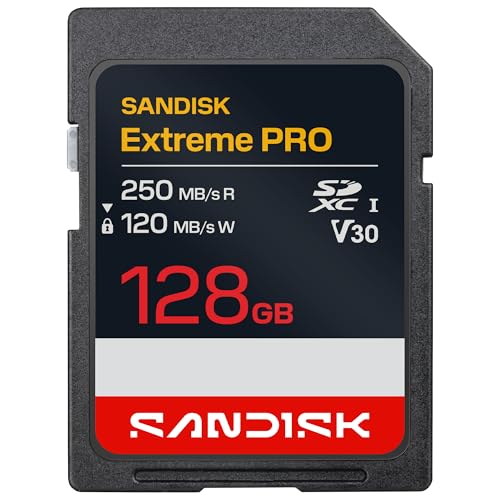
Unlike the U1 option, this 128GB Extreme PRO carries V30 and U3 ratings alongside Class 10, making it the higher video-class choice in this group. SanDisk claims read speeds up to 250MB/s; the features also state up to 120MB/s write speeds for this capacity, despite a separate higher write-speed claim applying to larger capacities. Those upper speeds require a compatible host and are not guaranteed in every camera or reader. It is a fit for buyers who value stronger video-class ratings and faster file transfer potential, but those gains depend on compatible equipment.
Bottom line: Choose this when V30/U3 ratings and fast transfers matter.
GIGASTONE 128GB 4K Camera Pro

This GIGASTONE 128GB card combines a V30, U3, Class 10 rating with a full-sized SD format and a mini case. GIGASTONE describes it as compatible with 4K UHD video and lists transfer speeds up to 100MB/s; that figure is not a guarantee of camera write performance. Its waterproof, temperature-proof, x-ray-proof, shock-proof, and magnetic-proof protections distinguish it from the other 128GB options, but no protection rating is supplied, so it should not be treated as permission to expose a card to hazards. A five-year limited warranty is also included.
Bottom line: Pick it for the included case and stated protection features.
SanDisk Ultra 64GB

The main difference here is capacity: this SanDisk Ultra has 64GB, half the storage of the 128GB cards. SanDisk positions it for compact to midrange point-and-shoot cameras and camcorders, and its Class 10 rating is aimed at Full HD video. The maximum transfer speed is 80MB/s, below the read-speed figures of the larger SanDisk choices. It suits a buyer who prefers a smaller card or rotates cards often, while anyone recording longer sessions or keeping more images on one card should consider 128GB instead.
Bottom line: Choose it if 64GB fits your shooting and storage habits.
GIGASTONE 256GB 4K Camera Pro

With 256GB, this GIGASTONE is the highest-capacity option here, useful for buyers who want more room on a single card. GIGASTONE lists a V30 rating, UHS-I, and transfer speeds up to 170MB/s, and describes the card as 4K UHD compatible for digital cameras, HD camcorders, and DSLRs. It also includes a mini case and claims waterproof, temperature-proof, x-ray-proof, shock-proof, and magnetic-proof protection, but gives no protection rating. Its large capacity can keep more files together, though buyers who prefer frequent backups may favor smaller cards.
Bottom line: Pick it when 256GB capacity is the priority.
How to choose a Canon T7 SD card
Choose a card by matching the speed class to your recording needs, then decide how much capacity you want to carry. Class 10 is the baseline rating shown across these options; U1 is a video speed class associated with a 10MB/s minimum sustained write speed, while U3 and V30 indicate 30MB/s minimum sustained write speeds. A higher class is useful for heavier video workloads, but the camera must support the recording mode. If you mainly shoot stills and Full HD clips, U1 or Class 10 can be adequate; for 4K-oriented use, start with V30/U3 and verify camera compatibility.
SD card capacity and file planning
Card capacity determines how many photos and video minutes fit before offloading, but actual usable space and file sizes vary. A 64GB card can suit shorter outings or frequent transfers, while 128GB gives more room between backups; 256GB keeps more material on one card but concentrates more files in one place. A practical rule is to estimate the size of a typical shoot and choose at least twice that capacity if you want a buffer for extra clips. Use multiple cards when separating shoots or limiting the amount of material at risk from a lost or damaged card.
| Use case | Rating to consider | Capacity approach |
|---|---|---|
| Stills and Full HD | Class 10 or U1 | 64GB for short outings; 128GB for more room |
| 4K-oriented recording | V30 or U3 | 128GB or 256GB based on recording duration |
| Faster file transfers | Compare read speed and reader support | Capacity does not determine transfer speed |
SD speed ratings and transfer speeds
Speed-class markings and headline transfer speeds measure different things. U1 and U3 use minimum sustained write-speed thresholds, while read-speed figures such as 140MB/s or 250MB/s refer to maximum transfers under suitable conditions. A camera’s buffer, card interface, file format, and card reader can all limit real-world throughput. For long video takes, favor the minimum sustained write rating over a large read-speed number; for moving files to a computer, check that the reader and connection can use the card’s interface. Never assume the fastest printed number will be reached in every device.
Using and caring for an SD card
Format a card in the camera before an important session, and safely eject it from a computer before removal to reduce the risk of file-system problems. Keep a second copy of important photos and clips on another device; a card is portable storage, not a backup. Avoid removing a card while the camera is writing, and do not rely on water- or impact-resistance claims as a substitute for careful handling. Store cards in a case when not in use, and replace a card that repeatedly produces read or write errors rather than trusting it with irreplaceable files.
Frequently Asked Questions
Does the Canon T7 use a full-size SD card?
Yes, the Canon T7 uses the full-size SD card format rather than microSD directly. A microSD card needs a full-size adapter, which adds another connection point and is easier to misplace.
What speed class is enough for Canon T7 video?
For Full HD clips, Class 10 or U1 is a reasonable baseline; U1 represents a 10MB/s minimum sustained write speed. For 4K-oriented recording, V30 or U3 indicates a 30MB/s minimum, but confirm the camera supports the specific recording mode before relying on it.
Is a 256GB SD card too large for a Canon T7?
The options include a 256GB SDXC card, but confirm the camera’s supported card capacity before ordering. Larger cards can hold more files between transfers, while splitting a shoot across smaller cards can limit how much content is on one card.
Will a faster SD card make the Canon T7 take photos faster?
A faster card can help clear the camera buffer sooner, but it does not increase the camera’s maximum burst rate. The improvement depends on the camera interface, file format, burst length, and whether the card’s write speed exceeds the camera’s own limit.
How often should I format a Canon T7 SD card?
Format the card in the camera after backing up its contents when you begin a fresh card cycle or change its use. Formatting erases files, so copy important photos and videos elsewhere first and never format a card to troubleshoot before preserving its contents.