
Compression Socks for Short Legs: 5 Fits Compared

For short legs, choose Absolute Support Petite Sheer Knee-Highs if you want a specifically petite, short-length knee-high with 15–20 mmHg compression. The 8.25-inch reduced-length Truform 8865 Reduced-Length Stockings is an alternative for firmer 20–30 mmHg support; crew socks suit shoppers who want a shorter style rather than a knee-high.
We earn a commission if you buy through links on this page. As an Amazon Associate I earn from qualifying purchases. Products are compared on manufacturer specifications, not hands-on testing.
- Best overall: Absolute Support Petite Sheer Knee-Highs – Its petite short-length knee-high design and 15–20 mmHg graduated compression directly match the request.
- Best for firm support: Truform 8865 Reduced-Length Stockings – The reduced-length stocking measures 8.25 inches and provides 20–30 mmHg graduated compression.
- Best for lightweight crews: Lightweight 15–20 mmHg Crew Socks – Thin, lightweight crew socks offer 15–20 mmHg compression and a mid-calf style.
| Product | Best for | Style and length | Compression | Pack | Shop |
|---|---|---|---|---|---|
| Absolute Support Petite Sheer Knee-Highs | Petite knee-highs | Short-length knee-high | 15–20 mmHg | 3 pairs | Check Price on Amazon |
| Truform 8865 Reduced-Length Stockings | Firm closed-toe fit | Reduced-length, 8.25 in | 20–30 mmHg | 1 pair | Check Price on Amazon |
| MGANG Short-Length Open-Toe Stockings | Open-toe firm support | Short length; open toe | 20–30 mmHg | — | Check Price on Amazon |
| Lightweight 15–20 mmHg Crew Socks | Lightweight crew style | Crew, mid-calf | 15–20 mmHg | 4 pairs | Check Price on Amazon |
| Women’s Crew Compression Socks, 5 Pairs | Multipack crew socks | Crew; height — | — | 5 pairs | Check Price on Amazon |
Compression Socks for Short Legs
Compare the short-length and crew styles by their fit, pressure, and intended use.
Absolute Support Petite Sheer Knee-Highs

Absolute Support Petite Sheer Knee-Highs is the clearest match for shoppers seeking a petite, short-length knee-high: it combines a sheer style with 15–20 mmHg graduated compression. The three-pair set is black and machine washable, making it a practical choice for regular rotation. Choose it if you want a knee-high that is explicitly identified as petite and short length rather than a general crew sock. The tradeoff is the modest compression range; shoppers who need firm 20–30 mmHg support should consider a different option and follow clinician guidance for prescribed compression.
Bottom line: Choose these for petite short-length knee-high coverage and moderate compression.
Truform 8865 Reduced-Length Stockings

Truform 8865 Reduced-Length Stockings pairs reduced-length with 20–30 mmHg graduated compression, a closed toe, and a defined heel. The 8.25-inch height distinguishes it from the crew styles and provides a concrete measurement for comparing coverage. Its unisex nylon-spandex knit is latex-free, with a soft top and roomy toe. This option suits shoppers seeking firmer support in a closed-toe stocking. The limitation is that it is sold as a single pair, and the manufacturer calls for measurement against its size chart, so check leg and ankle measurements before choosing a size.
Bottom line: Pick this for reduced-length, closed-toe stockings with firm compression.
MGANG Short-Length Open-Toe Stockings
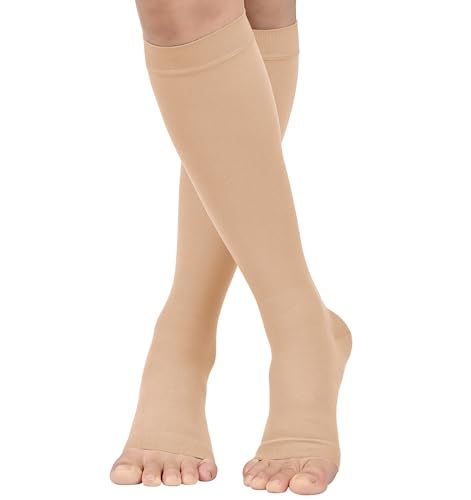
MGANG Short-Length Open-Toe Stockings is a short-length open-toe stocking for shoppers seeking firm compression rather than sheer or crew coverage. Its open toe differs from the closed-toe alternative and may suit people who prefer exposed toes. Conditions such as DVT require clinical advice.
Bottom line: Choose this if an open toe and short-length firm support are priorities.
Lightweight 15–20 mmHg Crew Socks

Lightweight 15–20 mmHg Crew Socks stands apart as a thin, lightweight crew sock with 15–20 mmHg graduated compression, moisture-wicking nylon, and reinforced toes and heels. Its mid-calf, above-ankle cut is shorter in style than a knee-high, making it a candidate for people who prefer less coverage. The four-pair set suits warm-weather wear or workouts according to the manufacturer. However, the size is Large-X-Large, not a petite length designation, so it is less directly tailored to short legs than a specifically short-length stocking. Match the size to the maker’s fit guidance.
Bottom line: Pick these for a lightweight crew cut rather than petite knee-high coverage.
Women’s Crew Compression Socks, 5 Pairs

Women’s Crew Compression Socks, 5 Pairs offers five crew pairs in five colors with a nylon-spandex blend and targeted ankle-support knit. The crew cut makes it a shorter-style alternative to knee-high stockings, while the medium size provides a defined size choice. This set is best suited to someone who values color variety and crew coverage over a petite-length knee-high fit or a documented pressure specification.
Bottom line: Choose this for a colorful crew multipack when a pressure rating is not your priority.
How to choose compression socks for short legs
Start with the garment length and pressure range, because a short style is not automatically sized for every shorter leg. A knee-high reaches below the knee, while crew socks typically end around mid-calf; check actual height or a petite/short designation when the maker provides one. Compression is measured in mmHg, and 15–20 mmHg is a moderate range compared with 20–30 mmHg firm compression. For a specifically petite knee-high and 15–20 mmHg, Absolute Support Petite Sheer Knee-Highs is the direct match; for reduced-length firm coverage, compare Truform 8865 Reduced-Length Stockings. If compression is prescribed, use the clinician’s specified level rather than choosing by feel.
How to get the right sock fit
Measure the ankle at its narrowest point and calf at its widest point, then use the maker’s sizing chart; leg length alone does not determine compression fit. Take measurements early in the day, before swelling typically increases, and repeat them if one leg is notably larger. A sock that bunches, rolls, or leaves painful deep marks may be poorly fitted; don’t size down to increase pressure. The 8.25-inch height on Truform 8865 Reduced-Length Stockings gives a useful length reference, but its medium sizing still needs measurement. Short-length labels can describe garment height rather than a particular wearer’s entire leg proportions, so confirm both circumference and length.
Compression levels and sock styles
Compression socks differ by both pressure and coverage: crew cuts stop below the knee, while knee-high stockings cover the lower leg to just below the knee. The products here range from 15–20 mmHg crews and petite knee-highs to 20–30 mmHg short stockings. Use the table to narrow choices by fit and purpose, not as a substitute for medical advice.
| Need | Style and pressure | Choice |
|---|---|---|
| Petite knee-high | Short length; 15–20 mmHg | Absolute Support Petite Sheer Knee-Highs |
| Reduced-length firm stocking | 8.25 inches; 20–30 mmHg | Truform 8865 Reduced-Length Stockings |
| Short open-toe firm stocking | Short length; 20–30 mmHg | MGANG Short-Length Open-Toe Stockings |
| Lightweight crew | Mid-calf; 15–20 mmHg | Lightweight 15–20 mmHg Crew Socks |
Safe wear and care
Put compression socks on smooth and wrinkle-free, since folds can create concentrated pressure; remove them if you develop numbness, new pain, or color changes and seek medical advice. People with known circulation problems, diabetes-related sensory loss, or suspected blood clots should consult a clinician before using firm compression. For routine care, hand washing or a gentle machine cycle and air drying help protect elastic fibers; heat can weaken stretch over time. Absolute Support Petite Sheer Knee-Highs is machine washable, but use its garment care guidance. Replace socks when they sag, lose their graduated feel, or develop damaged elastic, because worn-out compression may no longer fit as intended.
Frequently Asked Questions
How do I measure my legs for compression socks?
Measure ankle circumference at its narrowest point and calf circumference at its widest point, preferably in the morning before swelling builds. Compare both values with the maker’s size chart, and measure each leg separately if they differ.
Are 15–20 mmHg compression socks strong enough?
A 15–20 mmHg sock provides moderate compression, while 20–30 mmHg is a firmer range. Use the pressure recommended by a clinician if you have a diagnosed condition or were prescribed compression.
Should compression socks cover the knee?
Crew styles generally stop around mid-calf, while knee-high styles end just below the knee. Choose knee-high coverage when you need compression over the lower leg rather than only an ankle or crew style.
When should I take compression socks off?
Many people wear daytime compression and remove it before bed unless a clinician directs otherwise. Take socks off sooner for numbness, increasing pain, skin color changes, or a sock that rolls into a tight band.
How often should compression socks be replaced?
Replace compression socks when elastic loosens, the fabric becomes damaged, or the socks no longer stay in place; daily-wear pairs commonly need replacement every 3 to 6 months. Gentle washing and air drying help preserve stretch.