
Best Insoles for Warehouse Work: 5 Options Compared

Dr. Scholl’s Work All-Day Gel Insoles suits most warehouse workers because its extended gel cushioning is designed to absorb impact on hard floors. Choose a different option if you need firm arch support, a specific size range, or orthotics designed for higher body weight.
Warehouse insoles add cushioning or structure inside work shoes and boots, but the right choice depends on available shoe volume and the support your feet need.
We earn a commission if you buy through links on this page. As an Amazon Associate I earn from qualifying purchases. Products are compared on manufacturer specifications, not hands-on testing.
- Best overall: Dr. Scholl’s Work All-Day Gel Insoles – Extended gel cushioning is designed for long shifts on concrete and other hard floors.
- Best for breathable cushioning: DWTWLE 4D Cloud Memory Foam Insoles – Honeycomb construction and a U-shaped memory foam heel focus on airflow and impact absorption.
- Best for firm arch support: Dr. Scholl’s Advanced Pain Relief Orthotics – Rigid high-arch support is designed for people weighing over 220 pounds.
| Product | Best for | Support or cushioning | Weight guidance | Size range | Shop |
|---|---|---|---|---|---|
| Dr. Scholl’s Work All-Day Gel Insoles | Hard-floor shifts | Extended gel cushioning | — | Trim to fit | Check Price on Amazon |
| DWTWLE 4D Cloud Memory Foam Insoles | Airflow and cushion | Memory foam, gel heel insert | — | Men’s US 7–11 | Check Price on Amazon |
| Dr. Scholl’s Advanced Pain Relief Orthotics | Plantar fascia support | Heavy-duty arch support | Supports up to 340 lb | Men’s 10.5–11; women’s 11.5–12 | Check Price on Amazon |
| VALSOLE Heavy Duty Support Orthotics | High-arch support | Rigid high-arch support | Over 220 lb | Men’s 11–11.5; women’s 13–13.5 | Check Price on Amazon |
| WalkHero Heavy Duty Work Boot Insoles | Work boot stability | Rigid arch support | Over 220 lb | Men’s 6–6.5; women’s 8–8.5 | Check Price on Amazon |
Best insoles for warehouse work
Compare cushioning, support style and size fit against the demands of your shift and footwear.
Dr. Scholl’s Work All-Day Gel Insoles
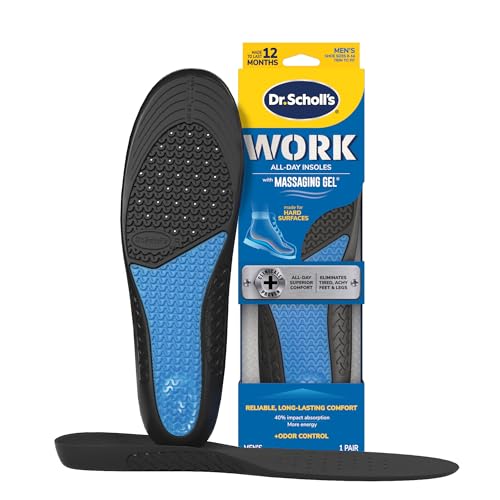
Dr. Scholl’s Work All-Day Gel Insoles stands out for extended gel cushioning aimed at workers spending long hours on hard surfaces. The brand says its design distributes pressure and reduces shock and impact from floors such as concrete, asphalt, wood and hard dirt. The trim-to-fit design suits workers whose shoe size falls outside a fixed range, provided they can keep the insole aligned when trimming. Choose it if cushioning is the priority; workers seeking rigid arch control should consider a more structured orthotic instead.
Bottom line: Choose these for cushioned support during long shifts on hard floors.
DWTWLE 4D Cloud Memory Foam Insoles

DWTWLE 4D Cloud Memory Foam Insoles pairs memory foam with a honeycomb pattern, moisture-wicking material and a gel insert beneath the insole, making its feature mix distinct from the gel-focused or rigid-support options. The U-shaped heel is intended to absorb impact, while the honeycomb design promotes air circulation. Its men’s size range is US 7–11, so it may not suit workers outside that span. Choose it for a cushioned, airflow-oriented design; those who need firm arch structure may prefer an orthotic-style insert.
Bottom line: Choose these if airflow and soft cushioning matter most.
Dr. Scholl’s Advanced Pain Relief Orthotics

Dr. Scholl’s Advanced Pain Relief Orthotics is a structured orthotic rather than a general gel cushion, with heavy-duty arch support and a support limit of 340 pounds. The brand says it targets multiple areas, including the heel, arch and ball of the foot, and is intended for work shoes and boots. The size is a narrow range—men’s 10.5–11 or women’s 11.5–12—so check your shoe size before choosing it. This option suits workers seeking substantial support, but its size range limits fit for many others.
Bottom line: Choose these if your size fits and you want heavy-duty arch support.
VALSOLE Heavy Duty Support Orthotics
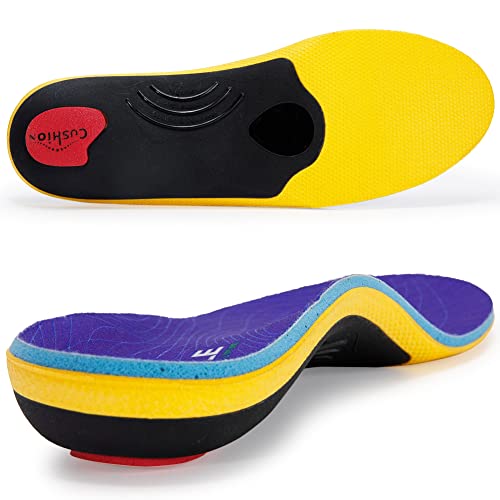
VALSOLE Heavy Duty Support Orthotics is built around rigid high-arch support and is designed for people weighing over 220 pounds, setting it apart from the cushioning-first choices. The brand says its shock-guard approach helps reduce impact, and the maker mentions a Poron heel pad. This size covers men’s 11–11.5 or women’s 13–13.5, which is a limited fit range. Pick it if those sizes fit and you want a firm orthotic feel; workers preferring a soft, flexible insert may find that structure unsuitable.
Bottom line: Choose these for a firm high arch in the size range.
WalkHero Heavy Duty Work Boot Insoles
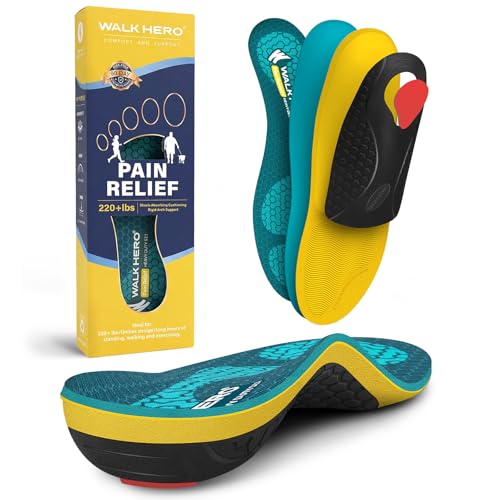
WalkHero Heavy Duty Work Boot Insoles combines a rigid nylon arch sheet with shock absorption and is specifically framed for work boots, unlike the broad-use cushioning designs. The brand positions it for people weighing over 220 pounds and describes pressure balancing at the heel and forefoot. This version fits men’s 6–6.5 or women’s 8–8.5, so workers outside those sizes need another fit. Choose it when a stable, structured insert for boots is the goal; it is not the most adaptable choice if you need broad sizing.
Bottom line: Choose these for rigid support in work boots and the sizes.
How to choose warehouse work insoles
Match the insert to your main need: cushioning for hard-floor impact, or a structured orthotic for firmer arch support. Insoles often take up roughly 1/8 to 1/4 inch of shoe depth, so a close-fitting safety shoe can become tight even when the length is right. Remove the factory footbed only when the shoe allows it, then check that the heel remains seated and toes can move. For a simple decision rule, choose a trim-to-fit cushion when you need flexibility and your work shoe has limited volume; choose rigid support only if the shoe can accommodate its structure without lifting the heel.
Compare cushioning and support styles
Gel and foam inserts soften impact, while rigid orthotics emphasize structure under the arch. A softer insert may feel less intrusive in a snug shoe, but it does not provide the same firm arch support as a rigid shell. Use this comparison to narrow the style before checking each model’s size.
| Need | Style to consider | Fit check |
|---|---|---|
| Long hours on hard floors | Gel cushioning | Confirm there is room above the toes |
| Airflow with soft cushioning | Foam and honeycomb design | Stay within the size span |
| Firm arch structure | Rigid orthotic | Check the size and shoe depth |
Warehouse floors also vary: concrete transmits more impact than resilient flooring, so prioritize cushioning if the floor is hard and your shoe’s own midsole is thin.
Get the insole fit right in work shoes
Length and shoe volume both matter: an insert that reaches the toe but crowds the upper can cause pressure during a shift. Compare the insole against the removable footbed, keeping the heel cup aligned; trim only along the toe edge when the design permits it. Work boots with a removable liner generally offer more room to exchange footbeds than low-volume safety shoes, but fit still depends on the boot’s shape. Check that the heel does not lift and that the toe box remains comfortable while standing. A tight fit is a reason to choose a thinner cushion rather than forcing a rigid insert into the shoe.
Break in supportive insoles safely
Introduce a new rigid orthotic over several days rather than wearing it for an entire shift immediately; start with a few hours and increase wear if it remains comfortable. Stop using an insert if it causes new numbness, blistering or sharp pain, since pressure can build during repeated walking and lifting. Keep insoles dry between shifts: remove them from the shoes overnight and let both air out, especially if moisture collects. Replace an insert when its cushioning is visibly compressed or its arch structure is damaged; worn material can no longer provide the support it was designed to deliver.
Frequently Asked Questions
How thick should warehouse work insoles be?
A typical replacement insole adds about 1/8 to 1/4 inch of depth, though rigid orthotics can occupy more room. Choose a thinner insert if your safety shoes already feel snug across the toes.
Can I use orthotic insoles in safety shoes?
Yes, if the shoe has enough internal space and the orthotic sits flat without lifting the heel. Test the fit standing up; a raised heel can reduce stability and crowd the toe area.
How often should work insoles be replaced?
Many workers replace insoles every 6 to 12 months, sooner if cushioning stays compressed or the support visibly deforms. Heavy daily use and damp shifts can shorten their useful life.
Should I remove the factory insole first?
Remove the factory footbed when it is removable and the replacement is designed to take its place. Stacking inserts can raise the heel and reduce toe clearance, especially in close-fitting safety shoes.
How long should I wear new orthotic insoles at first?
Start with about 2 to 3 hours a day and add a few hours as comfort allows. Stop if the insert causes sharp pain, numbness or skin irritation rather than trying to push through a full shift.