
SEESE Cordless Leaf Blower: Models and Alternatives

For most buyers seeking a SEESE cordless leaf blower, SEESE Turbo 600 CFM is the clearest fit because it pairs a 600 CFM airflow claim with a 21V, 4.0Ah battery. Choose SEESE Cyber 750 CFM instead if its 750 CFM claim and larger 8.0Ah battery better match your priorities; the other options are alternatives from different brands.
A cordless leaf blower uses a rechargeable battery to power a motor and move loose debris with directed air. Match the airflow and battery setup to the area you clean, and use extra caution around people, pets, dust and loose objects.
We earn a commission if you buy through links on this page. As an Amazon Associate I earn from qualifying purchases. Products are compared on manufacturer specifications, not hands-on testing.
- Best overall: SEESE Turbo 600 CFM – It is a SEESE model with a 600 CFM airflow claim and a 21V, 4.0Ah battery.
- Best for larger battery capacity: SEESE Cyber 750 CFM – Its 21V, 8.0Ah battery is larger than the other SEESE model’s.
- Best for spare battery rotation: Cordless Blower with Two 4.0Ah Batteries – It includes two 4.0Ah batteries and a charger.
| Product | Best for | Battery | Batteries included | Speed control | Shop |
|---|---|---|---|---|---|
| SEESE Turbo 600 CFM | SEESE handheld use | 21V, 4.0Ah | 1 | — | Check Price on Amazon |
| SEESE Cyber 750 CFM | Larger battery capacity | 21V, 8.0Ah | 1 | Stepless | Check Price on Amazon |
| FAOGO Handheld Blower | Two-battery rotation | — | 2 | — | Check Price on Amazon |
| Sakerplus Cordless Blower | Light debris cleanup | 4.0Ah | 2 | — | Check Price on Amazon |
| Cordless Blower with Two 4.0Ah Batteries | Longer low-speed sessions | 4.0Ah each | 2 | Stepless | Check Price on Amazon |
SEESE Cordless Leaf Blowers and Alternatives
Compare the SEESE options first, then consider the alternatives by battery setup and control style.
SEESE Turbo 600 CFM

Among these choices, this is the SEESE model with a 600 CFM airflow figure and a 21V, 4.0Ah battery. The maker also describes a brushless motor and a 2.7-pound handheld design. Its use cases include yard leaves, wood shavings and car drying, so it suits buyers who want one blower for light outdoor cleanup and non-yard tasks.
The product name and features do not give a runtime figure, so anyone planning long sessions should confirm the expected runtime before ordering. Airflow alone does not establish how long a battery-powered blower can maintain a particular speed.
Bottom line: Choose this if you want a SEESE handheld model with a 600 CFM airflow figure.
SEESE Cyber 750 CFM
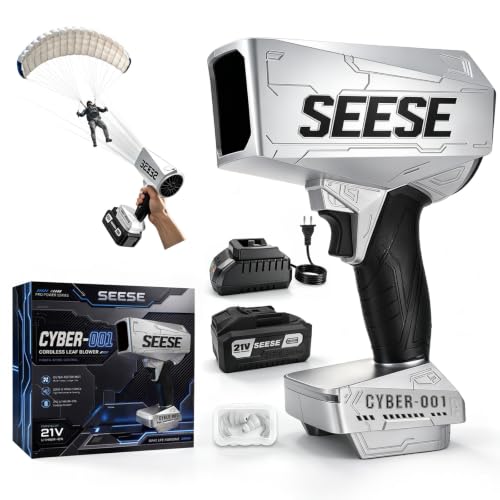
This SEESE model separates itself with a larger 8.0Ah battery and a stepless speed control, compared with the 4.0Ah battery on the other SEESE option. The maker claims 750 CFM airflow, up to 2,000 g of blowing force and a 52,000 RPM brushless motor. It is aimed at yard work as well as car drying and snow removal.
Buyers who need a spare pack for uninterrupted work should confirm the included battery count before ordering; battery capacity by itself is not a runtime guarantee.
Bottom line: Pick this if you prefer a larger battery capacity and stepless speed control.
FAOGO Handheld Blower

Unlike the SEESE models, this FAOGO alternative comes with two batteries, each with a maker-claimed 13-plus minutes of strong airflow; the maker says swapping them can provide 26-plus minutes total. The maker also claims a 990,000 RPM turbine motor and wind speeds over 50 m/s, or 110-plus mph. Its 2.8-pound weight and anti-vibration handle are intended for handheld yard, patio and garden cleanup.
Those airflow and runtime figures are manufacturer claims, not a guarantee for every setting or task.
Bottom line: Choose this if having two batteries for rotation matters more than a CFM figure.
Sakerplus Cordless Blower

This compact Sakerplus option is presented for light debris such as dry leaves and dust, while the SEESE models make stronger airflow claims. Its features describe 260 CFM, a 2.3-pound weight and one-handed use for patios, decks and small areas. The product name says it includes two batteries and a storage case, and identifies a 4.0Ah battery.
The details also give a different weight, so confirm the assembled weight before ordering if carrying comfort is a deciding factor. Its own guidance says heavier continuous use may require breaks, making it a less natural choice for extended heavy cleanup.
Bottom line: Choose this for small-area cleanup when light debris is the main task.
Cordless Blower with Two 4.0Ah Batteries

This alternative emphasizes battery rotation: it includes two 4.0Ah batteries and a fast charger, whereas the SEESE choices include one battery in their names. The maker claims up to 30 minutes of operation per battery at low speed and wind speeds up to 65 m/s. Stepless speed adjustment and two extended nozzles are also part of the product name and features.
The claimed runtime applies to low speed, so it should not be read as a high-speed estimate. This product’s wind speed is not directly comparable with CFM, which measures air volume rather than air speed; buyers focused on airflow volume should compare products that provide that same measure.
Bottom line: Pick this if two 4.0Ah packs and low-speed runtime are your priorities.
How to compare cordless leaf blower airflow
CFM measures the volume of air moved, while mph measures air speed; neither figure alone tells you how a blower will handle every kind of debris. Airflow volume helps describe how much air moves, while speed helps describe how forcefully the stream travels. Compare products using the same unit, and do not treat RPM or grams of thrust as interchangeable with either CFM or mph.
Use a measurable rule: if you need to compare volume, shortlist models with a CFM figure and compare that figure directly; if a model gives only mph, do not rank it by CFM. Wet leaves tend to cling more than dry leaves, and airflow direction matters near gravel, mulch or dust. Start at a lower setting near loose material, then increase only as needed.
Choosing a battery setup for yard cleanup
Battery amp-hours describe stored capacity, not a guaranteed runtime; speed setting, workload and battery condition affect how long a blower runs. Two batteries can let you rotate packs, but they do not establish the operating time of either pack. The runtime for Cordless Blower with Two 4.0Ah Batteries applies to low speed, while FAOGO Handheld Blower gives a per-battery estimate and a total when swapping packs.
For a large or extended cleanup, favor a product that gives a runtime for the setting you expect to use, or plan a pause to recharge. For a short patio cleanup, convenience and manageable weight may matter more than maximum capacity. Never assume a battery from one brand fits another: battery platforms and chargers are not universal, so match the pack and charger to the blower.
Safe use around leaves, dust and people
Eye protection and hearing protection are sensible when operating a powered blower, especially during prolonged use or around dry dust and debris. A blower can propel grit, small stones and twigs, so clear the area and direct the air away from people, animals, windows and traffic. Keep loose clothing and hair away from moving parts.
Use the lowest setting that moves the material, particularly near gravel, garden beds and dry soil where a strong stream can scatter stones or raise dust. Avoid blowing debris toward storm drains or neighboring areas; gather and dispose of yard waste according to local rules. Do not use a blower to move burning material, and stop if the motor, battery or housing becomes unusually hot.
When a compact blower is the better fit
A compact handheld blower can be easier to store and handle for steps, patios, cars and small patches of leaves, while a broad yard can call for more sustained airflow and battery capacity. Compare product weight as assembled, including the battery, because the bare tool can feel different from the operating weight. If the published weights conflict, confirm the assembled weight before ordering.
Match the nozzle and airflow to the surface: concentrated streams can move heavier debris but also scatter gravel, while a broader stream may clear open areas more evenly. Work from the edges toward a collection point instead of chasing leaves across the whole yard. For dust-sensitive areas, use a broom, damp cleanup method or other approach that does not lift fine particles into the air.
Frequently Asked Questions
What does CFM mean on a cordless leaf blower?
CFM means cubic feet per minute and measures air volume. Compare CFM figures directly only when both products provide that measurement; mph describes air speed, not the same quantity.
Does a higher amp-hour battery last longer?
A higher amp-hour rating indicates more battery capacity, but it does not guarantee a specific runtime. Speed setting, debris load and battery condition all affect operating time.
Can cordless blower batteries be shared between brands?
Do not assume batteries are interchangeable across brands. Battery platforms and chargers vary, so use a pack and charger specified for the blower.
Is a leaf blower safe to use near gravel?
Use the lowest effective setting and point the airflow away from people, windows and vehicles because a blower can propel small stones. For loose gravel or dry soil, sweeping or another low-dust method may be safer.
Should I wear hearing protection with a leaf blower?
Hearing protection is a prudent choice during prolonged blower use, especially if the motor sounds loud at your working distance. Eye protection also helps guard against grit and twigs propelled by the airflow.