
Rear Main Seal Sealant: 3 Additives Compared

For a rear main seal leak, Bar’s Leaks Rear Main Seal Repair, 16.9 oz is the most direct match because its maker specifically designs it for rear main leaks and gives a 100-mile or 2-day target for most leaks. Choose another formula if you need an additive for other vehicle systems or a smaller 8-ounce bottle.
Rear main seal sealant is an oil additive intended to condition seals rather than replace a damaged seal; it cannot address every source of an oil leak.
We earn a commission if you buy through links on this page. As an Amazon Associate I earn from qualifying purchases. Products are compared on manufacturer specifications, not hands-on testing.
- Best overall: Bar’s Leaks Rear Main Seal Repair, 16.9 oz – Specifically designed for rear main leaks, with the maker’s stop leak timeframe.
- Best for multi-system use: BlueSeal Oil Stop Leak, 8 oz – The maker says the 8-ounce formula also works in transmissions, power steering, differentials, and hydraulic systems.
- Best for gas or diesel: BlueDevil 00234 Rear Main Sealer, 8 oz – The maker specifies compatibility with gas and diesel engines and synthetic or conventional oils.
| Product | Best for | Bottle size | Formula | Other stated uses | Shop |
|---|---|---|---|---|---|
| Bar’s Leaks Rear Main Seal Repair, 16.9 oz | Targeted rear seals | 16.9 oz | — | Timing cover, cam seal | Check Price on Amazon |
| BlueSeal Oil Stop Leak, 8 oz | Multi-system seals | 8 oz | Petroleum-free | Transmission, steering, differential | Check Price on Amazon |
| BlueDevil 00234 Rear Main Sealer, 8 oz | Oil type flexibility | 8 oz | Petroleum-distillate-free | Timing cover | Check Price on Amazon |
Rear Main Seal Sealant Compared
Compare the formula, volume, and application scope before choosing an oil additive.
Bar’s Leaks Rear Main Seal Repair, 16.9 oz
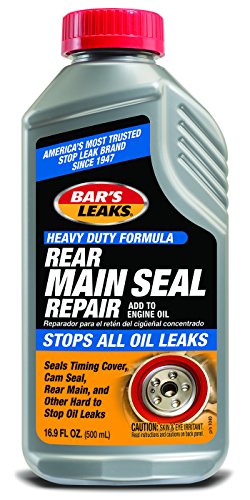
Bar’s Leaks Rear Main Seal Repair, 16.9 oz is the only formula here explicitly designed for rear main leaks, making it the clearest match when that is the suspected leak point. The maker says to add the entire bottle to the crankcase where engine oil is added, at or between oil changes, without overfilling; most leaks should stop within 100 miles or 2 days of driving. It also targets timing cover and cam seal leaks. The limitation is that it is an engine-oil additive, not a seal replacement, so it may not resolve a mechanically damaged seal.
Bottom line: Choose this when the leak is believed to come from the rear main seal and you want a specifically targeted formula.
BlueSeal Oil Stop Leak, 8 oz

BlueSeal Oil Stop Leak, 8 oz differs by extending beyond the engine: the maker says it can recondition rubber seals in transmissions, power steering, differentials, rack-and-pinion systems, and hydraulic systems. Its 8-ounce petroleum-free, non-clogging formula is poured into the oil sump or crankcase, and the maker specifies use in gasoline and diesel engines. The wide system scope may suit an owner addressing seal leaks in more than one type of system. The limitation is that it is not described as specifically targeting rear main seals, unlike Bar’s Leaks Rear Main Seal Repair, 16.9 oz.
Bottom line: Pick this if multi-system seal conditioning matters more than a rear main-specific formula.
BlueDevil 00234 Rear Main Sealer, 8 oz

BlueDevil 00234 Rear Main Sealer, 8 oz stands out for its compatibility with synthetic and conventional oils, alongside gas and diesel engines. The maker describes a pour-in treatment that rejuvenates dried, cracked, and shrunken rubber seals while driving and says it targets rear main seal and timing cover leaks without engine disassembly. Its petroleum-distillate-free formulation is another distinction for buyers comparing seal conditioners. The limitation is that this is an 8-ounce bottle, and its scope does not extend to the transmission, steering, differential, or hydraulic systems covered by BlueSeal Oil Stop Leak, 8 oz.
Bottom line: Choose this when oil-type flexibility and stated gas-or-diesel compatibility are priorities.
How to choose rear main seal sealant
Start by matching the leak location and system: a rear main seal leak points toward an engine-oil additive, while leaks in steering or hydraulic systems call for a formula whose maker names those systems. Here, Bar’s Leaks Rear Main Seal Repair, 16.9 oz is specifically designed for rear main leaks, BlueSeal Oil Stop Leak, 8 oz names several other systems, and BlueDevil 00234 Rear Main Sealer, 8 oz names rear main and timing cover leaks.
Seal conditioners are not mechanical repairs. An external leak can also come from nearby parts such as an oil pan gasket, valve cover gasket, or transmission input seal, so confirming the leak source matters before adding an additive. If oil is dripping rapidly, the oil-pressure warning appears, or the level falls below the safe range, stop driving and address the leak rather than waiting for a treatment response.
What additive formulas and uses mean
Oil additives work by circulating through the lubricated system; seal-conditioning formulas aim to improve the flexibility of elastomer seals. They cannot rebuild missing material, correct a split seal, or fix a loose fastener. The word “permanent” on a product label does not make an additive equivalent to replacing a failed seal.
For this group, the practical distinction is where each maker says the formula can be used. BlueSeal Oil Stop Leak, 8 oz names engine, transmission, steering, differential, and hydraulic systems; Bar’s Leaks Rear Main Seal Repair, 16.9 oz and BlueDevil 00234 Rear Main Sealer, 8 oz focus on engine leak areas. Never pour an engine treatment into a separate reservoir unless the product explicitly names that system, because fluids and seal materials vary across components.
How to add sealant without overfilling
Check the engine-oil level on level ground before adding any crankcase treatment. A dipstick reading above the full mark can indicate overfill; removing the excess is safer than adding a whole bottle on top. Bar’s Leaks Rear Main Seal Repair, 16.9 oz specifically instructs users to add its full bottle without overfilling, while BlueSeal Oil Stop Leak, 8 oz and BlueDevil 00234 Rear Main Sealer, 8 oz describe pour-in application.
Use the correct fill opening and keep additives out of coolant, brake-fluid, and fuel reservoirs. If the oil is already at the full mark, first determine whether there is room for the additive within the engine’s capacity. A treatment should not delay inspection when a leak leaves fresh oil under the vehicle or oil reaches hot exhaust parts.
When a seal additive is not the right fix
Choose mechanical diagnosis over a conditioner when a seal is torn, displaced, or leaking heavily; additives cannot restore a physical gap. Rear main seal replacement often involves transmission removal, so a mistaken diagnosis can lead to unnecessary repair work. Oil can travel along an engine or transmission housing, making the visible drip point different from the source.
Monitor the dipstick and the ground after treatment, and avoid driving if the oil level drops quickly or warning lights appear. The maker of Bar’s Leaks Rear Main Seal Repair, 16.9 oz gives most leaks a window of 100 miles or 2 days, but that claim is not a safe waiting period for a severe leak. A mechanic can distinguish a rear main leak from nearby gasket or housing leaks before a major repair is authorized.
Frequently Asked Questions
Can rear main seal sealant fix a torn seal?
No; a conditioner cannot replace missing or split seal material. A visibly damaged or displaced seal needs mechanical repair, and heavy oil loss should be addressed before driving.
How long can rear main seal additive take to work?
The maker of Bar’s Leaks Rear Main Seal Repair, 16.9 oz says most leaks stop within 100 miles or 2 days of driving. That timeframe is not a reason to continue driving if oil is leaking rapidly or the level is falling.
Can I add rear main seal additive between oil changes?
Yes, the maker of Bar’s Leaks Rear Main Seal Repair, 16.9 oz says its bottle can be added at or between oil changes. Check the oil level first and avoid exceeding the full mark on the dipstick.
Does rear main seal sealer work with synthetic oil?
The maker of BlueDevil 00234 Rear Main Sealer, 8 oz says its formula works with synthetic and conventional oils. Confirm compatibility for the specific treatment and engine before use when that information is essential.
Can engine stop leak go in power steering fluid?
Only use a formula that explicitly names power steering as a compatible system; BlueSeal Oil Stop Leak, 8 oz names power steering, while engine-only products should stay in the crankcase. Reservoir fluids are not interchangeable, so use the correct fill point.