
Invicta Invincible in Detail Since 1837: Watches Compared

Invicta 8929OB Pro Diver Automatic is the best starting point for most people drawn to Invicta watches because its 40mm case is smaller than the 48mm and 50mm quartz alternatives, and its automatic movement avoids a battery. The phrase “Invincible in detail since 1837” does not identify a particular model among these choices.
Choose a different watch if you want a larger case, quartz timekeeping, or a digital display with fitness features; those needs point to different options below.
We earn a commission if you buy through links on this page. As an Amazon Associate I earn from qualifying purchases. Products are compared on manufacturer specifications, not hands-on testing.
- Best overall: Invicta 8929OB Pro Diver Automatic – A 40mm case and Japanese automatic movement distinguish it from the larger quartz models.
- Best for diving: Invicta 0073 Pro Diver Chronograph – Its 200-meter water-resistance rating and unidirectional bezel suit diving use.
- Best for a 50mm case: Invicta 25852 Pro Diver – The largest case measures 50mm across.
| Product | Best for | Case diameter | Movement | Water resistance | Shop |
|---|---|---|---|---|---|
| Invicta 8929OB Pro Diver Automatic | Compact automatic fit | 40mm | NH35A automatic | 200m | Check Price on Amazon |
| Invicta 0073 Pro Diver Chronograph | Diving activities | 48mm | Japanese quartz VD53 | 200m | Check Price on Amazon |
| Invicta 25852 Pro Diver | Largest case | 50mm | Japanese quartz VD53 | 100m | Check Price on Amazon |
| Invicta 20291 Pro Diver Silicone Strap | White strap | 48mm | Japanese quartz VD53 | 100m | Check Price on Amazon |
Invicta Pro Diver Watches Compared
Compare the case size, movement and water-resistance rating to match a watch to your wrist and intended activities.
Invicta 8929OB Pro Diver Automatic

At 40mm across, Invicta 8929OB Pro Diver Automatic has the smallest case in this group and is the only automatic model among the analog watches. Its NH35A Japanese automatic movement has 24 jewels; the exhibition back lets you see the movement. The black dial, gold-tone steel case and bracelet, mineral crystal, screw-down crown and coin-edge bezel give it a distinct combination of features. Choose it if you want a smaller case and automatic winding. Its 14mm thickness and 152-gram weight may still feel substantial, and an automatic watch needs regular wear or winding to keep running.
Bottom line: Choose this if you want the group’s smallest case and an automatic movement.
Invicta 0073 Pro Diver Chronograph

For a 200-meter rating in a larger quartz watch, Invicta 0073 Pro Diver Chronograph pairs a 48mm gold-tone steel case with a blue dial and blue bezel ring. Its Japanese quartz VD53 movement powers three functional subdials for 60 minutes, 60 seconds and 24 hours; the band adjusts by adding or removing links. The maker describes this model as suitable for diving, unlike the 100-meter choices here. Pick it for that stated activity range and chronograph functions. At 310 grams and 12.5mm thick, it is a substantial watch, so its weight and wrist fit deserve consideration.
Bottom line: Choose this for the group’s diving-suitable rating and chronograph subdials.
Invicta 25852 Pro Diver
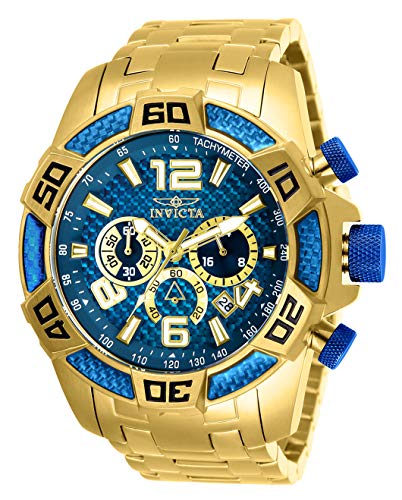
Invicta 25852 Pro Diver has the widest case here at 50mm, with a 17.5mm thickness, gold-tone steel construction and blue dial. The Japanese quartz VD53 movement includes 60-minute, 60-second and 24-hour subdials, while luminous hands and markers improve legibility in low light. Its bracelet adjusts by adding or removing links, and the unidirectional bezel is steel. The maker rates it for 100-meter water resistance and recreational water sports, but not diving. This is the option to consider for a prominent case; its size may overwhelm a smaller wrist.
Bottom line: Choose this if a 50mm case and blue dial are your priorities.
Invicta 20291 Pro Diver Silicone Strap

Invicta 20291 Pro Diver Silicone Strap stands apart with a white silicone strap paired with a gold-tone steel case, a silver dial and a black top bezel ring. The 48mm case is 16.5mm thick, and the Japanese quartz VD53 movement has 60-minute, 60-second and 24-hour subdials. Unlike the link bracelets on the other analog options, this strap closes with a buckle. The maker gives it a 100-meter rating for recreational water sports and says it is not suitable for diving. Choose it if you want a silicone strap; the 48mm case remains large despite the strap’s flexible fit.
Bottom line: Choose this for a silicone strap and a 48mm case.
How to Choose an Invicta Watch
Start with case diameter and how you plan to use the watch: the options here span 40mm to 50mm, while their water-resistance ratings range from 100m to 200m. Case diameter is measured across the case, not the strap, and thickness affects how high a watch sits under a cuff. If you prefer a less prominent case, consider the 40mm option before the 48mm and 50mm models. Then choose quartz for battery-powered timekeeping or automatic for a movement wound by wrist motion or manual winding. A larger water-resistance number does not by itself establish that a watch is certified to a dive-watch standard.
For activity fit, use the maker’s limits for each watch rather than treating the ratings as interchangeable. The 100-meter models here are described for recreational water sports and not diving; the 200-meter models are described as suitable for diving.
Quartz and Automatic Movements
Quartz and automatic movements keep time differently: quartz uses a battery and electronic oscillator, while an automatic movement stores energy in a mainspring wound by wrist motion. Quartz watches generally need a battery replacement every few years, though actual intervals vary by movement and use. Automatic watches stop when their stored power runs down, so an occasional wearer may need to reset one before use. In this selection, the three larger analog models use Japanese quartz movements; the 40mm model is automatic. If you want to avoid battery changes, choose the automatic option, but plan for winding or resetting after it sits unworn. If you want battery-powered operation, choose one of the quartz models.
Water Resistance and Safe Use
Water-resistance ratings are based on controlled pressure tests, not a promise that a watch is suitable for every real-world water activity. A 100-meter rating is not a universal permission to dive; the maker specifically excludes diving for the 100-meter watches in this group. For diving, consider only a model whose maker explicitly describes it as suitable for diving, and verify that its condition and crown are appropriate before entering the water. Water resistance can decline as seals age or after impacts, so have seals checked periodically, especially if the watch is regularly exposed to water. Never operate a crown while the watch is wet, and rinse salt water from a steel bracelet after exposure.
Bracelet and Strap Fit
A metal bracelet usually needs link adjustment to fit, while a silicone strap fastens through a buckle and holes. The bracelet models here allow links to be added or removed; the silicone model uses a buckle. A watch that slides freely around the wrist can strike nearby surfaces, while a strap worn too tightly can be uncomfortable as the wrist changes size during the day. For a metal bracelet, have links removed evenly and retain the spare links. Before buying, measure wrist circumference and compare it with the band length, while allowing room for adjustment. If you cannot get a secure fit within the available adjustment, choose a different strap or case combination.
Frequently Asked Questions
Can a 100-meter watch be used for diving?
A 100-meter rating alone does not mean a watch is suitable for diving. The maker describes the 100-meter watches here for recreational water sports and says they are not suitable for diving.
What is the practical difference between quartz and automatic watches?
Quartz watches run on a battery, while automatic watches wind a mainspring through wrist motion or manual winding. An automatic watch may stop after sitting unworn; a quartz watch eventually needs a battery replacement.
How do I choose the right watch case size?
Compare case diameter with your wrist and consider thickness as well as width. The watches here range from 40mm to 50mm across, so someone seeking a less prominent case should start with the 40mm option.
Should I use a watch crown while swimming?
Keep the crown closed and do not operate it while the watch is wet. Water can enter through an open crown, and pressure ratings assume the watch is properly sealed.
How often should a watch’s water resistance be checked?
Have water resistance checked periodically if the watch is regularly exposed to water, particularly after impacts or as seals age. A pressure check can identify a seal problem before water reaches the movement.