
Waterproof Paint for Fountains: 4 Coatings Compared

For a fountain that will hold water, Pond Armor Clear Pond Epoxy, 1.5 Qt is the closest match because it is an epoxy coating made for water features and submerged applications. Choose a different coating only if your project is a masonry wall or general leak repair rather than a water-holding fountain.
Fountain coatings need to suit the surface and remain appropriate for continuous water exposure; wall waterproofer and roof sealant are not interchangeable with pond coatings.
We earn a commission if you buy through links on this page. As an Amazon Associate I earn from qualifying purchases. Products are compared on manufacturer specifications, not hands-on testing.
- Best overall: Pond Armor Clear Pond Epoxy, 1.5 Qt – Its use includes waterproofing fountains and other submerged water features.
- Best for flexible crack coverage: TUFINEIN Rubber Liquid Sealant, 53 oz – The maker says its rubber coating covers small gaps and cracks.
- Best for masonry walls: INSL-X WaterBlock Acrylic Masonry Waterproofer, 1 Gal – It is an acrylic waterproofer for interior and exterior concrete walls.
| Product | Best for | Coating type | Color | Container size | Shop |
|---|---|---|---|---|---|
| Pond Armor Clear Pond Epoxy, 1.5 Qt | Submerged water features | Epoxy | Clear | 1.5 qt | Check Price on Amazon |
| TUFINEIN Rubber Liquid Sealant, 53 oz | Flexible leak repair | Rubber sealant | Neutral gray | 53 oz | Check Price on Amazon |
| INSL-X WaterBlock Acrylic Masonry Waterproofer, 1 Gal | Concrete wall sealing | Acrylic masonry paint | White | 4 qt | Check Price on Amazon |
| Rust-Oleum Watertite Latex, 1 Qt | Interior masonry walls | Latex masonry paint | White | 1 qt | Check Price on Amazon |
Waterproof Paint for Fountains Compared
Match the coating to the surface and whether it will be continuously submerged before choosing.
Pond Armor Clear Pond Epoxy, 1.5 Qt

Unlike the other options, this clear epoxy is specifically intended for ponds, fountains, waterfalls and other water features. The maker says it forms a waterproof barrier on concrete, stone, wood and metal, with additional compatibility for brick, gunnite, shotcrete and select plastics. It is self-priming and intended for submerged applications, making it the most relevant choice here for a fountain basin. The 1.5-quart kit is a smaller container than the gallon masonry paint. Confirm the required preparation, cure time and suitability for any fish or plants before filling the fountain.
Bottom line: Choose this for a fountain basin when the surface is compatible and the coating can fully cure before filling.
TUFINEIN Rubber Liquid Sealant, 53 oz

This flexible rubber sealant differs from the dedicated pond epoxy by targeting cracks and general leak repair rather than naming fountains or submerged basins as its intended use. The maker says it can cover small gaps and cracks, forms an initial film in 2–4 hours, and is suitable for multiple surfaces including roofs, gutters, basements and wood. Its temperature range is −40°F to 176°F. The neutral-gray finish may not suit a fountain where a clear coating is desired, and its uses do not establish suitability for continuous immersion. Treat it as a repair coating only after confirming the exposure conditions.
Bottom line: Consider it for flexible exterior leak repair, not as a substitute for a coating specified for submerged fountains.
INSL-X WaterBlock Acrylic Masonry Waterproofer, 1 Gal
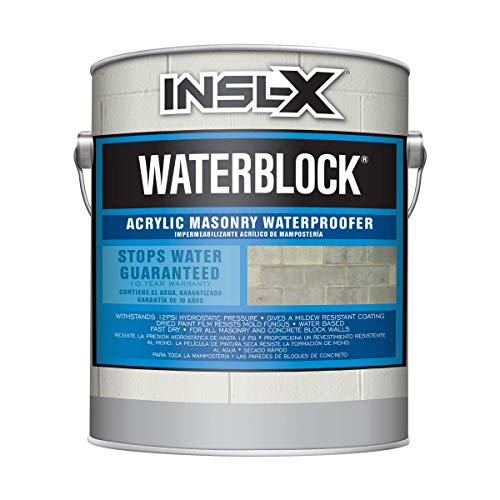
This acrylic waterproofer is formulated for vertical concrete walls, which separates it from the fountain-focused epoxy. The maker lists interior and exterior basement walls, foundations, retaining walls, cinder blocks, stucco and brick; it also gives an application temperature range of 50°F to 90°F and says the coating withstands up to 12 psi hydrostatic pressure. Those wall-focused uses may fit a fountain’s exterior masonry, but they do not establish suitability for a submerged basin. Its white color and 1-gallon size also make it a different choice from the clear, smaller pond coating. Keep the water-contact side in mind when matching the product to the job.
Bottom line: Choose it for a vertical masonry surface, not for the fountain’s water-holding interior.
Rust-Oleum Watertite Latex, 1 Qt
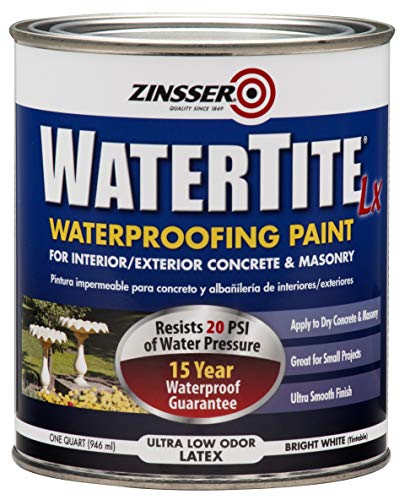
This latex waterproofing paint is a wall coating rather than a dedicated fountain finish. The maker says it is for dry walls, applies with a brush or roller, resists up to 20 pounds of water pressure, and carries stated waterproofing and mold- and mildew-proof film guarantees. The white, 1-quart container could be relevant to an interior masonry repair where its intended application fits. However, the specifications do not identify submerged water-feature use, so do not assume that pressure resistance means it is appropriate inside a basin. For a fountain, the dedicated pond epoxy is the closer fit.
Bottom line: Use it for a compatible masonry wall application rather than a continuously submerged fountain surface.
How to choose waterproof paint for a fountain
Choose by water exposure first: a basin that stays full needs a coating intended for submerged use, while exterior walls may need only resistance to dampness or seepage. Concrete, brick, stone, metal and wood do not all accept the same coating, so confirm the coating matches the prepared substrate. For a water-holding fountain, favor a product that explicitly names water features or immersion; a wall coating’s hydrostatic-pressure rating alone does not establish immersion suitability. If the fountain has fish or plants, confirm that the fully cured coating is appropriate for that use before filling. Also compare the container coverage guidance and required number of coats on the product label, since surface texture and porosity affect how much coating a basin needs.
Fountain basin coating versus masonry wall paint
A fountain basin coating is intended to form a barrier on surfaces exposed to standing or circulating water, while masonry wall paints generally target vertical walls and water pressure from soil or moisture. Pressure resistance is not the same as continuous immersion: a coating can resist water pushing through a wall without being intended to sit underwater. Surface position matters too; a vertical retaining wall and the submerged floor of a basin face different exposure. Use this comparison to narrow the type, then verify substrate and application conditions.
| Project surface | Coating direction | Key distinction |
|---|---|---|
| Water-holding basin | Dedicated pond or water-feature epoxy | Intended for submerged use |
| Vertical concrete wall | Masonry waterproofer | Wall use, not automatically immersion |
| Small exterior gap or leak | Flexible rubber sealant | Crack coverage does not establish basin use |
Preparing a fountain surface for coating
Surface preparation determines whether a coating can bond: remove loose material, dirt, algae and existing coatings that are not firmly attached, then let the surface reach the dryness required by the product. Concrete and masonry can be porous, and cracks or weak mortar may need repair before coating; paint cannot stabilize failing material. Avoid applying coatings outside their temperature limits: the INSL-X product calls for 50°F to 90°F conditions, illustrating why application windows matter. A smooth, clean substrate also helps prevent thin spots, especially at corners and around plumbing penetrations. Confirm that the surface material is among the coating’s compatible substrates before starting.
Curing and water exposure after painting
Do not refill a fountain until the coating has reached its specified cure, not merely a dry-to-touch or initial-film stage. A thin surface film can feel dry before the material has fully hardened, and premature water exposure can compromise adhesion or performance. Cure time changes with coating chemistry, temperature, humidity and coat thickness, so use the product-specific cure window rather than assuming one universal wait. For water that may contact animals or plants, verify aquatic suitability and any required curing or rinsing steps before introducing them. Keep the pump off during application and curing, and protect the freshly coated surface from debris that could create weak spots.
Frequently Asked Questions
Can regular waterproof wall paint go inside a fountain?
Only if its maker specifically allows continuous immersion and the fountain’s surface is compatible. Resistance to hydrostatic pressure on a wall does not by itself mean a paint is suitable for a submerged basin.
How long should fountain paint cure before adding water?
Wait for the coating’s full cure time, not just its touch-dry time. Temperature, humidity and coat thickness can change curing, so use the product’s specified window before refilling.
Does a fountain coating work on concrete and stone?
Some coatings are made for both, but compatibility depends on the specific coating and surface preparation. Clean off loose material and confirm the exact substrate is allowed before coating.
Can a newly painted fountain hold fish or plants?
Confirm that the cured coating is suitable for aquatic life before adding fish or plants. A waterproof claim alone does not establish safety for animals or plants, and the coating must reach its full cure first.
Can I paint a fountain in cold weather?
Use the coating’s application temperature range; the INSL-X masonry paint here calls for air and surface temperatures from 50°F to 90°F. Cold conditions can slow curing, so avoid assuming the same wait time across temperatures.