
Motorcycle Tire Pressure Monitors Compared by Setup

For most riders, Sykik Rider SRTP300 is the straightforward choice because it has a dedicated 1.5-inch monitor and a rechargeable display battery. Choose an app-based system instead if you want phone notifications, or a solar-assisted display if you prefer a separate LCD unit.
A motorcycle TPMS uses wheel sensors to report pressure, and some systems also report temperature; it supplements, rather than replaces, a pressure gauge and tire checks.
We earn a commission if you buy through links on this page. As an Amazon Associate I earn from qualifying purchases. Products are compared on manufacturer specifications, not hands-on testing.
- Best overall: Sykik Rider SRTP300 – Its dedicated 1.5-inch monitor avoids relying on a phone display.
- Best for phone alerts: FOBO Bike 2 – Bluetooth 5.0 pairs with the FOBO app for real-time monitoring and alerts.
- Best for solar charging: Solar-Charge LCD Motorcycle TPMS – Its LCD receiver has a solar panel and reports front and rear pressure and temperature.
- Best for waterproofing: Motorcycle TPMS with IP67 LCD – Its two external sensors and LCD monitor are rated IP67.
| Product | Best for | Readout | Power | Sensor setup | Shop |
|---|---|---|---|---|---|
| Sykik Rider SRTP300 | Dedicated monitor | 1.5-inch monitor | Rechargeable monitor | — | Check Price on Amazon |
| FOBO Bike 2 | Phone notifications | FOBO app | — | — | Check Price on Amazon |
| Motorcycle TPMS with IP67 LCD | Waterproof LCD | LCD display | — | Two external sensors | Check Price on Amazon |
| LEEPEE TPMS 5.0 | Phone-based alerts | Motorcare app | — | — | Check Price on Amazon |
| Solar-Charge LCD Motorcycle TPMS | Solar-assisted display | LCD digital display | Solar charging | Two external sensors | Check Price on Amazon |
Motorcycle Tire Pressure Monitors
Compare these systems by how they deliver readings and what setup they require.
Sykik Rider SRTP300

Unlike the phone-based options, this system includes a dedicated 1.5-inch monitor, so readings do not depend on opening a smartphone app. It uses PSI and Fahrenheit by default, and the monitor has a rechargeable battery. Sykik says the monitor battery lasts 9–12 months and sensor batteries last two years with normal use; it also provides a one-year US warranty. This suits riders who want a separate display. The main limitation is that the features do not identify sensor mounting style, so riders with tight valve-stem clearance should confirm fit before ordering.
Bottom line: Pick this if you want a separate monitor rather than phone-only readouts.
FOBO Bike 2
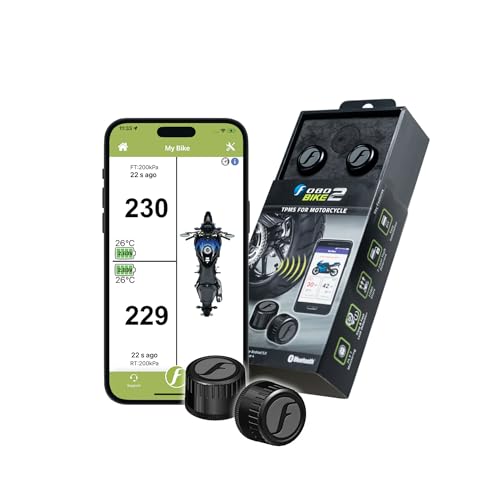
FOBO Bike 2 stands apart with Bluetooth 5.0 and app-based monitoring rather than a dedicated LCD receiver. The maker says it tracks pressure and temperature continuously and can alert riders to low pressure, slow or fast leaks, and abnormal temperature; cloud sync is also included. It is designed for riders who prefer phone notifications and an app setup without an additional receiver.
Bottom line: Choose it if phone alerts and Bluetooth monitoring suit your setup.
Motorcycle TPMS with IP67 LCD

Its maker says the wireless system reports tire pressure and temperature in real time and gives an audiovisual alarm when it detects abnormalities. That makes it a fit for riders who want a standalone screen and external valve-stem sensors. External sensors also need clearance around the valve stems.
Bottom line: Choose it if IP67 protection and a dedicated LCD are priorities.
LEEPEE TPMS 5.0

LEEPEE centers its monitoring on the Motorcare app for iOS and Android, with no separate receiver identified in its features. The maker says the system monitors pressure in real time and offers high- and low-pressure, air-leak, high- and low-temperature, and battery-level alerts. Its sleep mode activates after 10 minutes of vehicle inactivity, which suits riders who want app alerts and sensor power management. Check app compatibility with your phone and available valve-stem clearance before choosing it.
Bottom line: Pick it if you want multiple alert types in a phone-based setup.
Solar-Charge LCD Motorcycle TPMS

It shows front and rear pressure and temperature, with PSI or Bar and Fahrenheit or Celsius options. The maker describes seven alarms, including high or low pressure, high temperature, rapid air loss, signal loss, and low battery alerts. This suits riders who want a separate readout with a solar top-up. Solar charging depends on sunlight, so riders who store a bike indoors should not rely on it as the only charging method. Its two sensors are external, so check valve-stem clearance.
Bottom line: Choose it if you want an LCD with solar-assisted charging and selectable units.
How to choose a motorcycle tire pressure monitor
Choose a motorcycle TPMS by readout style, sensor arrangement and alert needs. A display-based system gives readings on a dedicated screen; an app-based system sends them to a compatible phone, so check whether your preferred phone supports the app before buying. Direct TPMS sensors measure pressure at the wheel, while the receiver or app presents the readings. External cap-style sensors screw onto valve stems, so account for clearance near brake parts and wheel components. A TPMS is an alerting aid, not a replacement for a reliable hand gauge: check tires before a ride and investigate a warning promptly. If you routinely ride with a passenger or luggage, use the motorcycle maker’s pressure guidance for that load rather than assuming one pressure suits every trip.
How to check motorcycle tire pressure
Set tire pressure when the tires are cold, before riding, because heat from riding raises pressure and can make a warm reading misleading. Use the motorcycle maker’s recommended front and rear pressures, which may differ, rather than the maximum pressure molded on the tire sidewall; that sidewall figure is a tire limit, not necessarily the bike’s operating target. A useful decision rule is to recheck with a handheld gauge whenever the TPMS reading conflicts with your normal cold-pressure check. Look over tires for cuts, embedded objects, bulges or visible damage as well: a pressure sensor cannot identify every tire problem. Do not bleed a warm tire down to its cold specification; let it cool and measure again.
External sensors and motorcycle wheel fit
External TPMS sensors attach at the valve stem, while internal sensors sit inside the wheel assembly. External units are easier to add without opening a wheel, but their size and shape can matter where a valve stem sits close to a brake caliper, spoke or other component. Check clearance through a full wheel rotation before riding after installation, and secure any lock hardware supplied with a sensor. Internal sensors generally require wheel access and may involve tire removal, so installation is a different job from fitting screw-on caps. Either sensor type should be checked for secure mounting and correct front-versus-rear pairing; a swapped position can make a warning harder to interpret.
What motorcycle TPMS alarms can and cannot tell you
A TPMS can flag a pressure change or, on systems with temperature sensing, an unusual heat reading, but it cannot tell you why the reading changed. A puncture, a leaking valve, a loose sensor or a temperature shift can all warrant a closer check. When an alarm appears, slow down safely and stop somewhere clear before inspecting the tire; do not stare at a display while riding. Compare the indicated value with a gauge once stopped, then inspect for visible damage and air loss. Pressure that falls again after inflation needs attention before the next ride. Use alarm thresholds that match the motorcycle maker’s recommended cold pressures, and avoid treating an alert-free screen as proof that a tire is sound.
Frequently Asked Questions
Should I check motorcycle tire pressure cold?
Yes. Check before riding, because heat raises tire pressure and can distort a comparison with the motorcycle’s cold-pressure recommendation. If the tires are warm, let them cool before adjusting to the cold target.
Can I use the pressure on the tire sidewall?
Use the motorcycle maker’s recommended operating pressure, not the sidewall maximum as a target. Front and rear targets can differ, and passenger or luggage loads may affect the recommended setting.
Do motorcycle TPMS sensors fit every valve stem?
No universal fit should be assumed, especially for external cap-style sensors. Check clearance around the valve stem, brake components and wheel through a full rotation before riding.
Does a TPMS replace a tire pressure gauge?
No. Use a gauge for cold-pressure checks and treat the TPMS as an alerting aid. A pressure reading also cannot reveal every cut, bulge or embedded object.
What should I do when a tire alarm sounds?
Slow down and stop in a safe place before checking the tire; do not inspect a display while riding. Verify pressure with a gauge and look for damage or continuing air loss before continuing.