
Solar Powered Truck Cab Lights: 3 Options Compared

For solar powered truck cab lights, Solar No-Drill Cab Lights is the named match for a flat roof and adhesive installation, with solar charging and a claimed 9 hours of backup illumination. Choose Solar RGB Strobe Cab Lights instead if you want RGB strobe lighting and app or remote control; confirm local rules before using colored or flashing roof lights on public roads.
We earn a commission if you buy through links on this page. As an Amazon Associate I earn from qualifying purchases. Products are compared on manufacturer specifications, not hands-on testing.
- Best overall: Solar No-Drill Cab Lights – Solar charging, no-drill adhesive mounting and up to 9 hours of backup illumination suit a flat roof.
- Best for RGB controls: Solar RGB Strobe Cab Lights – It combines RGB strobe lighting with remote and app control, plus USB-C backup charging.
- Best for white lights: Solar White Motion-Sensor Cab Lights – It offers white solar cab lights with a motion-sensor and up to 9 hours of reserve charge.
| Product | Best for | Backup charging | Mounting | Controls | Shop |
|---|---|---|---|---|---|
| Solar No-Drill Cab Lights | Flat roof mounting | Solar; battery backup | Adhesive, no drill | Motion sensor | Check Price on Amazon |
| Solar RGB Strobe Cab Lights | RGB light control | Solar; USB-C backup | Peel-and-stick base | Remote and app | Check Price on Amazon |
| Solar White Motion-Sensor Cab Lights | White sensor lights | Solar; battery backup | No-drill fit | Motion sensor | Check Price on Amazon |
Solar Powered Truck Cab Lights Compared
Compare the charging options, mounting approach and controls before choosing a roof marker light.
Solar No-Drill Cab Lights
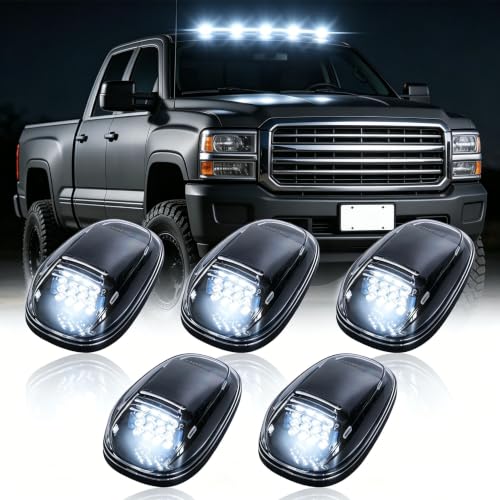
Solar No-Drill Cab Lights is the direct fit for a flat-roof installation that avoids drilling: adhesive mounting pairs with solar charging and a backup battery. The maker says the battery provides up to 9 hours of nighttime illumination, and describes 12 high-intensity amber LEDs. A vibration sensor is said to switch the lights on while driving and shut them off 2–5 minutes after stopping. The limitation is the surface requirement: the fit is specified for flat roofs, so buyers with curved or textured mounting areas should verify adhesion and placement first.
Bottom line: Choose this for a flat roof and a white-LED setup with an amber LED specification.
Solar RGB Strobe Cab Lights

Solar RGB Strobe Cab Lights stands apart with RGB strobe lighting and two control methods: a remote and an app. Solar charging is supplemented by a USB-C port for backup charging, and the detachable adhesive base is intended for repositioning or removal. The package details give dimensions of 4.13 by 2.16 by 1.57 inches. This is the better match for buyers who specifically want colored effects and flexible control, rather than a simple white roof marker. Its conspicuous strobe style may not suit every truck or road-use situation, so confirm applicable vehicle-lighting rules before using it.
Bottom line: Choose this when RGB effects and remote or app operation matter more than a plain marker light.
Solar White Motion-Sensor Cab Lights

Solar White Motion-Sensor Cab Lights is another white-light option, but its distinguishing details are the IP67 waterproof rating and a 9-hour backup battery reserve. Its motion-sensor is described as activating at night when the vehicle vibrates, which makes it a fit for buyers seeking automatic operation without an external power connection. The installation is described as drill-free across vehicles, but roof shape and adhesive compatibility still matter in practice. Unlike Solar RGB Strobe Cab Lights, it has no described USB-C backup charging or RGB control, so choose it for simpler white illumination rather than adjustable effects.
Bottom line: Choose this for white solar marker lighting with an IP67 rating and motion activation.
How to Choose Solar Powered Truck Cab Lights
Start with the light behavior and mounting surface, not the solar label: the options here range from white markers to RGB strobe effects, and adhesive mounting depends on a clean, compatible roof surface. Solar panels need daylight exposure, while a built-in battery or USB-C backup can help bridge limited sun. For a plain marker appearance, select white light; choose RGB only if colored effects are allowed and wanted. A practical decision rule is to avoid adhesive mounting on a visibly curved, dirty, waxed or textured area unless the maker confirms it will hold. Wireless roof lights do not replace required factory clearance lamps or a compliant installation where those are required.
Roof Light Fit and Placement
Roof fit is the first physical check for adhesive cab lights: a flat, clean, dry area gives the pad more consistent contact than a curved or ribbed panel. Clean with a surface-safe product and let the roof dry fully before mounting; avoid placing lights where roof racks, antennas or cargo can shade the solar panel. Roof marker lamps are commonly arranged across the front roof edge, but spacing and color requirements vary by vehicle classification and state rules. Treat added lamps as supplemental until you confirm the vehicle’s required lamp positions and visibility. If the roof has less than a flat, uninterrupted contact patch for the light base, verify the mounting plan before ordering.
Solar Charging and Motion Sensors
Solar cab lights depend on adequate daylight, and parked vehicles kept in garages or under covers can receive too little exposure to recharge reliably. A backup battery provides reserve rather than unlimited runtime; one option claims up to 9 hours, while another provides USB-C backup charging. Motion or vibration sensors can also trigger lights during vehicle movement, so sensor timing affects how long they remain illuminated after a trip. Before relying on automatic lights, check whether the sensor responds to vibration, whether activation is limited to darkness, and how shutoff works. Avoid assuming a sensor-equipped solar lamp will operate like a hardwired marker light in every weather or parking condition.
Weather Ratings and Road-Lighting Safety
An IP67 rating means a device is rated against dust ingress and temporary immersion under standardized test conditions, but it does not establish road-legal placement or guarantee a permanent adhesive bond. Amber is commonly used for front clearance and marker lamps on qualifying vehicles; colors and flashing patterns can be restricted, especially when they resemble emergency signals. RGB strobe lights deserve particular caution: check state vehicle-equipment rules before enabling colored or flashing effects on public roads. Keep added lamps from obscuring required factory lights, and do not treat a waterproof rating as proof that a unit is suitable for every wash method or high-pressure spray.
Frequently Asked Questions
How long do solar truck cab lights stay on?
Runtime depends on charge, darkness and sensor activity. One option claims up to 9 hours of nighttime illumination, but that figure is a maker claim rather than a guaranteed duration in every condition.
Will solar cab lights work in cloudy weather?
Solar charging is less reliable with reduced sun exposure, and a vehicle parked indoors receives no direct sunlight. One model includes USB-C backup charging, while the others describe built-in battery reserve.
Can adhesive cab lights go on a curved roof?
Adhesive mounts hold best on a clean, dry, flat contact area. A noticeably curved or textured roof can reduce contact, so confirm the base can sit flush before mounting.
Are RGB strobe cab lights legal on trucks?
Rules depend on vehicle type, location, color and flash pattern. Confirm state requirements before using RGB or flashing effects on public roads, particularly colors reserved for emergency or service vehicles.
What does IP67 mean for roof lights?
IP67 rates protection against dust ingress and temporary immersion under specified test conditions. It does not certify road-lighting compliance or prove that an adhesive mount will remain attached.