
German Power Plug Adapter: 5 Options Compared

For Germany, choose TESSAN Type E/F 7-in-1 Adapter if you need a Type E/F adapter with four US outlets and three USB ports; plug shape and grounding are the deciding factors. HANYCONY Type C 5-in-1 Adapter and TESSAN Type C Adapter 2-Pack are Type C options for travelers who only need a two-pin connection, while Anker Nano Universal Travel Adapter suits trips across several plug regions.
A travel adapter changes the plug shape, not the voltage. Check that each appliance supports Germany’s 230V supply, especially before using heating appliances.
We earn a commission if you buy through links on this page. As an Amazon Associate I earn from qualifying purchases. Products are compared on manufacturer specifications, not hands-on testing.
- Best overall: TESSAN Type E/F 7-in-1 Adapter – Type E/F plug with four AC outlets and three USB ports.
- Best for Schuko format: Type E/F Adapter with 2 Outlets – Type E/F adapter with two AC outlets and three USB ports.
- Best for multiple regions: Anker Nano Universal Travel Adapter – Universal plug compatibility includes Type C (EU), Type G and Type I.
| Product | Best for | Plug type | AC outlets | USB ports | Shop |
|---|---|---|---|---|---|
| TESSAN Type E/F 7-in-1 Adapter | Multiple devices | Type E/F | 4 | 3 | Check Price on Amazon |
| Type E/F Adapter with 2 Outlets | Compact charging | Type E/F | 2 | 3 | Check Price on Amazon |
| HANYCONY Type C 5-in-1 Adapter | USB-C charging | Type C | 2 | 3 | Check Price on Amazon |
| TESSAN Type C Adapter 2-Pack | Two travelers | Type C | 4 | 3 | Check Price on Amazon |
| Anker Nano Universal Travel Adapter | Multi-region trips | Universal, includes Type C | 1 | 4 | Check Price on Amazon |
German Power Plug Adapters
Compare plug formats and charging capacity, then match the adapter to your devices and destination sockets.
TESSAN Type E/F 7-in-1 Adapter
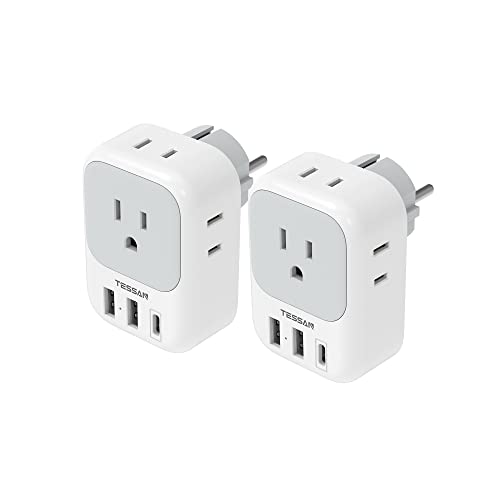
For a grounded European-style connection and several devices, this Type E/F adapter provides four American outlets and three USB ports, including one USB-C port. Its seven charging connections suit a shared hotel-room setup, and its USB-C output is rated at 15W maximum. The adapter is intended for compatible European sockets, including Germany.
The limitation is its plug format: it is not a universal travel adapter, so it will not cover destinations that use other socket types. Check device voltage before connecting equipment; a plug adapter does not convert voltage.
Bottom line: Choose this if you need a Type E/F plug and several charging connections.
Type E/F Adapter with 2 Outlets

This Type E/F adapter keeps its AC charging to two American outlets while adding three USB ports, two of them USB-C. The maker gives a maximum combined capacity of 2,500 watts at 250 volts and 10 amps, making the electrical limit important when connecting devices. Germany is among its compatible destinations.
Compared with multi-outlet models, it offers fewer AC connections, so it is a better match for a couple of plug-in devices plus USB charging than a larger group. It is not a voltage converter; verify that each appliance is dual-voltage before use.
Bottom line: Choose this when two AC outlets plus USB charging meet your needs.
HANYCONY Type C 5-in-1 Adapter

Two USB-C ports distinguish this Type C adapter, which also has two American outlets and one USB-A port. The maker rates its USB output at up to 3.1A and its maximum AC capacity at 2,500 watts, 250 volts and 10 amps. Its small body is about 2.2 inches wide by 1.1 inches deep by 1.5 inches high.
This is useful when USB-C charging matters more than a grounded plug format. The Type C connection is two-pin, and the adapter does not convert voltage; do not use it with single-voltage heating appliances unless they support the local supply.
Bottom line: Choose this if two USB-C ports are your priority and your devices are dual-voltage.
TESSAN Type C Adapter 2-Pack

This two-pack provides two Type C adapters, each with four American outlets and three USB ports, for travelers who want a separate adapter at each charging spot. The maker specifies a 100V–250V operating range and a 10A rated current. Type C is compatible with Germany according to the manufacturer, though the plug itself is a two-pin format.
Its advantage over a single adapter is having two units; its limitation is that neither is a voltage converter. Check appliance labels before use, particularly for hair dryers, straighteners or other heating devices.
Bottom line: Choose this when two Type C adapters and four outlets per unit fit your trip.
Anker Nano Universal Travel Adapter

For itineraries beyond Germany, this universal adapter accepts Type A, C, G and I plug formats and has a single AC outlet plus two USB-A and two USB-C ports. Its foldable, retractable pins make its 3.39-by-1.97-by-0.98-inch body easier to pack. The maker rates its USB output at 20W total, or 15W when shared, and its maximum current at 6A.
The one AC outlet is fewer than the multi-outlet alternatives, so it suits a traveler charging mostly by USB. The adapter does not convert voltage, and its two-pin connection should not be mistaken for a grounded connection.
Bottom line: Choose this for multi-region plug compatibility and primarily USB charging.
How to choose a German power plug adapter
Start with the socket connection and your device’s voltage label, not the number of charging ports. Germany uses 230V, 50Hz household power and commonly uses Type F Schuko sockets; a Type E/F plug is designed for this grounded European format. Type C is a two-pin, ungrounded format used across Europe, and it may fit compatible sockets, but it does not provide grounding. Choose a grounded adapter when the appliance plug requires a ground connection.
A plug adapter only changes the physical connection. If a device label says 100–240V, it is generally designed for a broad voltage range; a device marked 120V only needs appropriate voltage conversion rather than a simple plug adapter. With hair dryers, irons and other heating appliances, confirm voltage support and power requirements before packing.
Type C and Type E/F fit in Germany
Type E/F compatibility is the clearest match for Germany’s grounded socket format, while Type C is a smaller two-pin option for compatible ungrounded plugs. A Schuko Type F socket uses two round pins and side grounding contacts; Type E adds a grounding pin in the socket. Hybrid Type E/F plugs accommodate both styles. The adapter’s plug format must match the wall socket, and its receptacle must accept the appliance plug.
Use this quick guide to narrow the format by your connection needs; it does not replace checking the appliance’s voltage rating.
| Adapter format | Connection | Choose when |
|---|---|---|
| Type E/F | Grounded European-style plug | Your appliance needs grounding |
| Type C | Two-pin ungrounded plug | Your device uses a compatible two-pin plug |
| Universal with Type C | Multiple plug formats; two-pin connection | You need other regions as well |
Voltage and wattage checks before travel
Germany’s household supply is 230V at 50Hz, so check the input label on every device before plugging it in. A dual-voltage label such as 100–240V indicates the device can accept a range of mains voltages; a 120V-only appliance is not made compatible by a plug adapter. A voltage converter must be selected for the appliance’s wattage and use case, not just its plug.
Heating devices can draw substantial power, and adapter capacity is a separate limit from voltage compatibility. If an appliance’s rating exceeds the adapter’s current or wattage limit, do not connect it. Avoid stacking adapters or using an adapter as a substitute for a properly grounded connection.
Common mistakes with German plug adapters
The most common mistake is treating a travel adapter as a voltage converter. A dual-voltage phone charger may work with a plug adapter, but a single-voltage hair dryer may not; the input label decides. Another mistake is choosing by outlet count alone: check whether the appliance requires grounding, then check which plug format the adapter accepts.
Port sharing also affects USB charging. When multiple devices draw from shared USB output, available power is divided or capped by the adapter’s rating. Keep high-wattage appliances separate from small USB devices, and never exceed the current or power capacity. For under two grounded appliances, favor a grounded Type E/F adapter over a multi-region two-pin design.
Frequently Asked Questions
Does Germany use Type C or Type F sockets?
Germany commonly uses Type F Schuko sockets, and hybrid Type E/F plugs fit the grounded European format. Type C is a two-pin ungrounded plug, so check that the device does not require grounding.
Will a US hair dryer work with a German adapter?
Only if the hair dryer supports Germany’s 230V supply or is used with a suitable voltage converter rated for its wattage. A plug adapter alone changes the shape, not the voltage.
Can I charge a phone in Germany with a plug adapter?
Usually, if the charger’s input label covers 230V, a plug adapter can connect its US plug to the German socket format. Check the charger label and make sure its plug fits the adapter receptacle.
What does a 100–240V label mean on a charger?
A 100–240V input rating means the charger is designed to accept voltages across that range, which includes Germany’s 230V supply. You still need a plug adapter that matches the socket and charger plug.
Do German power adapters need to be grounded?
Grounding matters when the appliance plug or instructions require it; Type E/F adapters support the grounded European connection, while Type C is a two-pin ungrounded format. Never replace a required ground connection with an ungrounded adapter.